Financial due diligence tests whether a business’s reported numbers hold up — how much of the profit is real and repeatable, what the true debt is, how much working capital it needs, and what exposures sit outside the balance sheet. Startup Advisory runs buy-side FDD for acquirers and lenders, and sell-side FDD for owners preparing a sale.
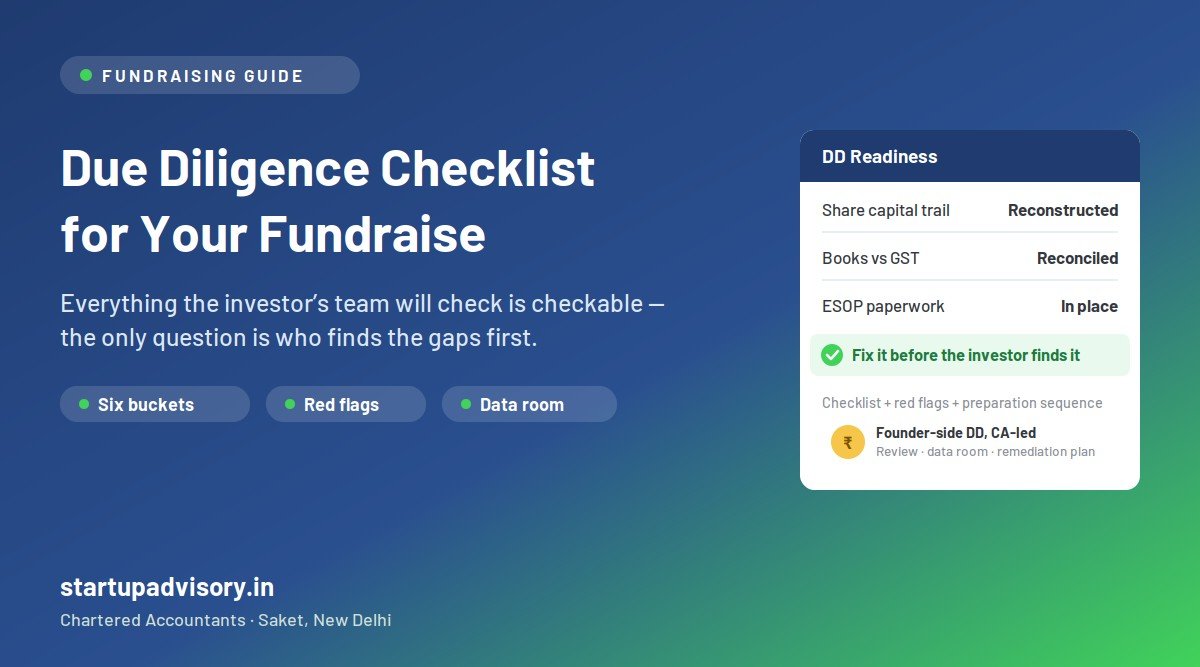
 Quality of earnings: reported EBITDA normalised for one-offs, owner-related costs, related-party pricing and accounting policy choices.Net debt: borrowings plus debt-like items — statutory dues in arrears, deferred payments, gratuity, customer advances.Working capital: monthly trend, seasonality and a normalised level to agree a working capital peg.Exposures: tax, contingent liabilities, litigation, guarantees and related-party balances.Output: red-flag summary, detailed FDD report and inputs for price, indemnities and conditions precedent in the SPA.Raising funds instead? See our investor-ready due diligence for startups preparing a round.
Reviewed by CA Neeraj Rohilla, FCA — Chartered Accountant, Startup Advisory, Saket, New Delhi.
Most deals are priced as a multiple of earnings and adjusted for debt and working capital. Each of those three numbers can move materially once someone looks closely: an EBITDA that included a one-off contract, a balance sheet that left out unpaid statutory dues, a working capital level that was flattered at year end. Financial due diligence finds those movements before the price is fixed, when they still change the deal.
Quality of earnings: revenue recognition and cut-off, customer concentration and churn, gross margin by product or segment, normalisation adjustments to EBITDA, and run-rate analysis.Net debt and debt-like items: bank and related-party borrowings, overdue GST, TDS, PF/ESI and MSME dues, unfunded gratuity and leave liabilities, deferred consideration, customer advances, capex creditors.Working capital: monthly trade receivables, inventory and payables, ageing, provisioning, and a normalised working capital level for the peg.Cash flow and capex: conversion of EBITDA to cash, maintenance vs growth capex, and the reliability of the business plan.Tax: income tax, GST and TDS compliance, open assessments and notices, and the exposure a buyer inherits in a share deal.Related parties: transactions with promoters and group entities, their pricing and whether they continue after closing.Contingent liabilities: guarantees, litigation, warranty claims and off-balance-sheet commitments.| Buy-side FDD | Sell-side (vendor) FDD | |
|---|---|---|
| For | Acquirers, investors, lenders | Promoters preparing a sale or merger |
| Aim | Find issues that affect price, structure and protections | Surface issues early and present them on your terms |
| Output | Red-flag report, FDD report, SPA inputs | Vendor DD report and a clean data room |
| Benefit | Price and indemnities based on evidence | Fewer surprises, faster deal, less price chipping |
FDD findings feed straight into the share purchase agreement — the price mechanism, specific indemnities, conditions precedent and warranties. Where the target is a company, we usually run it alongside secretarial due diligence so the corporate record is tested at the same time, and a Registered Valuer valuation where the Companies Act or FEMA requires one.
We act on one side of a transaction only. We do not take a buy-side mandate on a business for which we are the statutory auditor or for which we have prepared the accounts.

Vishal Singh


Ajay Philip

Pranshu Gaur

Ravish Mehta

Mohit Aggarwal

Sanjeev Sharma

Realtoadvisors

Sakshi Gupta
Rudranath Trip
Yash Rohilla
Sandro Cottus

Azan Hosein Photography
Neetu Yadav
Fresh guides on tax, GST and startup compliance from our CA team.
Share your details — our experts call you back. We use these details only to respond to you. See our Privacy Policy.