
GST & Compliance
57th GST Council Meeting Outcomes: What the 8 October 2026 Reforms Mean for Businesses
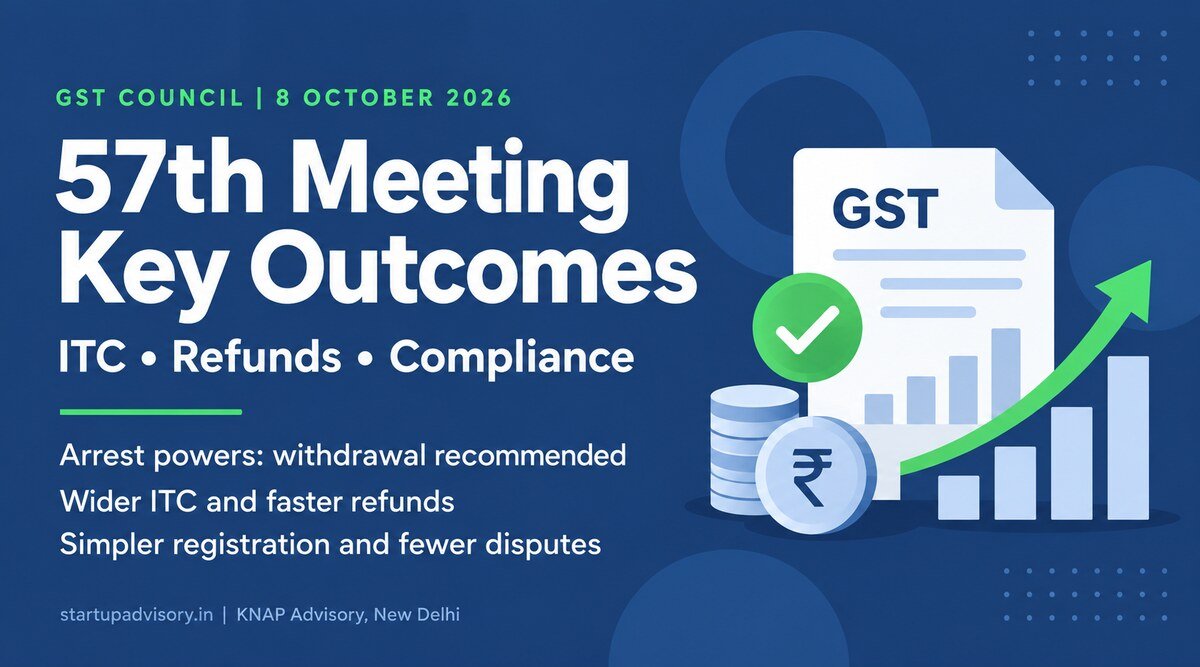
For a business owner, the practical question is where these recommendations could release cash, reduce repeated paperwork or change exposure to disputes. The largest opportunities are in accumulated credit, refund processing and registration. The most important preparation is to separate what can be documented now from what must wait for the implementing provisions.
Date correction: Our earlier meeting preview referred to 7 October. The meeting was rescheduled again and was held on 8 October, as confirmed by the official release. This article covers the announced outcomes.
Key outcomes at a glance
| Area | Recommendation | Business implication |
|---|---|---|
| Arrest and prosecution | Omit Section 69; raise prosecution threshold from ₹1 crore to ₹5 crore | Proposed change to enforcement powers; statutory amendments required |
| Small disputes | No show-cause notice below ₹10,000 combined tax; lower maximum general penalty | Potential relief from low-value litigation once enacted |
| Blocked ITC | Relax Section 17(5) restrictions for specified categories | Review insurance, catering and other eligible expense ledgers |
| Refund eligibility | Include input services in inverted-duty refunds and capital goods in specified refunds | Potential release of credit currently trapped in working capital |
| Refund processing | Phased automated cash-ledger, provisional and zero-rated refunds | Prepare accurate, system-readable refund data |
| E-commerce sellers | Proposed Rule 14B warehouse-based registration in other states | Expansion without a separate physical establishment, subject to conditions |
| Returns | Revised liability/ITC correction mechanism targeted for April 2027 return | Prepare reconciliation processes; consultation still to follow |
| Small B2C businesses | In-principle Annual Return Quarterly Payment scheme | Concept approval, rather than a filing option available today |
1. Withdrawal of arrest powers and fewer low-value disputes
The Council recommended complete withdrawal of GST arrest powers by omitting Section 69 of the CGST Act. It also recommended increasing the monetary threshold for prosecution from ₹1 crore to ₹5 crore and rationalising offences and punishments under Section 132. The proposed change to clause (c) focuses on fraudulent ITC availment without receipt of goods or services, or without an invoice or bill.
This is a substantial proposed enforcement reform. It does not mean tax, interest or civil penalties disappear, and it does not make fraud permissible. Until the law amendment takes effect, businesses must assess enforcement questions under the provisions currently applicable.
For disputes under Sections 73, 74 and 74A, the proposed minimum threshold for a show-cause notice is ₹10,000 of tax, combining CGST, SGST, IGST and cess. The release says no notice would be issued where that amount is less than ₹10,000. It also proposes corresponding treatment of notices and appeals below that threshold pending when the provision comes into force.
- The maximum general penalty under Section 125 is proposed to fall from ₹25,000 to ₹10,000.
- In non-fraud cases, a reduced 5% penalty is proposed where tax and interest are discharged within 30 days of the adjudication order under Section 73, or 60 days under Section 74A.
- The minimum ₹10,000 penalty condition in non-fraud cases is proposed to be removed.
- For penalty-only orders, an upper limit of ₹40 crore—₹20 crore CGST plus ₹20 crore SGST/UTGST—is proposed for appeal pre-deposits under the specified provisions.
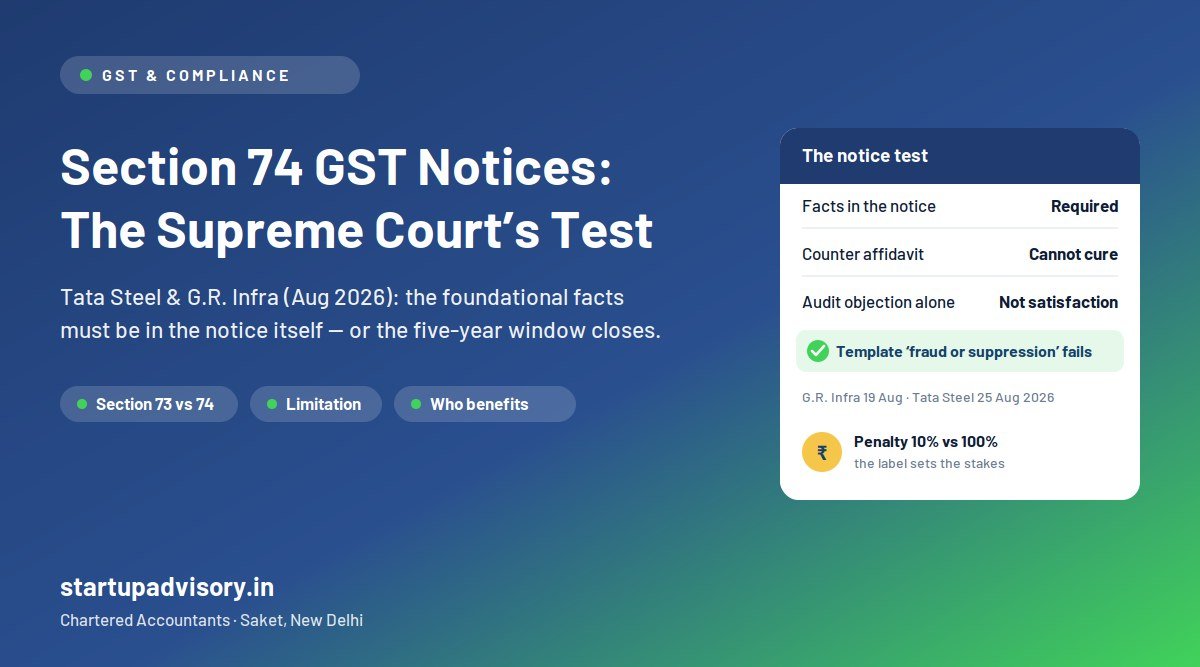
The Council also recommended comprehensive guidance on the quality and timing of notices and orders, justified use of fraud or suppression allegations, and personal hearings. See our discussion of Section 74 notices for related dispute issues.
2. Wider ITC: identify the expense categories that matter
The Council recommended amending Section 17(5) to remove restrictions on ITC for specified supplies, including:
- Outdoor catering and health and life insurance.
- Telecommunication towers and pipelines laid outside factory premises.
- Free samples.
- Goods destroyed or written off on expiry of shelf life as required by law.
For employers, the health and life insurance recommendation could materially change the cost of employee coverage. For manufacturers and distributors, free samples and legally required expiry write-offs deserve a separate ledger review. The release does not establish a blanket right to credit every written-off item, every employee expense or every construction cost.
Illustration: if an expense currently carries ₹1 lakh of GST that is blocked, qualifying credit of that amount could reduce its effective tax cost once the reform is enacted and its conditions are satisfied. That is a planning illustration, not permission to claim the credit in the current return.
The Council separately recommended a procedure for taxpayers to object to credit-ledger blocking under Rule 86A and obtain a personal hearing before the proper officer decides the objection. Keep the disputed invoices, supplier evidence and reasons for blocking organised.
3. Input-service and capital-goods refunds: two different dates
The proposed refund expansion distinguishes inverted duty structures from zero-rated supplies. It recommends including accumulated ITC on input services and capital goods in inverted-duty refunds, and capital-goods ITC in zero-rated refunds.
| Credit category | Recommended eligibility date | Important limit |
|---|---|---|
| Input services: inverted-duty refunds | ITC availed on or after 1 November 2026 | Subject to the implementing amendments and refund conditions |
| Capital goods: zero-rated and inverted-duty refunds | ITC availed on or after 1 April 2027 | Refund to be spread over 60 months |
These are recommended dates tied to when the credit is availed. They are not a general promise to refund historic balances, and capital-goods credit is not proposed as an immediate lump-sum refund. Maintain separate schedules for inputs, input services and capital goods, with invoice dates, credit-availment periods and the relevant supply category.
4. Faster refunds through phased automation
The first phase proposes automatic sanction of the full eligible excess cash-ledger refund, reduction of the acknowledgement/deficiency-memo window from 15 to 10 days, and deemed acknowledgement if the officer does not act within that window. For zero-rated and inverted-duty claims, the recommendation is 90% provisional refund automatically, based on system risk identification and evaluation.
The second phase proposes automated acknowledgement after system verification and, for acknowledged zero-rated claims, automated full sanction after adjustment of pending dues, based on system risk evaluation. It should not be read as an unconditional full automatic refund for every claim.
Other recommendations include system-readable RFD-01 data instead of scanned documents for the specified claims, removal of the 1.5-times domestic-value cap in Rule 89(4)(C), and clarification that the ₹1,000 threshold applies to the combined refund across tax heads. The release does not set a single commencement date for every automation measure.
Exporters and manufacturers can prepare now by reconciling invoices, returns and refund schedules. Our guide to Annexure-B JSON for GST refunds covers an existing filing requirement; follow the current process until a replacement is implemented.
5. Registration changes and e-commerce expansion
The Council recommended clearer registration-document guidance, revised REG-01 selections and a more helpful portal interface. Under the proposed Rule 19 change, amendments to registration particulars would be accepted automatically except for the principal place of business. For Rule 14A taxpayers, even principal-place changes would be automatic.
Cancellation is proposed to become system-based in phases, after pending returns are filed and dues paid. The first phase covers taxpayers who have never passed on ITC above ₹2.5 lakh in a month, and specified others who have filed their final GSTR-10 within the prescribed period. A later phase would extend automatic acceptance more broadly and integrate final-return details into REG-16.
For small goods sellers using e-commerce platforms, proposed Rule 14B would allow registration in a state where they have no physical presence by declaring the platform's warehouse as their principal place of business. The recommendation applies where intended ITC passed on is not more than ₹2.5 lakh per month, excluding stock transfers between distinct persons, and remains subject to conditions.
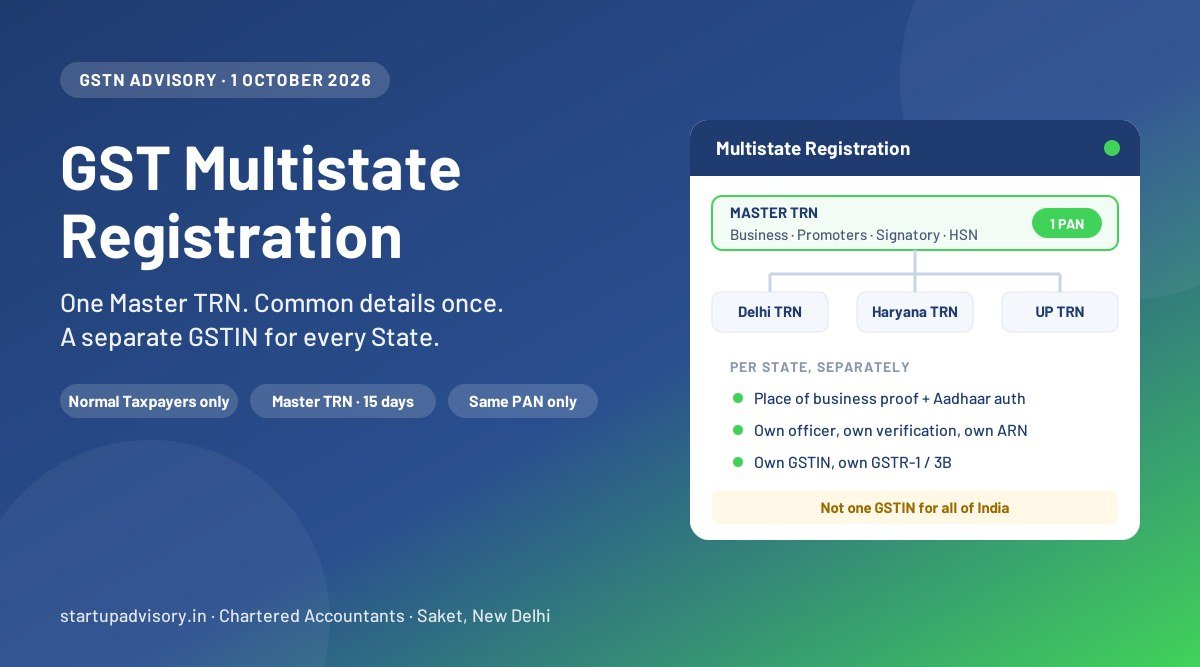
This could ease multi-state expansion; it is not a single all-India GST registration. Sellers should map warehouse states, stock transfers and the ITC passed to customers before choosing the new route.
6. Return corrections, late fees and the small-B2C scheme
The revised liability and ITC correction mechanism is proposed from the April 2027 return, following time-bound public consultation. It includes closer alignment of GSTR-1/1A/IFF with GSTR-3B, invoice-linked DRC-03 payments, IMS provisions, and electronic statements for reverse-charge tax/credit and ITC reversal/reclaim.
For taxpayers with preceding-year annual turnover up to ₹5 crore, a late-fee waiver is recommended for delayed Section 39(1) returns filed by the end of the month in which they were due. This is a conditional proposal, not an unrestricted waiver for all earlier late filings.
The Annual Return Quarterly Payment (ARQP) scheme received in-principle approval. It is intended for eligible taxpayers with preceding-year aggregate turnover up to ₹5 crore engaged exclusively in B2C supplies. Businesses cannot switch to annual filing merely because their turnover is below that number.
The Council also recommended extending e-invoicing to specified reverse-charge domestic purchases from unregistered persons and imports of services for taxpayers with aggregate annual turnover of ₹5 crore and above. Track the implementing scope and commencement date before changing invoice workflows.
7. E-way bills: intelligence-led checks, with exceptions
The proposed reforms require specific intelligence and authorisation by an officer not below Joint Commissioner for interception. Inspection and further detention/seizure action would generally be limited to states where the supplier or recipient is located or registered, with no interception in transit states.
The exception matters: where no e-way bill has been generated, or the conveyance carries no document showing origin or destination, inspection, detention or seizure could proceed irrespective of jurisdiction. The Council also recommended excluding goods and conveyances in transit from Section 130 confiscation provisions. Transport teams should continue to carry complete documentation.
8. Sector-specific tax recommendations
The meeting focused on processes, but it also addressed particular goods and services. Businesses in the following sectors should read the detailed release and subsequent instruments:
- EV passenger transport and operated rentals: proposed option of 5% GST with restricted ITC where battery charging is included in the consideration.
- E-commerce delivery: proposed 5% without ITC for specified delivery services, with platform liability under Section 9(5) in the identified cases; courier and postal services are excluded from that particular recommendation.
- Specified waste and scrap: proposed RCM on unregistered-to-registered supplies of plastic, electrical/electronic and tyre waste/scrap and used cooking oil; 2% TDS on specified registered-to-registered supplies.
- Second-hand vehicle dealers: clarification that the margin-scheme credit restriction concerns purchased second-hand vehicles, rather than all other inputs and services such as repairs, rent or advertising.
- Restaurants, catering, hotels and fitness: proposed limited same-line-of-business credit for the specified services, including hotel accommodation up to ₹7,500 per unit per day.
- Cross-border transactions: proposed uniform treatment of temporary or permanent IPR title transfers as services, and zero-rating certainty for qualifying overseas-buyer goods delivered in SEZ/FTWZ with permitted currency receipts.
- Other sectors: recommendations cover seed warehousing, coffee curing, R&D self-certification, certain foreign shipping-company imports, highway concessions, and classification issues for toys, sublimation paper and bio-stimulants.
What businesses should do next
- Map the financial impact. Separate blocked-credit expenses, input-service refund balances and capital-goods credit. Record the relevant availment periods.
- Keep current compliance on schedule. Continue filing returns, paying tax and responding to notices under the applicable law.
- Prepare refund data. Reconcile books, GSTR-1, GSTR-3B and GSTR-2B; check outstanding dues and supporting evidence.
- Review operational exposure. E-commerce sellers should map warehouse states; transport teams should check documentation; finance teams should identify proposed RCM e-invoicing requirements.
- Track implementation measure by measure. Record the amendment, notification or circular, effective date, eligibility and any portal rollout. Do not treat all recommendations as effective on one date.
How Startup Advisory can help
Our Saket team can help businesses across Delhi NCR assess the proposed ITC relief, prepare refund reconciliations, review multi-state registration requirements and respond to GST proceedings. Explore our GST advisory, GST registration and bookkeeping services, or contact us to discuss your position. Call 9311972982.
Sources and implementation status
- Ministry of Finance / PIB: Recommendations of the 57th Meeting of the GST Council, 8 October 2026, 7:03 PM IST. Primary source for the decisions and proposed dates discussed above.
- Business Standard: GST Council arrest-powers and notice-threshold report, 8 October 2026. Independent corroborating coverage.
- Business Standard: Meeting rescheduled to 8 October, 5 October 2026.
Based on the official recommendations released on 8 October 2026. This article does not certify that implementing instruments have been issued. Eligibility, dates and procedures must be checked against those instruments before taking action. General information; obtain advice for your facts.