
Virtual CFO
Fractional vs Part-Time vs Virtual CFO: Which One Does a Startup Need?
Founders searching for “fractional CFO India” usually find three terms used side by side, often on the same page. Our own Virtual CFO service page treats them as one service, and so do most providers. That is fair: none of these is a legal designation, and no Indian regulator defines or prices them.
What does differ is the engagement behind the label: whether you hire one person or a firm, how their time is fixed, whether they work on-site or remotely, and what happens when they are unavailable. This guide sets out those differences so you can choose on substance, not on the title in a proposal.
1. Are fractional, part-time and virtual CFOs actually different?
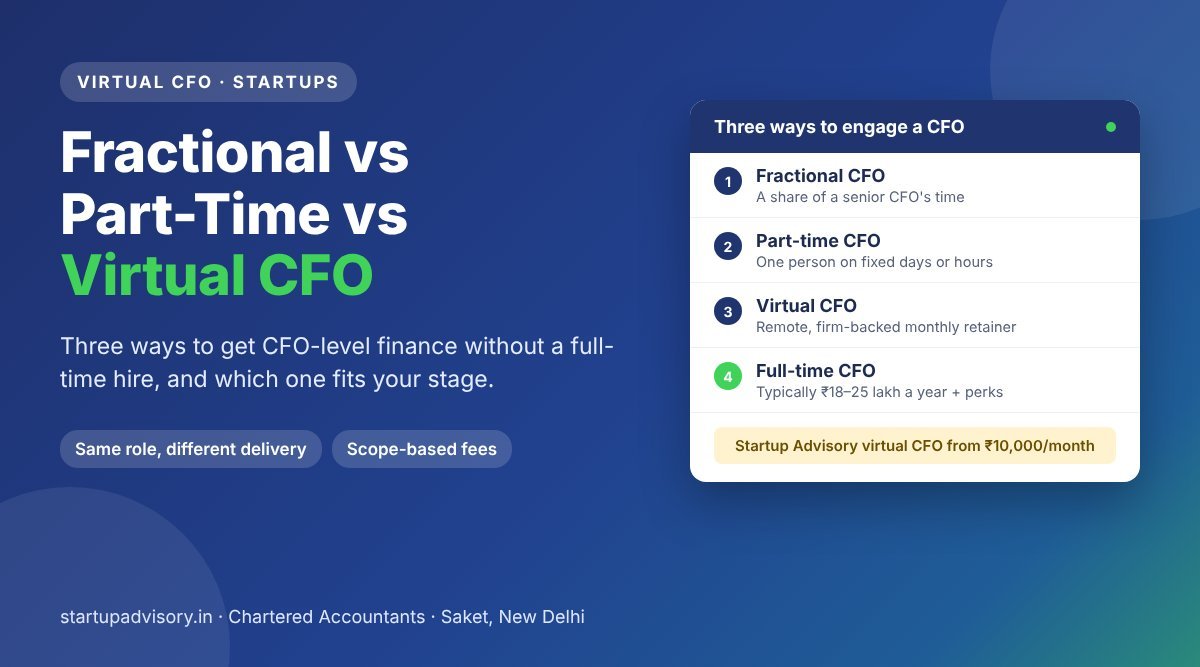
Not in what they do, but sometimes in how they do it. All three give you CFO-level work (forecasting, cash and runway management, MIS, budgeting, fundraising support and financial controls) without a full-time salary. The names emphasise different things:
- Fractional emphasises the share of time you buy: a slice of a senior CFO who works with several companies.
- Part-time emphasises a fixed schedule: set days or hours each week or month, usually from one individual.
- Virtual emphasises remote delivery: the work runs on cloud accounting, shared reports and video reviews, typically provided by a firm with a team behind the named CFO.
In practice the lines blur. A fractional CFO may work remotely most of the month, and a virtual CFO may come in for a board meeting. Read the scope, not the title.
2. What is a fractional CFO?
A fractional CFO is an experienced finance leader who gives your company a defined fraction of their working time, while doing the same for a few other businesses.
Fractional engagements often lean towards leadership work: sitting in management meetings, owning the fundraise numbers, negotiating with lenders or building the first finance team. They are frequently engaged as individuals, sometimes for a fixed project period such as a funding round.
3. What is a part-time CFO?
A part-time CFO is usually one person engaged for a set schedule, for example two days a week, either as a consultant or on a part-time contract. The appeal is continuity with one individual who learns your business closely.
The trade-off is key-person dependence. If that person is on leave, unwell or busy with another client during your month-end or a due-diligence request, the work waits. A part-time CFO also usually relies on your own accountant or bookkeeper for the underlying numbers.
4. What is a virtual CFO?
A virtual CFO delivers the CFO role remotely, working on your cloud books, shared dashboards and scheduled reviews. In India it is most often offered by a CA or advisory firm on a monthly retainer with defined deliverables, such as monthly MIS, a cash-flow view, budgets and compliance oversight.
Because a firm stands behind the engagement, work continues when one person is unavailable, and specialist questions on GST, TDS or company law can be answered in-house. That is how our own service works: delivered remotely from our Saket office, with in-person meetings by appointment. For the full list of what the role covers, see what a virtual CFO does.
5. How do the three compare side by side?
The table below shows the typical shape of each engagement. Individual arrangements vary, so treat it as a guide to the questions to ask.
| Factor | Fractional CFO | Part-time CFO | Virtual CFO |
|---|---|---|---|
| Usually engaged as | An individual, sometimes through a small practice | An individual consultant or part-time contract | A firm, with a named CFO and a team |
| How time is set | A share of the CFO’s time or a project period | Fixed days or hours per week or month | Monthly deliverables plus review meetings |
| Where the work happens | Mix of on-site and remote | Often on-site on set days | Mostly remote; on-site when needed |
| How it is paid | Retainer or project fee | Per day, per hour or monthly | Monthly retainer by scope |
| Cover when the CFO is unavailable | Depends on the individual | Usually none | Team cover within the firm |
| Compliance support (GST, TDS, ROC) | Usually through your accountant | Usually through your accountant | Often included as oversight |
| Best fit | A fundraise, lender talks or building a finance team | Steady, hands-on work with one person | Early and growth-stage startups needing monthly structure |
6. Which one does your startup need?
Choose by the problem you are solving this year, not by the title. A simple way to decide:
- You have books but no monthly view of cash, margins or budget: a virtual CFO retainer, paired with a bookkeeper.
- You are raising a round or negotiating a large loan in the next few months: a fractional CFO, or a higher-scope virtual CFO tier that includes the financial model, investor deck and data room.
- You need someone in the office on fixed days to run the finance team day to day: a part-time CFO, with a plan for cover during their absence.
- Finance needs a senior person every working day (several entities, a large team to lead, continuous investor and lender reporting): it may be time for a full-time CFO. See virtual CFO vs full-time CFO.
Many startups move between these over time. A common pattern is a virtual CFO for routine months and a step up in scope around a fundraise. If you are unsure whether you need any CFO support yet, start with when should a startup hire a virtual CFO.
7. How much does each option cost?
There is no standard or regulated fee for any of the three; each provider prices by scope and time. Individuals working fractionally or part-time commonly quote per day, per month or per project, so ask for the number of days or hours a quote assumes.
For a benchmark, these are Startup Advisory’s published virtual CFO starting prices from our service page and price list:
| Option | Starting price | What it adds |
|---|---|---|
| Virtual CFO: Essentials | ₹10,000 a month | Monthly MIS, cash-flow tracking and budgeting, GST, TDS and ROC compliance oversight |
| Virtual CFO: Growth | ₹25,000 a month | Essentials plus forecasting and scenario planning, unit economics and a monthly strategy review |
| Virtual CFO: Fundraise & Scale | ₹45,000 a month | Growth plus the financial model, investor deck, data-room support and CMA data for lenders |
| Full-time CFO | Typically ₹18–25 lakh a year, plus perks | A dedicated senior employee |
The tiers, what moves a quote and the annual comparison are covered in detail in virtual CFO cost in India.
8. What should the engagement letter cover, whatever the label?
The same points, because the risks are the same. Before you sign with an individual or a firm, get these in writing:
- Deliverables and calendar: which reports arrive each month, by what date, and how often you meet.
- Time commitment: days or hours included, and the rate for extra work during a fundraise or audit.
- Who does the work: the named CFO, and who covers when they are unavailable.
- Bookkeeping: whether transaction recording is included or stays with your accountant.
- Authority: whether the CFO can approve payments, access bank accounts or deal with investors on your behalf. Most outside CFOs advise and prepare; the founders and directors keep approvals and remain responsible for the company’s accounts and filings.
- Confidentiality and data: who owns the models and reports, and how access to your books is removed at the end.
- Exit terms: notice period and handover of files if you change provider or hire in-house.
How Startup Advisory can help
Startup Advisory is a CA-led firm in Saket, New Delhi, providing virtual CFO services to startups and SMEs across Delhi, Gurugram, Noida, Greater Noida, Ghaziabad and Faridabad. We can work as your fractional finance lead for a fundraise or as a steady monthly virtual CFO, alongside our bookkeeping team if you need one. Book a free consultation or call 9311972982, tell us your stage, and we will recommend a scope and send a written quote.
Sources and scope
- Startup Advisory, Virtual CFO services: plans and pricing (tier names, starting prices, inclusions, remote delivery and the full-time CFO cost range).
- Startup Advisory, published price list, Virtual CFO and Book-keeping sections.
Prepared 4 November 2026. “Fractional”, “part-time” and “virtual” CFO are market terms, not legal designations, and providers use them differently. Prices are Startup Advisory’s published starting prices for Delhi NCR and are indicative; the final fee depends on the agreed scope. The full-time CFO range is a typical figure, not a salary survey.