
GST / Reverse Charge
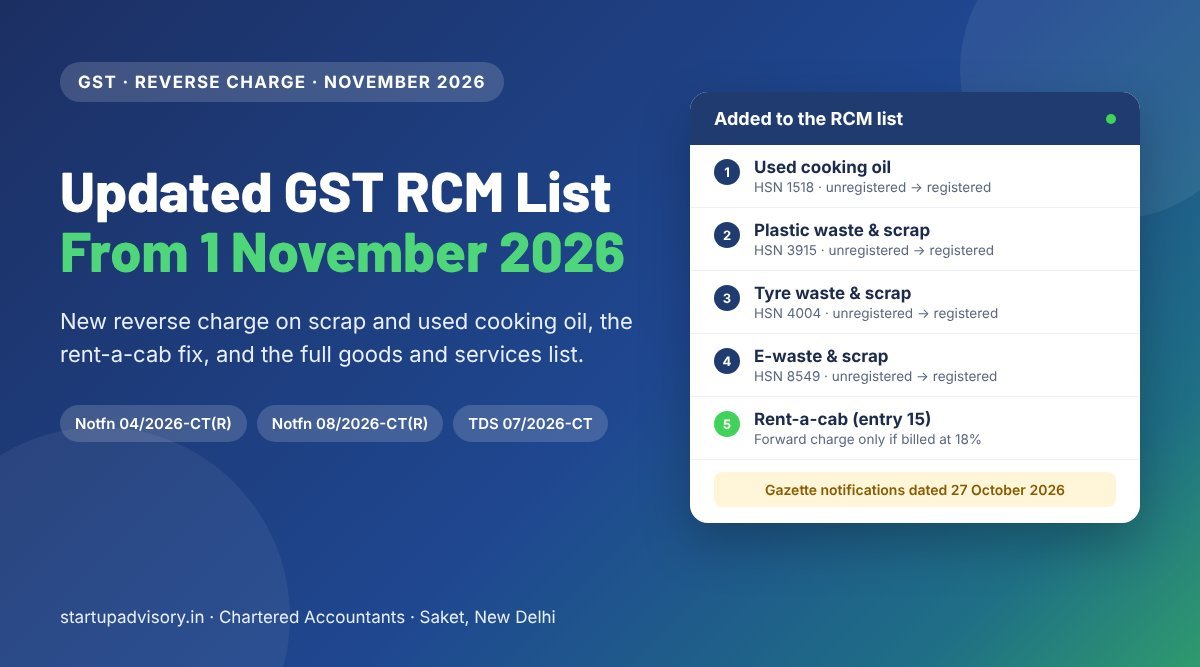
Updated GST Reverse Charge (RCM) List for Goods and Services from 1 November 2026
Reviewed by CA Neeraj Rohilla, FCA — Chartered Accountant, Startup Advisory, Saket, New Delhi.
- How reverse charge works in GST
- What changed on 1 November 2026
- Full RCM list: goods
- The scrap package: RCM, registration and TDS
- Full RCM list: services
- Rent-a-cab: the entry 15 change
- Import of services and IGST-only entries
- Section 9(5): what e-commerce operators pay
- Section 9(4): real estate promoters
- How to comply as the recipient
- Points to watch
- Checklist for November 2026
1. How reverse charge works in GST
Normally the supplier collects GST and pays it to the Government. Under the reverse charge mechanism (RCM), the recipient pays the tax instead. GST has four routes into RCM:
| Provision | What it covers | Where the list is |
|---|---|---|
| Section 9(3), CGST Act (Section 5(3) IGST, Section 7(3) UTGST) | Notified categories of goods and services: the recipient pays, whoever the supplier is | Goods: Notification No. 4/2017-Central Tax (Rate). Services: Notification No. 13/2017-Central Tax (Rate). IGST twins: 4/2017-IT(R) and 10/2017-IT(R) |
| Section 9(4) | Notified supplies by unregistered persons to notified classes of registered persons | Currently used only for real estate promoters (Notification No. 07/2019-Central Tax (Rate)) |
| Section 9(5) | Notified services supplied through an e-commerce operator: the operator pays as if it were the supplier | Notification No. 17/2017-Central Tax (Rate) |
| Section 5(3) IGST on imports | Services received from a supplier outside India | Serial 1 of Notification No. 10/2017-Integrated Tax (Rate) |
The 1 November 2026 changes touch the first and third routes. This article sets out the lists as amended.
2. What changed on 1 November 2026
All of the following were published in the Gazette of India (Extraordinary) on 27 October 2026, issued on the recommendations of the GST Council, and take effect from 1 November 2026. Each Central Tax notification has matching Integrated Tax and Union Territory Tax notifications, and the States issue their own SGST twins.
| Notification | What it does | Effect |
|---|---|---|
| 04/2026-Central Tax (Rate), G.S.R. 927(E) IGST: 04/2026-Integrated Tax (Rate), G.S.R. 928(E); UTGST: 04/2026-Union Territory Tax (Rate) | Inserts serials 2A, 3B, 3C and 9 in the goods RCM list (Notification No. 4/2017-Central Tax (Rate)) | RCM on used cooking oil, plastic waste and scrap, tyre waste and scrap, and e-waste bought from unregistered persons |
| 08/2026-Central Tax (Rate), G.S.R. 942(E) IGST: 08/2026-Integrated Tax (Rate), G.S.R. 943(E); UTGST: 08/2026-Union Territory Tax (Rate) | In serial 15 of the services RCM list (13/2017-CT(R)), column (3), substitutes “9” for “6”; the IGST notification substitutes “18” for “12” in serial 17 of 10/2017-IT(R) | Rent-a-cab supplied to a body corporate stays under RCM unless the operator bills at 18% |
| 06/2026-Central Tax, G.S.R. 934(E) | Substitutes the proviso to Notification No. 5/2017-Central Tax (registration exemption for suppliers making only RCM supplies) | Suppliers of used cooking oil and plastic, tyre, metal and electronic waste and scrap cannot rely on that exemption |
| 07/2026-Central Tax, G.S.R. 935(E) | Substitutes clause (d) of Notification No. 50/2018-Central Tax (persons who must deduct TDS under Section 51) | Registered buyers of the same five categories from registered suppliers must deduct GST TDS |
| 09/2026-Central Tax (Rate), G.S.R. 945(E) | Substitutes clause (v) of Notification No. 17/2017-Central Tax (Rate) under Section 9(5) | E-commerce operators pay tax on delivery services (other than postal and courier) supplied through them by persons not liable to register |
For the background to these changes, see our notes on the 57th GST Council meeting outcomes. The other rate notifications issued the same day (02, 03, 05, 06, 07 and 10/2026-Central Tax (Rate)) deal with rates, exemptions and a special procedure for toll operate-and-maintain concessionaires; they do not change the RCM lists.
3. Full RCM list: goods (Section 9(3))
This is the Table in Notification No. 4/2017-Central Tax (Rate) dated 28 June 2017, as it reads from 1 November 2026. Before this month it was last amended by Notification No. 06/2024-Central Tax (Rate) (metal scrap, from 10 October 2024). Rows marked NEW are the 1 November 2026 additions.
| S. No. | HSN | Goods | Supplier | Recipient (pays the tax) |
|---|---|---|---|---|
| 1 | 0801 | Cashew nuts, not shelled or peeled | Agriculturist | Any registered person |
| 2 | 1404 90 10 | Bidi wrapper leaves (tendu) | Agriculturist | Any registered person |
| 2A NEW | 1518 | Used cooking oil | Any unregistered person | Any registered person |
| 3 | 2401 | Tobacco leaves | Agriculturist | Any registered person |
| 3A | 3301 | Specified essential oils (other than citrus fruit oils), such as peppermint, spearmint, water mint, horsemint and bergamot oil | Any unregistered person | Any registered person |
| 3B NEW | 3915 | Waste and scrap of plastics | Any unregistered person | Any registered person |
| 3C NEW | 4004 | Waste and scrap of tyres | Any unregistered person | Any registered person |
| 4 | 5004 to 5006 | Silk yarn | Any person who manufactures silk yarn from raw silk or silk worm cocoons | Any registered person |
| 4A | 5201 | Raw cotton | Agriculturist | Any registered person |
| 5 | — | Supply of lottery | State Government, Union territory or local authority | Lottery distributor or selling agent |
| 6 | Any chapter | Used vehicles, seized and confiscated goods, old and used goods, waste and scrap | Central Government, State Government, Union territory or local authority | Any registered person |
| 7 | Any chapter | Priority Sector Lending Certificate | Any registered person | Any registered person |
| 8 | Chapters 72 to 81 | Metal scrap | Any unregistered person | Any registered person |
| 9 NEW | 8549 | Electrical and electronics waste and scrap | Any unregistered person | Any registered person |
The IGST list in Notification No. 4/2017-Integrated Tax (Rate) carries the same entries, so an inter-State purchase from an unregistered supplier is also caught. The wording of the four new entries is identical in the CGST and IGST notifications.
4. The scrap package: RCM, registration and TDS
The 1 November changes are designed to work together across the scrap supply chain. Metal scrap was brought under this model in October 2024; the other four categories now follow it. Who pays what depends on the supplier’s status:
| Goods | Unregistered supplier → registered buyer | Registered supplier → registered buyer |
|---|---|---|
| Used cooking oil (1518) | Buyer pays GST under RCM (serial 2A) NEW | Supplier charges GST; buyer deducts TDS under Section 51 NEW |
| Plastic waste and scrap (3915) | Buyer pays under RCM (3B) NEW | Supplier charges GST; buyer deducts TDS NEW |
| Tyre waste and scrap (4004) | Buyer pays under RCM (3C) NEW | Supplier charges GST; buyer deducts TDS NEW |
| Metal scrap (Chapters 72–81) | Buyer pays under RCM (serial 8, since 10 Oct 2024) | Supplier charges GST; buyer deducts TDS (since 10 Oct 2024) |
| E-waste and scrap (8549) | Buyer pays under RCM (9) NEW | Supplier charges GST; buyer deducts TDS NEW |
Registration of suppliers (Notification No. 06/2026-Central Tax)
Notification No. 5/2017-Central Tax, issued under Section 23(2), exempts from registration a person whose supplies are all taxed under reverse charge. Without a carve-out, a large scrap aggregator selling only to registered recyclers could stay outside GST, since the buyers pay the tax. From 1 November 2026 the proviso to that notification says the exemption does not apply to anyone supplying used cooking oil (1518), plastic waste and scrap (3915), tyre waste and scrap (4004), metal scrap (Chapters 72 to 81) or electrical and electronics waste and scrap (8549). In our reading, a supplier of these goods whose aggregate turnover crosses the Section 22 threshold must now register and charge GST; a small collector below the threshold can remain unregistered, and its registered buyer pays under RCM.
GST TDS on registered purchases (Notification No. 07/2026-Central Tax)
Section 51 TDS normally applies to Government departments and notified public bodies. Clause (d) of Notification No. 50/2018-Central Tax, inserted for metal scrap in 2024, extends it to “any registered person receiving supply” of the notified goods from another registered person. From 1 November 2026 the clause covers all five categories above. A buyer who falls under it must:
- take a separate TDS registration in Form GST REG-07;
- deduct TDS at the Section 51 rate (1% CGST and 1% SGST, or 2% IGST) where the total value of supply under a contract exceeds the Section 51 threshold of ₹2.5 lakh;
- pay it and file GSTR-7 by the 10th of the following month; and
- issue the TDS certificate. The supplier sees the credit in its electronic cash ledger once it accepts it.
5. Full RCM list: services (Section 9(3))
This is the Table in Notification No. 13/2017-Central Tax (Rate) dated 28 June 2017, as it reads from 1 November 2026. The only change this month is the figure in serial 15. The Gazette note to Notification No. 08/2026-Central Tax (Rate) records that the notification was last amended before that by Notification No. 07/2025-Central Tax (Rate) of 16 January 2025. The descriptions below are summarised; the notification text governs.
| S. No. | Service | Supplier | Recipient (pays the tax) |
|---|---|---|---|
| 1 | Transport of goods by road (GTA services) | Goods transport agency that has not opted to pay GST itself under forward charge | Located in the taxable territory and one of: a factory registered under the Factories Act; a registered society; a co-operative society; a GST-registered person; a body corporate; a partnership firm (including an AOP); a casual taxable person |
| 2 | Legal services | Individual advocate (including a senior advocate) or firm of advocates | Any business entity in the taxable territory |
| 3 | Services of an arbitral tribunal | Arbitral tribunal | Any business entity in the taxable territory |
| 4 | Sponsorship services | Any person | Body corporate or partnership firm in the taxable territory |
| 5 | Services by Government or local authority, other than renting of immovable property and specified services (such as certain postal services, services in relation to aircraft or vessels at ports and airports, and transport of goods or passengers) | Central Government, State Government, Union territory or local authority | Any business entity in the taxable territory |
| 5A | Renting of immovable property | Central Government, State Government, Union territory or local authority | Any person registered under the CGST Act |
| 5AA | Renting of residential dwelling | Any person | Any registered person |
| 5AB | Renting of any immovable property other than a residential dwelling | Any unregistered person | Any registered person, other than a composition taxpayer (exclusion from 16 January 2025) |
| 5B | Transfer of development rights, FSI (including additional FSI) for construction of a project | Any person | Promoter |
| 5C | Long-term lease of land (30 years or more) for construction of a project | Any person | Promoter |
| 6 | Services of a director | Director of a company or body corporate | That company or body corporate |
| 7 | Services of an insurance agent | Insurance agent | Any person carrying on insurance business |
| 8 | Services of a recovery agent | Recovery agent | Banking company, financial institution or NBFC |
| 9 | Transfer or permitting the use of copyright in original dramatic, musical or artistic works | Music composer, photographer, artist or the like | Music company, producer or the like |
| 9A | Transfer or permitting the use of copyright in original literary works | Author (unless the author has opted for forward charge) | Publisher |
| 10 | Services of members of the RBI’s Overseeing Committee | Committee members | Reserve Bank of India |
| 11 | Services of direct selling agents | Individual DSAs (other than a body corporate, partnership firm or LLP) | Banking company or NBFC |
| 12 | Services of a business facilitator | Business facilitator | Banking company |
| 13 | Services of an agent of a business correspondent | Agent of business correspondent | Business correspondent |
| 14 | Security services (supply of security personnel) | Any person other than a body corporate | Any registered person, other than a Government department registered only for TDS and a composition taxpayer |
| 15 CHANGED | Renting of a motor vehicle designed to carry passengers where the cost of fuel is included in the consideration | Any person other than a body corporate, supplying to a body corporate, who does not issue an invoice charging central tax at 9% (was 6%) | Any body corporate in the taxable territory |
| 16 | Lending of securities under the SEBI Securities Lending and Borrowing Scheme | Lender | Borrower |
For GTA, the supplier’s choice is made through the annual declaration on the GST portal. GTA that opts to pay tax itself charges GST at 18% with credit (the forward-charge rate was raised from 12% from 22 September 2025); otherwise the listed recipients pay 5% under RCM.
6. Rent-a-cab: the entry 15 change explained
Serial 15 has a built-in option. When a supplier that is not a body corporate (an individual, proprietor or firm running cabs) rents a passenger vehicle with fuel to a company, the company pays GST under RCM at 5%, unless the supplier issues an invoice charging central tax at the higher rate with credit. The higher rate was the reference point in column (3).
From 22 September 2025, Notification No. 15/2025-Central Tax (Rate) raised that higher rate for renting of passenger motor vehicles with operator from 6% to 9% central tax (12% to 18% overall), but the RCM entry kept saying 6%. For more than a year, then, the RCM entry referred to a rate that no longer existed in the rate notification. Notification No. 08/2026-Central Tax (Rate) closes the gap from 1 November 2026:
| Cab operator (non-corporate) bills a company… | Up to 31 October 2026 | From 1 November 2026 |
|---|---|---|
| at 18% (9% CGST + 9% SGST, or 18% IGST) | Entry referred to 6%/12%; position unclear | Forward charge: the operator pays |
| at 5%, or without GST | RCM: the company pays | RCM: the company pays at 5% |
Two practical points. Input tax credit on hiring of motor vehicles is generally blocked by Section 17(5)(b) unless one of the exceptions applies, so RCM paid on cabs is often a real cost. And if you are a company hiring cabs from small operators, ask each one in writing which option it uses, and keep the invoices on file. A 5% invoice from a registered operator still leaves the RCM liability with you.
7. Import of services and IGST-only entries
Notification No. 10/2017-Integrated Tax (Rate) mirrors the services list for inter-State supplies, with different serial numbers (rent-a-cab is serial 17 there, now reading 18% instead of 12%). Its serial 1 has no CGST equivalent: any service supplied by a person in a non-taxable territory to a person in the taxable territory (other than a non-taxable online recipient) is taxed under RCM. This is what makes a registered Indian business pay 18% IGST on foreign SaaS, AI tools, ad platforms and consultants. Nothing changed here on 1 November 2026; our guide to RCM on import of services covers it in detail.
8. Section 9(5): what e-commerce operators pay
Under Section 9(5) the e-commerce operator pays tax on notified services supplied through its platform. As amended, Notification No. 17/2017-Central Tax (Rate) covers:
- transport of passengers by radio-taxi, motorcab, maxicab, motor cycle, omnibus or other motor vehicle (subject to the exceptions in the notification);
- accommodation in hotels, inns, guest houses, clubs, campsites and similar places, except where the supplier is liable to register under Section 22(1);
- house-keeping services such as plumbing and carpentry, except where the supplier is liable to register under Section 22(1);
- restaurant services, other than those supplied at specified premises; and
- CHANGED delivery services, other than postal and courier services, except where the person supplying them through the operator is liable to register under Section 22(1). This clause was inserted from 22 September 2025 as “services by way of local delivery”; Notification No. 09/2026-Central Tax (Rate) widens it from 1 November 2026.
Notification No. 06/2026-Central Tax (Rate) also rewrites the delivery services entry in the services rate notification (11/2017-Central Tax (Rate)) to provide a 5% rate, without credit, for delivery services supplied through an e-commerce operator by a person not liable to register. Platforms that use gig delivery partners should review their tax set-up for November 2026 invoices.
9. Section 9(4): real estate promoters
Section 9(4) applies only where a notified class of registered person buys notified goods or services from unregistered suppliers. The only notification in force is Notification No. 07/2019-Central Tax (Rate), which makes promoters of residential and commercial real estate projects pay tax on specified purchases from unregistered suppliers (for example, a shortfall from the 80% purchases-from-registered-suppliers condition, and cement and capital goods bought from unregistered persons). It was not touched by the 27 October 2026 notifications.
10. How to comply as the recipient
The mechanics are the same for every RCM entry. What follows is written for the new goods entries, but applies equally to services.
- Registration. A person liable to pay tax under reverse charge must register under Section 24(iii), whatever its turnover.
- Time of supply. For goods, Section 12(3) makes it the earliest of (a) the date of receipt of the goods, (b) the date of payment entered in the books or debited in the bank, and (c) the date immediately after 30 days from the supplier’s invoice. For services, Section 13(3) uses 60 days. In our view, the new entries apply to supplies whose time of supply falls on or after 1 November 2026.
- Self-invoice. For purchases from an unregistered supplier, issue a self-invoice under Section 31(3)(f) within the period allowed by Rule 47A, and a payment voucher under Section 31(3)(g) when you pay.
- Rate. RCM notifications shift the liability; they do not set the rate. Apply the rate for the goods in Notification No. 9/2025-Central Tax (Rate) (or the services rate in 11/2017-Central Tax (Rate)). Our HSN code finder helps.
- Payment. RCM tax must be paid in cash through the electronic cash ledger, not from the credit ledger. Report it in Table 3.1(d) of GSTR-3B.
- Input tax credit. Claim it in Table 4A(3) of the same GSTR-3B, subject to Sections 16 and 17. For a normal manufacturer or trader this makes RCM largely a cash-flow cost.
- Records. Keep the supplier’s identity and address, weighbridge slips, delivery challans and payment records. Scrap and used-oil purchases are a known risk area for fake invoicing, which is why the Council moved them to RCM and TDS.
11. Points to watch
- Electric cabs. Notification No. 06/2026-Central Tax (Rate) adds new rate entries for renting and passenger transport by electrically operated vehicles where the cost of battery charging is included. RCM serial 15 still speaks of vehicles where the cost of fuel is included. Whether an EV rental with charging included falls in serial 15 is not addressed in the notifications. Take advice before deciding that a company hiring EV cabs from a non-corporate operator has no RCM liability.
- Mixed lots. An unregistered collector may sell a mixed truckload of metal, plastic and e-waste. Every one of these headings is now under RCM, but the rates can differ, so the self-invoice should split the lot by HSN.
- State notifications. The SGST half of the liability comes from each State’s own notification. Delhi and most States adopt the Central notifications promptly, but check your State’s notification before filing the November 2026 GSTR-3B.
- Old purchases. Purchases of used cooking oil, plastic, tyre or e-waste scrap from unregistered suppliers whose time of supply fell before 1 November 2026 were not under RCM. Do not pay RCM on October receipts by mistake.
12. Checklist for November 2026
- Map your purchases of used cooking oil, plastic, tyre, metal and electronic waste and scrap by supplier, and tag each supplier as registered or unregistered.
- Set up RCM self-invoicing for unregistered suppliers from 1 November 2026, with a payment voucher on payment.
- Apply for TDS registration (REG-07) if you buy these goods from registered suppliers, and start deducting on contracts above ₹2.5 lakh.
- If you supply these goods, check whether your turnover crosses the threshold. If it does, register and start charging GST, since the Notification 5/2017 exemption is no longer available.
- Write to non-corporate cab operators and confirm whether they bill at 18% (forward charge) or 5% (RCM).
- E-commerce platforms with delivery partners: review Section 9(5) liability under the new clause (v).
- Update your ERP or accounting tax codes for the new HSNs, and test the GSTR-3B mapping to Tables 3.1(d) and 4A(3).
- File the November 2026 GSTR-3B (due 20 December 2026 for monthly filers) with the new RCM liability paid in cash.
What we recommend
- Treat this as a supply-chain change, not a tax-rate change. The rate on scrap has not moved; who pays it has.
- Separate the two processes: RCM for unregistered sellers, TDS for registered ones. Most scrap buyers need both from this month.
- Get the cab position in writing from every operator, and check whether credit on the RCM paid is actually available to you.
- Keep the 27 October 2026 Gazette notifications on file with your November working papers.
- Gazette of India, Extraordinary, Part II, Section 3, Sub-section (i), No. 848, 27 October 2026 (CG-DL-E-27102026-277454): Notification Nos. 04/2026-Central Tax (Rate) (G.S.R. 927(E)), 04/2026-Integrated Tax (Rate) (G.S.R. 928(E)), 04/2026-Union Territory Tax (Rate), 06/2026-Central Tax (G.S.R. 934(E)) and 07/2026-Central Tax (G.S.R. 935(E)), F. No. CBIC-190354/142/2026-TRU
- Gazette of India, Extraordinary, 27 October 2026 (egazette.gov.in, document 277456): Notification Nos. 06/2026-Central Tax (Rate) (G.S.R. 936(E)), 08/2026-Central Tax (Rate) (G.S.R. 942(E)), 08/2026-Integrated Tax (Rate) (G.S.R. 943(E)), 08/2026-Union Territory Tax (Rate) and 09/2026-Central Tax (Rate) (G.S.R. 945(E)), F. No. 190354/142/2026-TRU
- Notification Nos. 4/2017-Central Tax (Rate), 13/2017-Central Tax (Rate), 17/2017-Central Tax (Rate), 4/2017-Integrated Tax (Rate) and 10/2017-Integrated Tax (Rate), all dated 28 June 2017, as amended; Notification Nos. 15/2025-Central Tax (Rate) and 17/2025-Central Tax (Rate) dated 17 September 2025
- Notification Nos. 5/2017-Central Tax (19 June 2017) and 50/2018-Central Tax (13 September 2018), as amended
- Sections 9, 12, 13, 16, 17, 22, 23, 24, 31 and 51, Central Goods and Services Tax Act, 2017; Section 5, Integrated Goods and Services Tax Act, 2017; Rule 47A, CGST Rules, 2017
This article is general information, not tax advice. It is based on the Gazette text of the notifications listed above. The services table summarises the entries of Notification No. 13/2017-Central Tax (Rate); rely on the notification text, and on your State’s SGST notification, before acting. Confirm your own position with a qualified professional.
How Startup Advisory Can Help
Startup Advisory is a CA-led firm in Saket, New Delhi. We handle GST compliance for businesses across Delhi NCR, including:
- An RCM review of your purchase ledger, supplier by supplier, against the lists above.
- Self-invoice and payment-voucher formats, and tax codes for Tally, Zoho Books or your ERP.
- GST TDS registration (REG-07), monthly GSTR-7 filing and TDS certificates for scrap buyers.
- GST registration for scrap and used-oil suppliers who lose the Notification 5/2017 exemption.
- Monthly GSTR-1 and GSTR-3B, with RCM liability and ITC reconciled to GSTR-2B.
Call 9311972982 or book a free consultation.