
GST & Compliance
GSTR-9 and GSTR-9C for FY 2025-26: Due Date, ITC Cut-off and Checklist
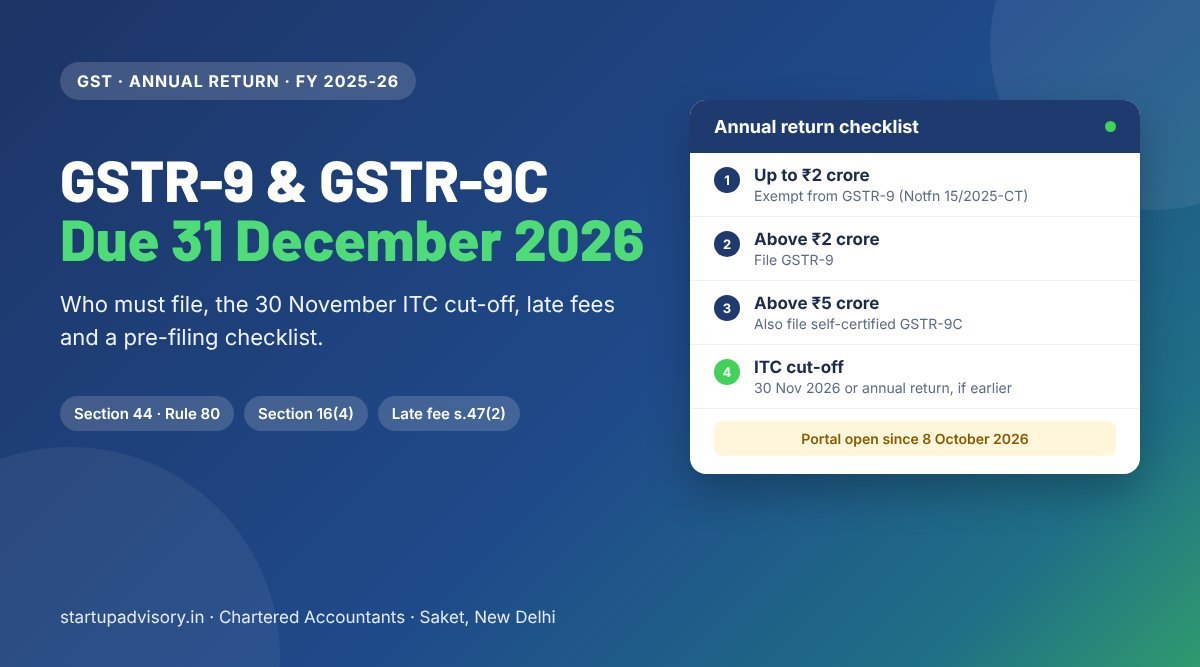
GSTN opened the FY 2025-26 annual return on the portal on 8 October 2026 (GSTN advisory, 13 October 2026). The form appears only once every GSTR-1 and GSTR-3B for the year has been filed. As of 3 November 2026 no extension of the 31 December date has been notified.
This guide covers who has to file, the dates that matter between now and 31 December, the late fee, and the reconciliations to finish before you press File. Every date and threshold below links to the CBIC or GSTN text it comes from.
1. When are GSTR-9 and GSTR-9C due for FY 2025-26?
Both are due on 31 December 2026. Rule 80(1) sets 31 December following the end of the financial year for GSTR-9, and Rule 80(3) requires GSTR-9C to be furnished along with the annual return by the same date.
| Date | What happens | Source |
|---|---|---|
| 8 October 2026 | GSTR-9 and GSTR-9C for FY 2025-26 enabled on the GST portal | GSTN advisory |
| 30 November 2026 | Last date to take ITC on FY 2025-26 invoices and debit notes (or the date the annual return is filed, if earlier) | Section 16(4) |
| 31 December 2026 | Due date for GSTR-9, and for GSTR-9C where it applies | Rule 80(1) and 80(3) |
| From 1 January 2027 | Late fee runs each day until the return is filed | Section 47(2) |
| 31 December 2029 | Last date to file at all: no annual return after three years from its due date | Section 44(2) |
2. Who has to file GSTR-9 for FY 2025-26?
Every regular registered taxpayer whose aggregate turnover for FY 2025-26 exceeds ₹2 crore. Notification No. 15/2025-Central Tax dated 17 September 2025 exempts a registered person whose aggregate turnover in any financial year is up to ₹2 crore from filing the annual return, for FY 2024-25 onwards.
- Outside Section 44 altogether: Input Service Distributors, persons deducting TDS under Section 51 or collecting TCS under Section 52, casual taxable persons and non-resident taxable persons (Section 44(1)).
- Composition taxpayers file GSTR-9A instead, under the proviso to Rule 80(1).
- Each GSTIN files separately. GSTN's GSTR-9 FAQ says the return is filed for each registration, including registrations under the same PAN in other States.
- Cancelled registrations still file the annual return for the year, and a taxpayer who switched between composition and regular files GSTR-9A and GSTR-9 for the respective periods (GSTN FAQ, questions 5 and 6).
3. Who has to file GSTR-9C, and does a CA have to certify it?
A registered person whose aggregate turnover for FY 2025-26 exceeds ₹5 crore must also file GSTR-9C, and no CA certification is required. Rule 80(3) calls it a "self-certified reconciliation statement" reconciling the returns with the audited annual financial statements.
Rule 80 was substituted by Notification No. 30/2021-CT dated 30 July 2021. Before that, GSTR-9C had to be certified by a chartered or cost accountant, and some older guides still say so. You still reconcile against the audited annual financial statement, so plan GSTR-9C after the books are final.
| Aggregate turnover, FY 2025-26 | GSTR-9 | GSTR-9C |
|---|---|---|
| Up to ₹2 crore | Exempt (Notification 15/2025-CT) | Not required |
| Above ₹2 crore, up to ₹5 crore | Required by 31 December 2026 | Not required |
| Above ₹5 crore | Required by 31 December 2026 | Required, self-certified, with GSTR-9 |
4. Why does 30 November 2026 matter more than 31 December?
Because it is the last date to take input tax credit on FY 2025-26 invoices. Section 16(4) bars ITC on an invoice or debit note after 30 November following the end of the financial year, or after furnishing the annual return, whichever is earlier.
Two practical consequences follow:
- Claim missed credit in GSTR-3B first. ITC cannot be claimed through GSTR-9 itself (GSTN FAQ, question 39). Any FY 2025-26 credit still missing must go through a GSTR-3B filed by 30 November 2026.
- Filing GSTR-9 early can cost credit. If you file the annual return before 30 November, the ITC window closes on that date. Unless your credit is fully reconciled, file after 30 November.
5. What is the late fee if GSTR-9 is filed after 31 December 2026?
Under Section 47(2) the late fee is ₹100 for every day of delay, capped at 0.25% of turnover in the State or Union territory. Notification No. 07/2023-Central Tax waives the CGST late fee above lower limits for FY 2022-23 onwards:
| Aggregate turnover in the year | CGST late fee per day | CGST maximum |
|---|---|---|
| Up to ₹5 crore | ₹25 | 0.02% of turnover in the State/UT |
| Above ₹5 crore, up to ₹20 crore | ₹50 | 0.02% of turnover in the State/UT |
| Above ₹20 crore | ₹100 (no waiver) | 0.25% of turnover in the State/UT |
These are CGST amounts. The State or UT GST Act has a parallel late-fee provision, so expect a matching amount under SGST/UTGST. The portal will not let you file GSTR-9 without paying the late fee (GSTN FAQ, question 36).
GSTR-9C carries a late fee too. GSTN's consolidated FAQ on GSTR-9/9C, citing Circular No. 246/03/2025-GST of 30 January 2025, says the Section 47(2) late fee covers the complete annual return, including GSTR-9C. The GSTR-9C late fee runs from the later of the GSTR-9 filing date and the due date until GSTR-9C is filed. The portal calculates it in a new Table 17 of GSTR-9C. Filing GSTR-9 on time and GSTR-9C a week later therefore still attracts seven days of late fee.
6. What should you reconcile before filing?
Start with the auto-populated tables, because several of them cannot be edited. GSTN's FAQ lists Table 6A (ITC from GSTR-3B), Table 8A (ITC as per GSTR-2B from FY 2023-24) and Table 9 (tax paid, except the tax-payable column) as locked.
- Outward supplies (Tables 4 and 5): match GSTR-1, GSTR-1A and IFF to the sales ledger. Since FY 2024-25, supplies added or amended through GSTR-1A also feed these tables (GSTN consolidated FAQ, question 5).
- ITC claimed (Table 6): split Table 6A into credit of the current year and credit of the preceding year. Since FY 2024-25 the form has Table 6A1 for ITC of the preceding year claimed in the current year; for FY 2025-26, that is FY 2024-25 credit claimed during FY 2025-26.
- ITC reversals (Table 7): report reversals of the current year's credit only, by reason, for example Rule 37 (Table 7A), Rule 37A (Table 7A1) and other reversals (Table 7H).
- GSTR-2B versus books (Table 8): download the "Table 8A document details" Excel from the GSTR-9 dashboard and explain the 8D difference. Credit of the year first claimed in the next year, up to the cut-off, goes in Table 8C and Table 13.
- Tax paid (Table 9) and any shortfall: you can declare additional liability in GSTR-9, but you pay it through FORM GST DRC-03 from the cash ledger (GSTN FAQ, questions 37 and 38).
- HSN summaries (Tables 17 and 18): use the downloadable Table 12 HSN details from GSTR-1 to fill these.
- GSTR-9C, if applicable: reconcile turnover and tax in the audited financial statements to GSTR-9, and record reasons for any unreconciled difference.
7. Does the 57th GST Council meeting change this year's annual return?
No, not for FY 2025-26 as things stand. On 8 October 2026 the Council approved, in principle, a concept note for an optional Annual Return Quarterly Payment (ARQP) scheme for B2C taxpayers with turnover up to ₹5 crore. It also recommended amending Sections 16, 37 and 39 to align them with the Section 16(4) ITC time limit (PIB press release, 8 October 2026).
The Council's own note says recommendations take effect only through notifications, circulars or amendments to the law. None of these has changed the FY 2025-26 due date or the thresholds above. Our summary of the meeting is in 57th GST Council meeting outcomes.
8. A filing plan for November and December
- By mid-November: file every pending GSTR-1 and GSTR-3B for FY 2025-26, or the GSTR-9 tile stays disabled.
- By 30 November: claim any FY 2025-26 credit still missing in GSTR-3B, and reverse what is ineligible.
- Early December: finish the Table 6, 7 and 8 reconciliation and settle any shortfall through DRC-03.
- Before 31 December: file GSTR-9, and GSTR-9C on the same day if your turnover exceeds ₹5 crore.
For the other GST and TDS dates this quarter, see our GST and TDS compliance calendar 2026. If your accounts are also under statutory audit, the statutory audit checklist sets out the order of work.
How Startup Advisory can help
Our Saket team prepares and files GSTR-9 and GSTR-9C for businesses across Delhi NCR. We run the GSTR-2B and books reconciliation, settle shortfalls through DRC-03 and time the filing around the 30 November ITC cut-off. See our GST advisory and compliance service, contact us or call 9311972982.
Official sources
- Section 44, CGST Act, 2017: annual return, exemption power, and the three-year bar in Section 44(2) (CBIC tax information portal).
- Rule 80, CGST Rules, 2017: GSTR-9 due 31 December; GSTR-9C self-certified above ₹5 crore.
- Section 2(6), CGST Act, 2017: aggregate turnover on an all-India, same-PAN basis.
- Section 16(4), CGST Act, 2017: ITC time limit of 30 November or the annual return date.
- Section 47(2), CGST Act, 2017: late fee of ₹100 a day, capped at 0.25% of turnover in the State/UT.
- Notification No. 15/2025-Central Tax, 17 September 2025: annual return exemption up to ₹2 crore from FY 2024-25 (copy hosted by the J&K Commercial Taxes Department).
- Notification No. 07/2023-Central Tax, 31 March 2023: late fee waiver for the annual return from FY 2022-23 (copy hosted by the Telangana Commercial Taxes Department).
- GSTN advisory, 13 October 2026: FY 2025-26 GSTR-9/9C enabled from 8 October 2026.
- GSTN FAQs on GSTR-9 and the consolidated FAQ on GSTR-9/9C for FY 2024-25 (17 December 2025), including the GSTR-9C late fee under Circular No. 246/03/2025-GST.
- PIB release on the 57th GST Council meeting, 8 October 2026.
Prepared 3 November 2026 from the sources above. Check the GST portal for any extension notified after this date before filing.