
GST / Registration
CBIC Circular No. 257/03/2026-GST: The New Guidelines for GST Registration Applicants, Explained
Reviewed by CA Neeraj Rohilla, FCA — Chartered Accountant, Startup Advisory, Saket, New Delhi.
- What the circular is, and is not
- What changes for applicants
- Which form to file
- Filling REG-01 correctly
- The place-of-business address
- Premises documents, case by case
- The three new formats
- Bank account details
- What officers can and cannot ask
- Processing timelines
- Rule 14A, and old cancelled GSTINs
- If you are stuck: the grievance route
- Points to watch in the circular
- Pre-filing checklist
1. What the circular is, and what it is not
Circular No. 257/03/2026-GST (F. No. CBIC-20001/2/2026-GST) was issued by the GST Policy Wing of the Central Board of Indirect Taxes and Customs on 26 October 2026 and signed by the Commissioner (GST). It is addressed to all Principal Chief Commissioners, Chief Commissioners and Directors General, and issued under Section 168(1) of the CGST Act, the power the Board uses to secure uniform implementation of the law across field formations.
The circular explains why it was needed. CBIC analysed registration applications, the reasons for rejection and the queries raised, and found that delays and rejections usually trace back to the same deficiencies: missing documents, incorrect or inconsistent details, and illegible uploads, most often in the applicant’s identity details, the proof of principal place of business, the constitution of the business and the authorised signatory’s details. Officers already had processing guidelines in Instruction No. 03/2025-GST dated 17 April 2025. This circular is the applicant-side counterpart:
It runs to 38 pages: ten paragraphs of guidelines, followed by six annexures:
| Annexure | Contents |
|---|---|
| I | 51 FAQs on the form, constitution, premises, bank account, goods and services, promoters and signatories |
| II | Checklist of documents for each constitution (proprietorship, firm/LLP, HUF, company, society/trust/AOP, Government department, PSU, local authority) |
| III | List of documents accepted as proof of principal place of business, by type of premises |
| IV | Affidavit format for inherited property (premises owned by a deceased ancestor) |
| V | Undertaking format where there is no rent agreement |
| VI | Consent letter format for premises made available by the owner |
2. What changes for applicants, at a glance
| Area | Position under the circular | Where |
|---|---|---|
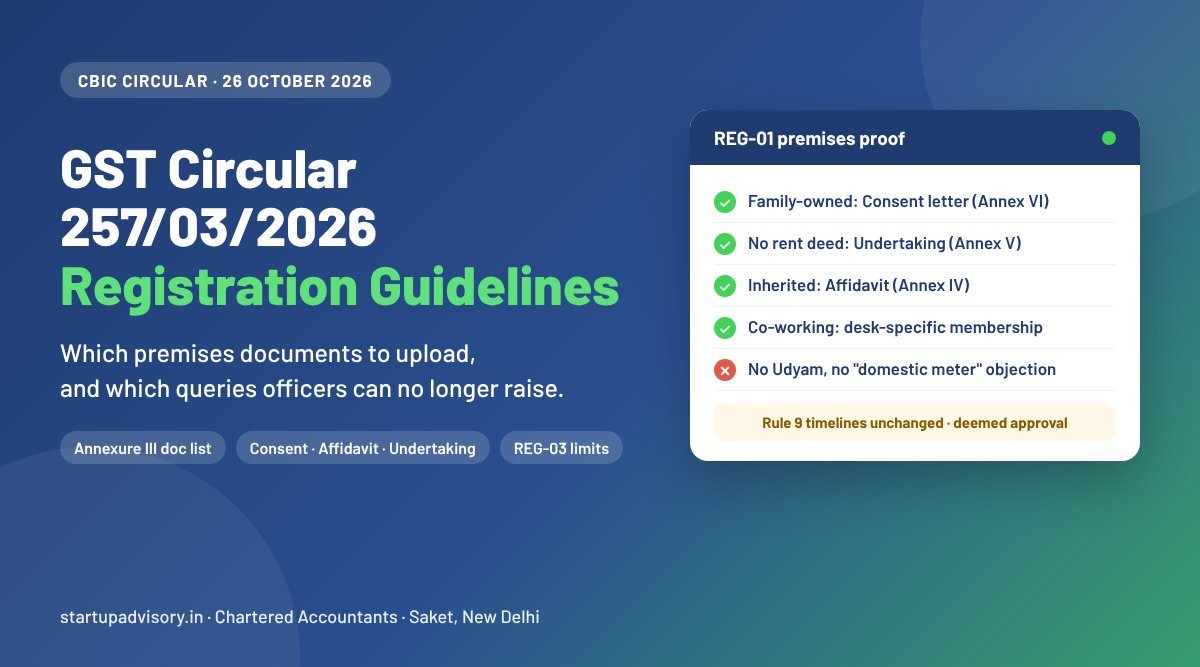
| Family-owned premises | Cannot be shown as “own”. Select “Consent” and upload the Annexure VI consent letter plus the owner’s ownership document | Para 3.8.2.1, 3.8.4; FAQ 22 |
| Inherited premises, no papers in your name | Annexure IV affidavit on ₹100 stamp paper, death certificate and one ownership document | Para 3.8.2.3; FAQ 29 |
| Unregistered rent agreement | Agreement plus one ownership document of the landlord. If the electricity or water bill is in your name, that bill can replace the landlord’s document | Para 3.8.3(a); FAQ 24 |
| No rent agreement at all | Annexure V undertaking plus a utility bill showing your possession | Para 3.8.3(b); FAQ 25 |
| Co-working space | Membership agreement naming your desk or cabin, plus the provider’s ownership document or its registered lease with the owner | Para 3.8.5; FAQ 26 |
| Jointly owned premises | No NOC from the other co-owners needed for a co-owner’s own registration; upload a document that shows both owners | FAQ 37 |
| Udyam certificate | Not required and not accepted as premises proof; officers should not ask for it | Para 5.4.1; FAQ 36 |
| Residence in another State or city | Not a ground for a query or rejection | Para 5.4.1; FAQ 30 |
| Residential premises, domestic meter, small bills | Officers must not judge these; bills are checked for name and address only | Para 6 |
| Photos of the premises or of the landlord | Not required or accepted as proof | FAQ 35 |
| Telecom towers, ATMs | Unmanned installations need not be declared as a PPoB or APoB | Para 3.9 |
| Rule 14A exit | REG-32 with REG-01 documents, processed like a normal application | Para 6.1; FAQ 10 |
| Earlier GSTIN on the same PAN suspended or cancelled | File all pending returns, including GSTR-10, and clear dues before applying again | Para 4 |
| Delay or unwarranted queries | Grievance to the Chief Commissioner (CGST) or Commissioner (SGST) on the notified e-mail | Para 8 |
3. Which registration form to file
Paragraph 3.1 and FAQ 5 restate which form applies to which applicant. Filing the wrong one is an avoidable rejection.
| Applicant | Form |
|---|---|
| Normal taxpayer, Input Service Distributor, casual taxable person | GST REG-01 |
| Tax deductor under Section 51 or e-commerce operator collecting tax under Section 52 | GST REG-07 |
| Non-resident taxable person | GST REG-09 |
| OIDAR supplier from outside India to non-taxable online recipients, or online money gaming supplier from outside India | GST REG-10 |
| UN bodies, embassies and other notified persons (Unique ID) | GST REG-13 |
The application is filed at Services > Registration > New Registration on gst.gov.in. FAQ 2 and 3 repeat the thresholds (₹40 lakh for goods-only suppliers, ₹20 lakh where services are supplied; ₹20 lakh and ₹10 lakh in special category States that opt for it) and the categories that must register regardless of turnover, such as inter-State suppliers, casual and non-resident taxable persons, reverse-charge payers, e-commerce sellers and operators, ISDs and agents. Suppliers of ice cream, pan masala and Chapter 24 tobacco goods must register regardless of the threshold. If you are unsure whether you need to register at all, our GST registration guide for Delhi covers the tests.
4. Filling Form REG-01 correctly
Part A (TRN generation). The legal name must match the PAN, and for companies the MCA incorporation certificate. For a proprietorship, the legal name is the proprietor’s own name, not the shop name. Choose the right State/UT and District for the principal place of business, and where an e-mail and mobile number are linked to the PAN, use the same ones (para 3.2.2).
Business details. Select the correct constitution and upload its proof: partnership deed for a firm, registration certificate or proof of constitution for a society, trust, club, AOP, Government department or local authority, and the Karta document for an HUF (para 3.3.1). SEZ units and developers must tick the SEZ option and give the Letter of Approval or Letter of Permission number, date, validity and approving authority, and upload it (para 3.3.2). If you want composition, casual taxable person status or Rule 14A, say “Yes” against that option at the time of filing (para 3.3.3). Pick the reason for registration carefully. FAQ 7 notes it must align with the constitution and the rest of the application, and that it matters later, even at cancellation.
Promoters, partners and directors. Paragraph 3.4.1 specifies whose details are needed:
- Proprietorship: the proprietor.
- Partnership firm or LLP: the managing partner and all other partners. DIN is mandatory for LLP designated partners.
- HUF: the Karta.
- Company: the managing director and all whole-time directors, with DIN (validated against MCA records, FAQ 45). CIN details are validated online at submission (FAQ 47).
- Association: all members of the managing committee. Trust: all members of the board of trustees.
Photographs. This is a frequent reason for queries, and paragraph 3.4.3 is specific. Upload a recent colour photograph of the individual alone, full front face, at proper resolution. It must not be a group photo, and it must not be a copy or crop of a PAN, Aadhaar, driving licence or passport. Photographs are needed for the proprietor; partners (up to ten where a firm has more); the Karta; the managing director or authorised person of a company; the managing trustee; managing committee members (up to ten); the CEO of a local authority or statutory body; and the person in charge in other cases (para 3.4.2).
Authorised signatories. Up to ten can be named, each with a photograph and an authorisation letter from the proprietor, partners, board, trust or committee appointing them (para 3.5). FAQ 50 suggests naming at least two, a primary and an alternate, so e-signing and Aadhaar steps are not held up if one is unavailable. Any adult can be a signatory; for a non-resident taxable person (REG-09) the signatory must be an Indian national (FAQ 48). The primary authorised signatory signs the application digitally (FAQ 51).
Authorised representative. Optional. If it is a GST practitioner enrolled under Section 48, give the enrolment ID; otherwise give name, designation, mobile, e-mail and PAN (para 3.6).
Goods and services. List all goods and services you supply or intend to supply, with accurate HSN/SAC; if you cannot add every item, add the most prominent ones (FAQ 41). Our HSN code finder helps. Items and promoter details can be changed later through a REG-14 amendment (FAQ 42 and 44).
5. The place-of-business address
The circular calls wrong or inadequate PPoB details “one of the major reasons” for rejections and queries (para 3.7.1). The address must be specific down to the unit:
- Building, flat, shop or plot number; Khasra or Khata number where applicable; road or street; locality; village, town or city; taluka or block; district; the correct PIN code; and a nearby landmark.
- Latitude and longitude where possible. You can set them by dragging the map marker on the portal to the exact premises.
- Not an open-ended address such as only a Khasra number, a colony or a village name. That invites a query or a negative physical-verification report.
- Exactly the same as the address on the uploaded proof.
Select the State and Centre jurisdiction that matches the PIN (para 3.7.3). A wrong jurisdiction means the application, or the physical-verification ARN, has to be transferred, which costs time. A P.O. Box or courier address is not acceptable as a PPoB or APoB (FAQ 32). Add every additional place of business in the State; the proof requirements are the same as for the PPoB (para 3.9). Several States also require electricity connection details (board name and consumer number) for the PPoB, including Maharashtra, Rajasthan, Odisha, Andhra Pradesh, Assam and Madhya Pradesh (para 3.10).
6. Premises documents, case by case
This is the heart of the circular. Every proof must be clear, complete and legible (para 3.8.7). In the table, an “ownership document” means any one of: latest property tax receipt, municipal khata, a document certifying property identification, latest electricity bill, or latest water bill, showing the full address (para 3.8.2.2, Annexure III).
| Your premises | Select | Upload |
|---|---|---|
| Owned by you (in your own name) | Own | One ownership document in your name |
| Owned by a deceased ancestor, nothing in your name | Not specified; usually Own | Death certificate + Annexure IV affidavit + one ownership document in the deceased’s or your name |
| Rented, registered agreement (where State law requires registration) | Rented/leased | The registered rent/lease agreement. FAQ 34 confirms nothing more is needed, even if the meter is shared |
| Rented, agreement not required to be registered | Rented/leased | Rent agreement + one ownership document in the landlord’s name |
| Rented, electricity or water bill in your name | Rented/leased | Your latest bill with full address + a valid rent agreement (in place of the landlord’s document) |
| Rented, no agreement | Rented/leased | Annexure V undertaking + latest electricity or water bill showing the premises (see section 13 on whose name) |
| Owned by a parent, spouse, sibling, partner or director | Consent | Annexure VI consent letter on plain paper signed by the owner (all co-owners, if more than one) + one ownership document in the owner’s name |
| Jointly owned, you are a co-owner | Own | A document showing both owners. No NOC from the other co-owners is required |
| Co-working space, provider owns the building | As applicable | Membership agreement (period, specific suite/cabin/desk) + one ownership document in the provider’s name |
| Co-working space, provider leases the building | As applicable | Membership agreement + the registered lease between the owner and the provider |
| SEZ unit or developer | — | Valid Letter of Approval / Letter of Permission from the Development Commissioner |
A few points the FAQs make explicit:
- “Own” means your own name. Premises owned by a parent, spouse, sibling, or by one of the partners or directors of the applicant entity, are not owned by the applicant (para 3.8.2.1). This is the single most common mis-selection we see in proprietorship and small-company applications.
- Latest means latest. An old electricity or water bill invites a query (FAQ 31).
- Multiple branches in one building can be one registration (one PPoB, the rest APoBs) or several, but each needs its own proof (FAQ 33).
- An SEZ unit always needs its own GSTIN, even if you already hold one for a non-SEZ place in the same State (FAQ 28).
- The consent letter must describe the space. Annexure VI asks for the precise part of the property allotted (for example, a cabin number and floor) where the applicant uses only a portion, and a statement that the portion is clearly demarcated and exclusively assigned to the applicant.
7. The three new formats
Until now, each State and often each officer had its own idea of what a consent letter or affidavit should say. The circular standardises three documents.
Annexure IV: Affidavit for inherited property
- When: the premises was owned by a deceased ancestor and no document is in your name.
- Signed by: you, as deponent, on non-judicial stamp paper of a minimum ₹100, before a First-Class Judicial Magistrate, Executive Magistrate or Notary Public.
- Declares: you are a legal heir of the deceased (name and date of death); the premises stood in the deceased’s name; you are in lawful possession and carry on business there; you pay the utility bills; you are responsible for the tax liabilities of the business.
- Upload with: the death certificate and one ownership document in the deceased’s or your name.
Annexure V: Undertaking where there is no rent agreement
- When: you rent the premises but have no written rent or lease agreement.
- Signed by: you, as proprietor, promoter or authorised signatory. The format does not prescribe stamp paper or attestation.
- Declares: the owner’s name; that no written agreement exists; that you have been in lawful possession since a stated month and year; that you pay the utility charges; that you are responsible for GST compliance at the address.
- Upload with: the latest electricity or water bill for the premises.
Annexure VI: Consent letter from the owner
- When: the premises belongs to someone else, such as a parent, spouse, sibling, partner or director, who lets you use it.
- Signed by: the owner, or every co-owner, on plain paper.
- Declares: the owner’s and applicant’s details and their relationship; the premises address; whether the whole premises or a described, demarcated and exclusively assigned portion is allotted; no objection to its use as principal or additional place of business; the owner’s PAN and contact number.
- Upload with: one ownership document in the owner’s name.
Use the wording of the annexures as closely as possible. A home-made NOC that leaves out the relationship, the description of the space or the owner’s PAN is exactly the kind of document that draws a REG-03.
8. Bank account details
Bank details are not mandatory at the time of application, but Rule 10A requires them within 30 days of registration or before the first GSTR-1/IFF, whichever is earlier (para 3.11, FAQ 39). The circular advises giving them in the application if the account already exists. The account must be in the applicant’s name and opened on the applicant’s PAN, and the proof is the first page of the passbook, the relevant page of a bank statement, or a cancelled cheque showing the name, account number, IFSC and branch. Up to ten accounts can be added (FAQ 40), and FAQ 38 says every account used for the business must be added, including accounts opened after registration.
9. What officers can and cannot ask for
For most applicants this is the most useful part. Paragraph 5.4 says an officer may issue a REG-03 notice within seven working days only in these cases:
- A document is incomplete or not legible: the officer may ask for a complete or legible copy.
- The address does not match the uploaded document, or the document does not appear to be valid proof of that address: the officer may ask for additional documents from the prescribed list.
- The address is incomplete or vague: the officer may ask for a complete, unambiguous address with proof.
Paragraph 5.4.1 then names queries that CBIC has seen and wants stopped:
Paragraph 6 goes further. Officers must stick to the prescribed document list, raise deficiencies only through REG-03 (not by other communication and not by outright rejection), and refrain from “personal or subjective assessments, such as classifying electricity connections as domestic or commercial, scrutinizing bill amounts, or deeming residential premises unfit for business”. Utility bills and property tax receipts are to be checked only for the applicant’s name and address. Rent agreements are checked mainly for validity, the names of both parties and the exact property address.
Where physical verification is ordered, the inspecting officer must report specifically on whether the premises exists, record the efforts made if it is not found, upload GPS-enabled site photographs, and reassign the ARN at once if it belongs to another jurisdiction. The report in REG-30 must be uploaded at least five days before the 30-day period ends (para 5.6).
10. Processing timelines
The circular restates the Rule 9 timelines. None of them is new, but having them in one Board circular makes them easier to hold officers to.
| Step | Time limit | Source |
|---|---|---|
| Rule 14A simplified registration, or Rule 9A system-identified low-risk applicant | Granted by the system within 3 working days | Para 5.3; FAQ 8 |
| Aadhaar authenticated, no physical verification | Officer to process within 7 working days | Para 5.1; Rule 9 |
| No Aadhaar authentication, risk-flagged, or officer orders physical verification | Within 30 days, after physical verification under Rule 25 | Para 5.1 |
| Biometric Aadhaar authentication at a GST Suvidha Kendra, where selected | Within 15 days of receiving the TRN (application is complete only after it) | Para 5.2; FAQ 13 |
| REG-03 notice by the officer | Within 7 working days of the application; within 30 days where physical verification applies | Para 5.4, 5.4.2 |
| Your reply in REG-04 | Within 7 working days of the notice | Para 5.5; FAQ 15 |
| Officer’s decision after your reply (approve, or reject in REG-05 with reasons) | Within 7 working days of the reply | Para 5.5; FAQ 16 |
| Physical verification report (REG-30) uploaded | At least 5 days before the 30-day period ends | Para 5.6 |
| Officer takes no action in time | Registration deemed approved; REG-06 issued on the portal | Para 5.7; FAQ 17 |
Opting for Aadhaar authentication is in your interest, as the circular itself says (para 5.1). Without it, you face a GSK visit for photographs and document verification, and a 30-day track with physical verification. All communication runs through the portal, so watch it and your registered e-mail (para 7). If an application is rejected, file a fresh one after correcting the deficiencies listed in the rejection order (FAQ 18).
11. Rule 14A, and applicants with an old cancelled GSTIN
Simplified registration. Rule 14A, in force from 1 November 2025, is for small suppliers whose tax on supplies to registered persons does not exceed ₹2.5 lakh a month. The conditions are restated in FAQ 9: file in REG-01, opt for Aadhaar authentication, and declare that you will not exceed the ₹2.5 lakh monthly limit and will not take more than one Rule 14A registration in a State on the same PAN. Registration comes within three working days.
Leaving Rule 14A. Paragraph 6.1 and FAQ 10 settle how to move to normal registration once you need to pass on more credit. File all returns due up to the date of application, having filed at least one return after getting the Rule 14A registration, then file Form GST REG-32 with the documents required in REG-01. It is processed like a fresh normal application, so the premises proofs in section 6 apply in full. Prepare them before you file.
Previously suspended or cancelled registration. If an earlier GSTIN on the same PAN was suspended under Rule 21A(2) or (2A), or cancelled under Rule 22, file every pending return for it, including the final return in GSTR-10 where applicable, and clear all dues before applying again (para 4).
12. If you are stuck: the grievance route
Paragraph 8 gives applicants a named escalation route. If processing is delayed or the officer raises unwarranted queries, file a complaint with the jurisdictional Chief Commissioner of Central Tax (for a Centre-allotted application) or the Commissioner of State Tax (for a State-allotted one), on the special e-mail ID each Zone or State notifies for this purpose. The circular asks field formations to publicise it through trade notices, so expect Delhi’s CGST Zone and the Delhi GST department to publish their addresses. Keep the ARN, the REG-03, your REG-04 and the relevant paragraph of the circular ready when you write in.
13. Points to watch in the circular
Read closely, the circular has a few loose ends. None changes the overall position, but they are worth knowing before you file or reply to a query:
- Wrong annexure reference. Paragraph 5.4(ii) lets officers seek additional documents “as per the list of documents in Annexure-IV”. The list of premises documents is Annexure III; Annexure IV is the inheritance affidavit. The reference is evidently to Annexure III.
- Whose name on the utility bill when there is no rent agreement. Paragraph 3.8.3(b) asks for a bill “containing the name of the tenant”. FAQ 25 says a document “in the applicant’s name”, while Annexure III accepts a document “in the name of the applicant or the owner”. Where the bill is in the landlord’s name, upload it with the Annexure V undertaking (which names the owner) and keep the circular’s Annexure III row handy in case of a query.
- Undertaking or affidavit? Annexure V is titled an undertaking, but its paragraph 9 calls itself an affidavit, and the format specifies no stamp paper or attestation. In States where officers expect a notarised document, notarising it costs little and removes the argument.
- Co-working lease must be registered. Where the provider has leased the building, the circular asks for the registered lease between owner and provider. Check this with your provider before you sign up; many operate on unregistered or expired leases.
- Consent of all co-owners vs no NOC for co-owners. These are different cases. Where a family member owns the property with others and you are not an owner, every co-owner must sign the consent (para 3.8.4.1). Where you are yourself a co-owner, no NOC from the others is needed (FAQ 37).
14. Pre-filing checklist
- Right form, right reason. REG-01, 07, 09, 10 or 13, and a reason for registration that fits your constitution.
- Names match PAN. Legal name as on PAN (and MCA for companies); proprietor’s own name for a proprietorship; PAN-linked e-mail and mobile.
- Everyone the form asks for is included, with DIN for directors and designated partners.
- Individual, full-face, recent colour photos, not ID-card crops or group photos.
- An authorisation letter for every signatory; name at least two signatories.
- Address down to the shop or flat number, correct PIN, map pin set, matching State and Centre jurisdiction.
- Nature of premises selected correctly: “Own” only if it is in your own name.
- Premises proof per section 6, with the latest utility bill and the Annexure IV, V or VI format where it applies.
- State-specific fields filled, such as the electricity consumer number in States that require it.
- Bank proof uploaded if the account exists, in the applicant’s name and PAN.
- Opt for Aadhaar authentication, and complete any GSK visit within the time allowed.
- Watch the portal and answer any REG-03 within seven working days, citing the circular if the query goes beyond it.
What we recommend
- Treat Annexure III as the document list. Upload what it asks for your premises type, and nothing that suggests a different story.
- Use the official formats for the affidavit, undertaking and consent letter instead of old NOC templates.
- Fix “own” vs “consent” before filing. It is the easiest rejection to avoid.
- Reply to queries on the circular’s terms. Give what paragraph 5.4 allows, decline politely what paragraph 5.4.1 rules out, and escalate under paragraph 8 if needed.
- Moving off Rule 14A? Prepare the full REG-01 premises set before filing REG-32.
- CBIC, Circular No. 257/03/2026-GST, F. No. CBIC-20001/2/2026-GST, “Guidelines for the handling applications for GST registration”, 26 October 2026, with Annexures I to VI
- CBIC, Instruction No. 03/2025-GST, 17 April 2025 (guidelines for officers processing registration applications), as referred to in the circular
- Sections 22, 24, 25, 48, 51, 52 and 168, Central Goods and Services Tax Act, 2017
- Rules 8, 9, 9A, 10A, 14A, 21A, 22 and 25, Central Goods and Services Tax Rules, 2017; Forms GST REG-01 to REG-07, REG-09, REG-10, REG-13, REG-14, REG-30 and REG-32
This article is general information, not tax advice. It is based on the text of Circular No. 257/03/2026-GST dated 26 October 2026. State GST departments may issue their own trade notices on it. Confirm your own position with a qualified professional before relying on it.
How Startup Advisory Can Help
Startup Advisory is a CA-led firm in Saket, New Delhi. We file GST registrations across Delhi NCR and other States, and answer the queries that follow:
- A premises check before filing: own, consent, rented or co-working, and the exact Annexure III documents for your case.
- Annexure IV, V and VI documents drafted to the circular’s format and checked against your property papers.
- REG-01 filed end to end, with Aadhaar authentication and GSK appointments handled.
- REG-03 replies that rely on the circular, and escalation under paragraph 8 where an officer goes beyond it.
- Rule 14A to normal registration (REG-32), and fresh registrations after an earlier GSTIN was cancelled.
Call 9311972982 or book a free consultation.