
Labour Law / Payroll
India’s Four New Labour Codes: What Changes for Employers and Startups (2026 Guide)
Reviewed by CA Neeraj Rohilla, FCA — Chartered Accountant, Startup Advisory, Saket, New Delhi.
- Effective dates and the four codes
- The 29 laws that were replaced
- The new definition of wages and the 50% rule
- Worked example: a startup salary
- Paying wages: timelines, deductions, bonus
- Working hours, overtime, leave and night shifts
- Gratuity and fixed-term employment
- EPF, ESIC and gig workers
- Industrial relations: the thresholds
- OSH Code: registration, contract labour, welfare
- Inspection, compounding and transition
- Employer checklist
1. Effective dates and the four codes
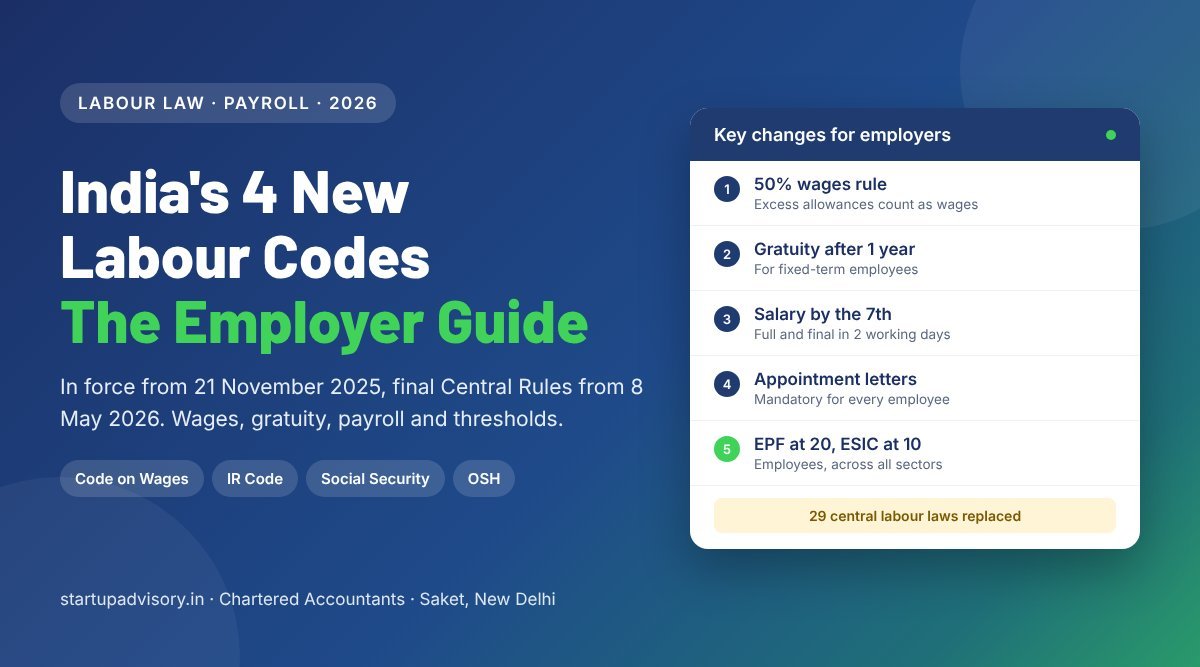
On 21 November 2025 the Ministry of Labour and Employment announced that the four codes “are being made effective from 21st November 2025, rationalising 29 existing labour laws”. Parliament had passed them years earlier: the Code on Wages in 2019 and the other three in September 2020. What was missing until 2025 was the date of commencement, and then the rules.
| Date | What happened |
|---|---|
| 8 August 2019 | Code on Wages, 2019 notified as law |
| 29 September 2020 | Industrial Relations Code, Code on Social Security and OSH Code notified as law |
| 21 November 2025 | All four codes made effective across the country |
| 30 December 2025 | Draft rules under all four codes pre-published for comments |
| 8 May 2026 | Final Central Rules notified: the Code on Wages (Central) Rules, 2026 (G.S.R. 343(E)), and the Central Rules under the Industrial Relations, Social Security and OSH Codes |
2. The 29 laws that were replaced
| Code | Acts it replaces |
|---|---|
| Code on Wages, 2019 (4) | Payment of Wages Act, 1936; Minimum Wages Act, 1948; Payment of Bonus Act, 1965; Equal Remuneration Act, 1976 |
| Industrial Relations Code, 2020 (3) | Trade Unions Act, 1926; Industrial Employment (Standing Orders) Act, 1946; Industrial Disputes Act, 1947 |
| Code on Social Security, 2020 (9) | Employee’s Compensation Act, 1923; ESI Act, 1948; EPF and Miscellaneous Provisions Act, 1952; Employment Exchanges (Compulsory Notification of Vacancies) Act, 1959; Maternity Benefit Act, 1961; Payment of Gratuity Act, 1972; Cine-Workers Welfare Fund Act, 1981; Building and Other Construction Workers Welfare Cess Act, 1996; Unorganised Workers’ Social Security Act, 2008 |
| OSH Code, 2020 (13) | Factories Act, 1948; Plantations Labour Act, 1951; Mines Act, 1952; the two Working Journalists Acts of 1955 and 1958; Motor Transport Workers Act, 1961; Beedi and Cigar Workers Act, 1966; Contract Labour (Regulation and Abolition) Act, 1970; Sales Promotion Employees Act, 1976; Inter-State Migrant Workmen Act, 1979; Cine-Workers and Cinema Theatre Workers Act, 1981; Dock Workers Act, 1986; Building and Other Construction Workers Act, 1996 |
The Ministry’s compliance handbook puts the simplification in numbers: registers down from 84 to 8, forms from 181 to 73, and 31 returns replaced by a single electronic return.
3. The new definition of wages and the 50% rule
This is the change that reaches every payroll. Section 2(y) of the Code on Wages defines wages as all remuneration, including basic pay, dearness allowance and retaining allowance, but excluding:
| Clause | Excluded from wages | Counted in the 50% test? |
|---|---|---|
| (a) | Statutory bonus not part of contractual remuneration | Yes |
| (b) | Value of house accommodation, light, water, medical attendance or other excluded amenities | Yes |
| (c) | Employer contribution to pension or provident fund, and interest on it | Yes |
| (d) | Conveyance allowance or travel concession | Yes |
| (e) | Sums to cover special expenses of the job | Yes |
| (f) | House rent allowance (HRA) | Yes |
| (g) | Remuneration under an award, settlement or court order | Yes |
| (h) | Overtime allowance | Yes |
| (i) | Commission | Yes |
| (j) | Gratuity payable on termination | No |
| (k) | Retrenchment compensation, retirement benefits, ex-gratia on termination | No |
What the Ministry has clarified in its FAQs (December 2025 and March 2026):
- One definition for all four codes. The same “wages” drives gratuity, social security, bonus and the other codes, and it has applied from 21 November 2025.
- Performance incentives, ESOPs and reimbursements are not wages. Annual performance-based incentives are outside the definition.
- Employer PF and pension contributions and statutory bonus count towards the 50% test; gratuity, ESI and other retirement benefits do not.
- Overtime is part of the 50% calculation.
- Leave encashment is not treated as an allowance under Section 2(y).
- Remuneration in kind (food coupons, mobile recharges and similar) cannot exceed 15% of wages.
4. Worked example: a startup salary
A software engineer at a Delhi startup earns total monthly remuneration of ₹1,00,000, structured as below. (Gratuity and other retirement benefits are left out of the test, so they are not shown.)
| Component | Amount (₹) | Treatment |
|---|---|---|
| Basic pay + DA | 30,000 | Wages |
| Special allowance | 10,000 | Wages (not on the exclusion list) |
| HRA | 40,000 | Excluded, clause (f) |
| Conveyance allowance | 10,000 | Excluded, clause (d) |
| Employer PF contribution | 3,600 | Excluded, clause (c) |
| Sales commission | 6,400 | Excluded, clause (i) |
| Total remuneration | 1,00,000 |
- Excluded items (a) to (i): 40,000 + 10,000 + 3,600 + 6,400 = ₹60,000.
- 50% limit: 50% of ₹1,00,000 = ₹50,000.
- Excess added back: 60,000 − 50,000 = ₹10,000.
- Wages under the code: 30,000 + 10,000 + 10,000 = ₹50,000, not the ₹30,000 basic + DA that a pre-code gratuity calculation would have used.
Gratuity for this employee is now calculated on ₹50,000 a month. After five years, at 15 days’ wages a year (wages ÷ 26 × 15 × years), that is roughly ₹1.44 lakh instead of about ₹0.87 lakh on basic + DA alone. Multiply that across the team and it changes the gratuity provision in your accounts.
5. Paying wages: timelines, deductions, bonus
| Rule | What the Code on Wages requires |
|---|---|
| Monthly wages | Paid before the expiry of the seventh day of the following month |
| Weekly / fortnightly / daily | Last working day of the week / before the end of the second day after the fortnight / end of the day |
| Exit (resignation, removal, dismissal, retrenchment) | All wages due within two working days (Section 17) |
| Deductions | Total deductions capped at 50% of wages in a wage period |
| Wage slips | Issued on or before payment of wages |
| Minimum wage | Never below the rate notified by the appropriate government; the Centre also sets a national floor wage |
| Equal remuneration | No gender discrimination in wages for the same or similar work |
| Bonus | Minimum 8.33%, maximum 20% of wages, for employees within the notified wage limit who worked at least 30 days in the year |
| Registers | Muster roll, wage, overtime, and fines and deductions registers, kept for five years |
Unlike the Payment of Wages Act, which protected only employees below a wage limit, the Ministry has confirmed that the timely-payment provisions apply to all employees, including managers and senior staff. The two-working-day rule is the one most startups break today: a full and final settlement that waits for the next payroll run is now late. Gratuity has its own 30-day window (see section 7).
The Code on Wages (Central) Rules, 2026 fix minimum wages on a daily basis: the hourly rate is the daily rate divided by eight, and the monthly rate is the daily rate multiplied by 26. Variable dearness allowance is revised twice a year, before 1 April and before 1 October, and the floor wage is reviewed at intervals of not more than five years.
6. Working hours, overtime, leave and night shifts
- Hours: the Ministry’s FAQs state that the OSH Code prescribes 8 hours a day, and the final Rules keep weekly working hours within 48 hours.
- Overtime: work beyond 8 hours in a day (for daily wagers) or 48 hours in a week is paid at twice the normal rate of wages, at the end of the wage period. Overtime allowance also counts in the 50% test.
- Weekly rest: at least one rest day a week, and no more than 10 consecutive days without a full rest day (Code on Wages (Central) Rules, 2026).
- Women at night: women may work in all establishments and all types of work. For work before 6 a.m. or after 7 p.m., the employer needs the woman’s written consent and the prescribed safety measures, which in the Central Rules include transport for pick-up and drop and CCTV.
- Leave: a worker can carry forward up to 30 days of leave to the next calendar year, and leave applied for but refused can be carried forward without limit. Leave can be encashed at the end of the year (beyond 30 days) and on leaving. These leave provisions cover workers and supervisors earning up to ₹18,000 a month; a State law that is more favourable to the employee still applies.
- Health check-ups: the OSH Code requires employers to provide free annual health check-ups to employees as prescribed. The Central Rules apply it to workers who have completed 40 years of age in dock work and building and construction; check your State’s rules for other sectors.
7. Gratuity and fixed-term employment
| Point | Position under the Code on Social Security |
|---|---|
| Which employers | Every factory, mine, plantation, port and railway company, and every shop or establishment with 10 or more employees |
| Regular employees | After five years of continuous service (not needed on death or disablement) |
| Fixed-term employees | After one year of service under the contract (Section 53) |
| Amount | 15 days’ wages for each completed year (a part year above six months counts as a year), on wages last drawn under the new definition |
| Ceiling | As notified by the Central Government; currently ₹20 lakh |
| Time limit | Within 30 days of becoming payable (Section 56) |
| From when | Gratuity on the revised wages applies w.e.f. 21 November 2025 |
Fixed-term employment is a recognised category under the codes, and gratuity after one year is its headline benefit. The Ministry clarifies that this covers employees engaged directly by the employer, not contract labour; a contractor’s workers still need five years of service for gratuity.
For employees who leave on or after 21 November 2025, the Ministry’s FAQs say gratuity is paid on the rate of wages last drawn, as per the Code on Social Security. The FAQs do not deal separately with service before that date, so take advice before settling a large claim; for the books, the prudent course is to provide on code wages for the full service, which is why the gratuity provision rises. Our gratuity calculator gives a quick estimate.
8. EPF, ESIC and gig workers
- EPF now applies to every establishment with 20 or more employees. The old requirement that the business be in a “scheduled” industry has gone, so a services startup that crosses 20 employees must register.
- ESIC applies to every establishment with 10 or more persons (other than a seasonal factory), and smaller establishments can join voluntarily. The Central Government can extend it to a hazardous or life-threatening occupation even where one person is employed. The Ministry’s March 2026 FAQs confirm that the ESI wage ceiling of ₹21,000 a month continues.
- Gig and platform workers are covered for the first time. Under Section 114, aggregators contribute 1% to 2% of annual turnover, capped at 5% of the amount paid or payable to gig and platform workers, towards a Social Security Fund; the exact rate is to be notified by the Central Government. Under the final Central Rules, a worker qualifies for scheme benefits after at least 90 days with one aggregator or 120 days across aggregators in the previous financial year.
If your startup runs a delivery, ride, freelance or marketplace platform, model the 1–2% contribution now and track the payouts to gig workers separately in your books, since the 5% cap is measured against them. Our PF and ESI calculator helps with the regular payroll side.
9. Industrial relations: the thresholds
| Requirement | Applies at |
|---|---|
| Grievance Redressal Committee (up to 10 members, equal employer and worker representation, women proportionately represented) | 20 or more workers |
| Works Committee | 100 or more workers, if the appropriate government orders it |
| Lay-off, retrenchment and closure: notice regime (one month’s notice for retrenchment, 60 days for closure) | 50 to 299 workers |
| Standing orders; prior government permission for lay-off, retrenchment or closure | 300 or more workers |
| Worker Re-Skilling Fund: 15 days’ wages per retrenched worker | Every retrenchment |
| Notice of change in service conditions | Takes effect only 21 days after notice |
| Sole negotiating union | Union with 51% or more of workers on the muster roll |
The IR Code’s “worker” excludes people in managerial or administrative roles and supervisors earning more than ₹18,000 a month. Most of a tech startup’s team will be outside the retrenchment chapters, but the Grievance Redressal Committee counts workers, so operations, support and warehouse staff can bring you over 20 sooner than you expect.
10. OSH Code: registration, contract labour, welfare
- Registration: every establishment with 10 or more employees must register electronically within 60 days of coming into existence, and report changes within 30 days. This single registration replaces several separate ones.
- Appointment letters must be issued to every employee.
- Contract labour: the provisions apply where 50 or more contract workers were employed on any day in the preceding 12 months, and a contractor with 50 or more must hold a licence, valid for five years. One common licence can cover a factory, beedi and cigar premises and contract labour.
- Inter-state migrant workers: applies at 10 or more; the employer pays an annual lump-sum journey allowance for the to-and-fro trip home.
- Welfare: canteen where 100 or more workers are employed; crèche where 50 or more employees are employed.
- Returns: one annual return, filed electronically, in place of the separate returns under the old Acts.
- Accidents: accidents causing death or serious injury must be reported to the authorities within the time the appropriate government prescribes.
11. Inspection, compounding and transition
- Inspector-cum-Facilitator: inspectors now also advise employers on compliance. Inspections are web-based and randomised, and reports must be uploaded within 48 hours.
- Compounding and improvement notices have been introduced for the first time, and many first-time offences now attract fines rather than imprisonment.
- Transition: the Ministry stated that, until rules under the codes are in place, the rules, notifications and schemes under the old Acts continue to the extent they are consistent with the codes (Section 6 of the General Clauses Act). The Central Rules arrived on 8 May 2026. Watch for your State’s final rules, which will set the forms and registers you actually file.
12. Employer checklist
- Run the 50% test on every salary structure and record the code-wages figure for each employee in your payroll software.
- Recompute the gratuity provision on code wages from 21 November 2025, and add fixed-term employees with one year of service.
- Move the payroll date to on or before the 7th, and set up a two-working-day full and final settlement process.
- Issue appointment letters to every existing employee who does not have one, and to every new joiner.
- Count heads against the thresholds: 10 (OSH registration, ESIC, gratuity), 20 (EPF, Grievance Redressal Committee), 50 (contract labour, crèche), 300 (standing orders, retrenchment permission).
- Update registers and notices: wage, attendance, overtime and deduction registers kept for five years, with minimum wages, working hours, wage period, pay date and the Inspector-cum-Facilitator’s details displayed.
- Review fixed-term and contractor agreements for parity of pay and benefits and for the contractor’s licence.
- Get written consent and safety arrangements before rostering women before 6 a.m. or after 7 p.m.
- Platforms: track payouts to gig and platform workers and budget for the aggregator contribution.
- Watch for your State’s final rules under each code and file the single annual return electronically when it falls due.
- Press Information Bureau, Ministry of Labour and Employment, “Government Makes the Four Labour Codes effective to Simplify and Streamline Labour Laws”, 21 November 2025 (PRID 2192463)
- Ministry of Labour and Employment, Compliance Handbook for Employers Under the Four Labour Codes (labour.gov.in, February 2026)
- Ministry of Labour and Employment, FAQs on Labour Codes (labour.gov.in, January 2026) and Additional FAQs on Labour Codes (as on 16 March 2026)
- Ministry of Labour and Employment, Annual Report 2025-26, Chapter 1 (labour.gov.in, June 2026)
- PIB, Rajya Sabha written reply on provisions for workers in the Labour Codes, 5 February 2026 (PRID 2223852)
- Code on Wages (Central) Rules, 2026, G.S.R. 343(E), 8 May 2026, and the Central Rules under the Industrial Relations Code, the Code on Social Security and the OSH Code notified the same day, as summarised by PRS Legislative Research (Monthly Policy Review, May 2026, and Rules note of 30 June 2026)
- Sections 2(y) and 17 of the Code on Wages, 2019; Sections 53, 56 and 114 of the Code on Social Security, 2020
This article is general information, not legal advice. It is based on the Ministry of Labour and Employment’s published handbook, FAQs and press releases and on the Central Rules as notified on 8 May 2026. State rules under the codes can differ in forms, registers and some thresholds; rely on the code and the rules that apply to your establishment, and confirm your position with a qualified professional before acting.
How Startup Advisory Can Help
Startup Advisory is a CA-led firm in Saket, New Delhi. We help startups and growing businesses across Delhi NCR move their payroll onto the labour codes:
- A 50% wages test across your salary structures, with a restructuring option and the cost of each.
- Gratuity provision recomputed on code wages, including fixed-term staff, for your FY 2026-27 books.
- EPF and ESIC registration and monthly compliance as you cross 10 and 20 employees.
- Appointment letter, wage slip and full and final settlement formats that meet the new timelines.
- Monthly payroll processing and bookkeeping, or a virtual CFO to own the whole people-cost budget.
Call 9311972982 or book a free consultation.