
FEMA / Foreign Investment
Can a Nepali Citizen Own 100% of an Indian Company? FDI Rules for 2026
Reviewed by CA Neeraj Rohilla, FCA — Chartered Accountant, Startup Advisory, Saket, New Delhi.
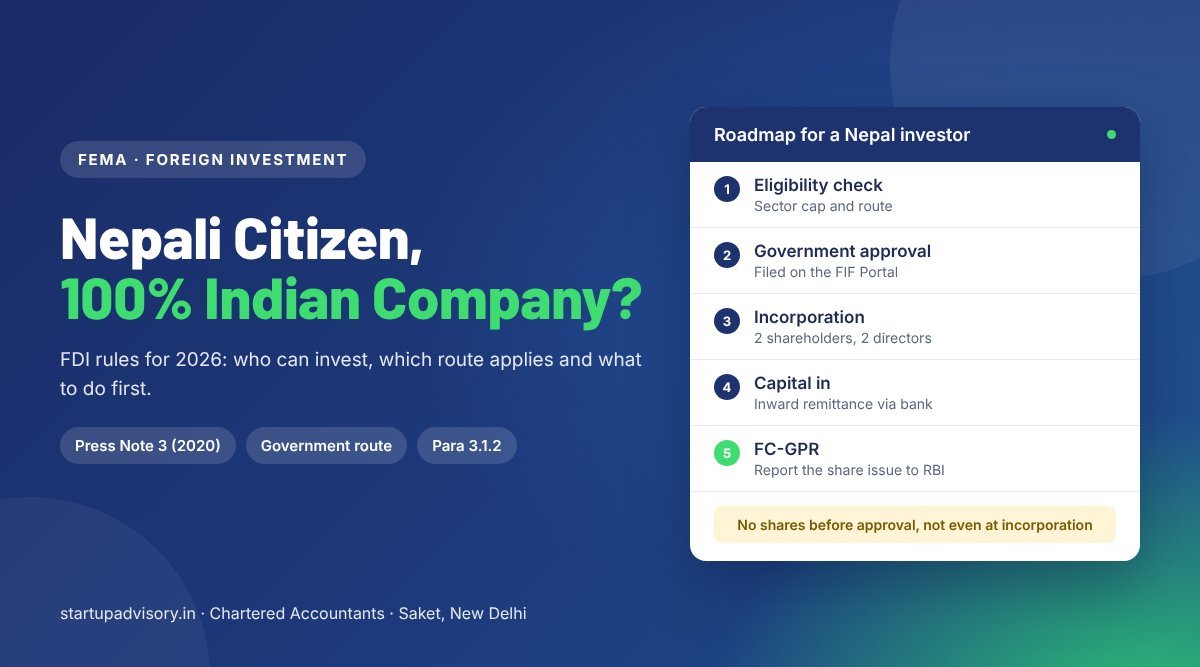
- Citizens of Nepal are eligible to invest in Indian companies on a repatriation basis (para 3.1.2 of the Consolidated FDI Policy).
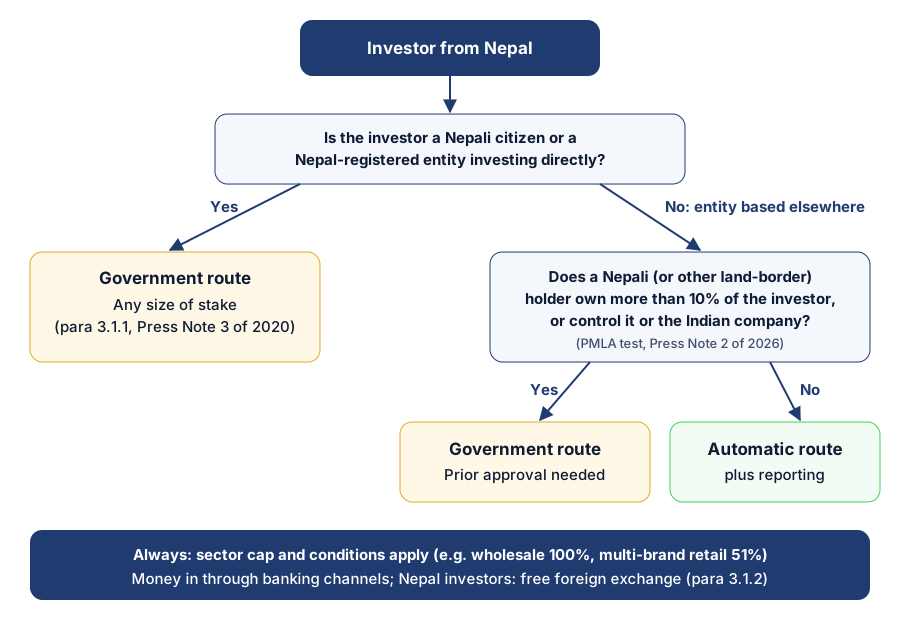
- Every direct investment by a citizen or entity of Nepal goes through the Government route, whatever the amount or sector (para 3.1.1).
- The 2026 amendment relaxes the test only for indirect, non-controlling holdings in an investor entity based outside a land-border country. It does not create a 10% automatic route for a Nepali individual.
- Sector caps still apply: wholesale trading allows 100%, while multi-brand retail is capped at 51% and has other conditions.
- A foreign-owned private company needs at least two shareholders, two directors and one director who stays in India for 182 days or more in the financial year. An OPC is not available.
- Do not use an Indian nominee shareholder to avoid the approval. It is a FEMA contravention, and the penalty can be up to three times the amount involved.
- Why open borders don’t mean automatic investment
- Is a Nepali citizen an eligible investor?
- Why Nepal falls under the land-border rule
- What changed in 2026?
- Para 3.1.2 vs the land-border rule
- Do sector caps still apply?
- Can you incorporate first and get approval later?
- Company structure rules
- Common mistakes
- Step-by-step roadmap
A Nepali entrepreneur who wants to open a trading or manufacturing business in India often asks one question first: can I hold all the shares myself? This guide answers that question for a Nepali citizen company in India as the law stands on 13 November 2026. It covers who may invest, which approval route applies, what the 2026 amendment changed, and the order in which to do things. We have kept apart what the law requires, what happens in practice and what we recommend.
1. Why doesn’t the open border make investment automatic?
It doesn’t, because people and goods move under different rules from investment. Nepali citizens can travel, live and work in India without a visa, and goods made in Nepal enter India on concessional terms under the India–Nepal Treaty of Trade. Foreign investment is governed separately, by the Foreign Exchange Management Act, 1999 (FEMA), the Foreign Exchange Management (Non-debt Instruments) Rules, 2019 (the “NDI Rules”) and the Government’s FDI Policy.
Under those rules, Nepal is a country that shares a land border with India. Since April 2020, investment from such countries has needed Government approval, and Nepal was not exempted. Many first-time investors miss this and assume the open border carries over to share capital.
2. Is a Nepali citizen an eligible investor in an Indian company?
Yes. Para 3.1.2 of the Consolidated FDI Policy Circular of 2020 says that NRIs resident in Nepal and Bhutan, and citizens of Nepal and Bhutan, are permitted to invest in the capital of Indian companies on a repatriation basis. “Repatriation basis” means the investor can later take the sale proceeds and dividends back out of India, subject to tax and FEMA rules.
The paragraph adds one condition: the consideration must be paid only by way of inward remittance in free foreign exchange through normal banking channels. “Free foreign exchange” means a freely convertible currency such as US dollars, rather than Nepali rupees or Indian rupee cash carried across the border.
3. Why does Nepal fall under the land-border rule?
Because Press Note 3 (2020), issued by DPIIT on 17 April 2020, made every country that shares a land border with India a Government-route country. That rule now sits in para 3.1.1 of the FDI Policy and in Rule 6(a) of the NDI Rules. India’s land neighbours are Bangladesh, Bhutan, China, Myanmar, Nepal, Pakistan and Afghanistan.
In plain terms, para 3.1.1 says:
- an entity of a land-border country, or a citizen of one, can invest only under the Government route;
- the same applies where the beneficial owner of an investment is a citizen of such a country; and
- a later transfer that brings beneficial ownership within these categories also needs Government approval.
The Government route means that prior approval of the Government of India is needed (para 3.4.1 of the FDI Policy). The application is filed on the Foreign Investment Facilitation Portal and forwarded to the ministry responsible for the sector. Land-border proposals also go through a security check. We explain the filing in our guide to Government route approval on the FIF Portal (coming soon in this series).
4. What changed in 2026, and does it help a Nepali owner?
The 2026 change clarified who counts as a land-border “beneficial owner”. It does not help a Nepali citizen who invests directly or wants control.
DPIIT issued Press Note 2 (2026 Series) (file dated 15 March 2026), amending para 3.1.1. It says the decision takes effect from the date of the FEMA notification. The NDI Rules were amended later in 2026, and the RBI’s Master Direction on Foreign Investment (updated up to 15 June 2026) now carries the new wording in para 3.2. Under the revised rule:
- “Beneficial owner” takes its meaning from section 2(1)(fa) of the Prevention of Money-laundering Act, 2002 (PMLA), and is worked out under Rule 9(3) of the PML (Maintenance of Records) Rules, 2005. For a company investor, that threshold is ownership of more than 10% of its shares, capital or profits.
- Beneficial ownership is treated as vesting in a land-border country if its citizens or entities hold rights above that threshold in the investor entity, or rights that give control over the investor entity, or rights that give ultimate effective control over the Indian company.
- An investor entity with any land-border ownership that does not need approval must still report the investment, in the format set out in DPIIT’s standard operating procedure.
This is where the “10% relief” comes from. Suppose a US or Singapore fund has a Nepali or Chinese investor holding, say, 7% of the fund, with no control. That investor is not a beneficial owner under the new test, so the fund can invest under the automatic route and report the holding instead of waiting for approval.
A Nepali individual or a Nepali company that subscribes to shares itself is a different case. It is a citizen or an entity of a land-border country investing directly, so it is caught by the first limb of para 3.1.1 whatever the percentage. Even a 5% direct stake needs approval, and a 100% stake certainly does. Reports of the Cabinet decision also mention faster, time-bound processing for some manufacturing sectors. That is not in the Press Note text, and it would not cover a trading business in any case. We cover the 2026 changes in detail in our Press Note 2 (2026) explainer (coming soon in this series).
5. Doesn’t para 3.1.2 conflict with the land-border rule?
No. The two paragraphs answer different questions, and an investor from Nepal has to satisfy both.
| Question | Para 3.1.2 (Nepal and Bhutan) | Para 3.1.1 (land border) |
|---|---|---|
| What it decides | Who may invest and how the money must come in | Which route applies: automatic or Government |
| Effect for a Nepali citizen | Eligible, on repatriation basis, by inward remittance in free foreign exchange | Government route only |
| Changed in 2026? | No | Yes, the beneficial-owner test was clarified |
Para 3.1.2 opens the door, and para 3.1.1 decides which door you walk through. Reading 3.1.2 as an exemption from approval is a common mistake.
6. Do sector caps still apply to an investor from Nepal?
Yes. The land-border rule only changes the route. The sector’s cap and conditions still apply on top of it. Two trading examples show the difference:
| Activity | FDI cap | Route for most investors | Route for a Nepali investor |
|---|---|---|---|
| Wholesale trading, including cash & carry (para 5.2.15.1) | 100% | Automatic | Government |
| Multi-brand retail trading (para 5.2.15.4) | 51% | Government | Government, and 100% ownership is not possible |
Wholesale trading also has conditions of its own. Sales must go only to businesses holding a tax registration, trade licence or similar permit, or to institutions for their own use, and to Government. Full day-to-day records of every sale must be kept. Sales to group companies cannot exceed 25% of the wholesale venture’s total turnover. A B2B business that starts selling to consumers can end up doing retail without meaning to. Multi-brand retail needs, among other things, a minimum foreign investment of US$100 million. So a Nepali founder planning a trading business should usually structure it as wholesale.
7. Can you incorporate first and get approval later?
No. When a company is incorporated, the people who sign the memorandum as subscribers agree to take shares. If a Nepali citizen is a subscriber, the shares issued to them at incorporation are themselves the foreign investment. So the Government approval has to be in hand before the incorporation forms are filed with the Nepali citizen as a subscriber.
In practice, some promoters try to incorporate with Indian subscribers and transfer the shares later. That transfer brings in land-border ownership, so it also needs prior approval under para 3.1.1. And if the Indian subscribers are really holding for the Nepali investor, it becomes the nominee problem described below. The cleaner route is to file for approval with the proposed company structure, draft MoA and AoA, and business plan, and then incorporate.
8. What structure rules apply to a foreign-owned company?
The Companies Act, 2013 sets the same minimums for a foreign-owned private company as for any other. Here is what that means for a Nepali promoter:
| Requirement | Rule | What it means for a Nepali promoter |
|---|---|---|
| At least 2 shareholders | Section 3(1)(b) | “100% foreign-owned” usually means the Nepali citizen plus a second foreign shareholder, often a family member or the founder’s own company. Both holdings need approval. |
| At least 2 directors | Section 149(1) | Directors need a Director Identification Number. A Nepali citizen can be a director. |
| 1 resident director | Section 149(3) | At least one director must stay in India for 182 days or more in the financial year. This can be the Nepali founder if they live in India, or an Indian professional director. |
| No OPC | Rule 3, Companies (Incorporation) Rules, 2014 | Only a natural person who is an Indian citizen can form a One Person Company. |
Documents signed in Nepal, such as passports, address proofs and board resolutions of a Nepali company, are normally notarised and attested by the Embassy of India in Kathmandu before use in India. Confirm the current attestation practice before you start, because it affects your timeline.
9. What are the common mistakes, and what do they cost?
- Indian nominee shareholders. Putting shares in the name of an Indian friend or employee who holds them for the Nepali investor doesn’t avoid the land-border rule, because the beneficial owner is still a Nepali citizen. It is a contravention of FEMA. Under section 13 of FEMA, the penalty can be up to three times the sum involved where the amount can be quantified, and continuing contraventions attract a further daily penalty. It also creates a real ownership risk for the investor.
- Sending money before approval. If funds arrive before approval and shares can’t be issued, the bank may have to return the money, and the company risks a reporting default. Remit only after the approval letter and the AD bank’s confirmation.
- Ignoring Nepal’s own rules. Nepal regulates investment abroad by its residents, and permission from Nepal Rastra Bank may be needed before a Nepali citizen invests outside Nepal. We do not advise on Nepal law. Take advice from a Nepal lawyer or chartered accountant before you commit.
- Choosing the wrong activity code. Describing a B2B wholesale business loosely as “trading” or “retail” in the application can push it into multi-brand retail, where the cap is 51%.
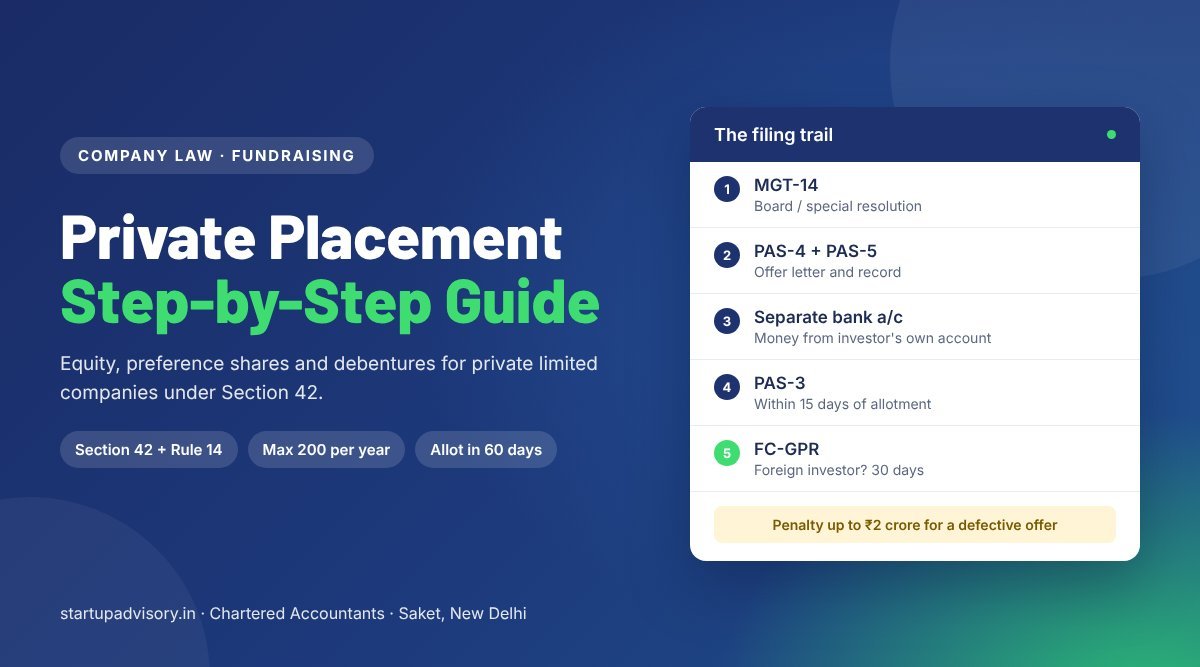
- Missing post-allotment reporting. After shares are issued, the company must report them to the RBI in Form FC-GPR on the FIRMS portal, generally within 30 days of allotment. Late reporting attracts a late submission fee.
10. Step-by-step roadmap for a Nepali citizen company in India
This is the order we follow. The timelines are practical estimates based on experience, not statutory deadlines, and land-border proposals often take several months to clear.
| Step | What happens | Typical time (estimate) |
|---|---|---|
| 1. Eligibility check | Confirm the activity, sector cap and conditions; plan the shareholding, directors and capital | 1–2 weeks |
| 2. Nepal-side advice | Confirm any permission needed in Nepal to invest abroad | Depends on Nepal process |
| 3. Government approval | File on the FIF Portal with KYC, ownership chart, business plan, source of funds and draft MoA/AoA; answer queries | Often several months |
| 4. Incorporation | File SPICe+ with the approved structure; obtain DINs, PAN and TAN | 2–4 weeks after approval |
| 5. Bank account and capital | Open the company’s bank account; receive the inward remittance as approved; issue shares | 2–4 weeks |
| 6. FC-GPR | Report the share issue to the RBI on FIRMS | Within 30 days of allotment |
| 7. Registrations | GST, IEC if importing, Shops & Establishment, trade licence and other sector registrations | 2–6 weeks |
What we recommend
If you are a Nepali citizen planning a company in India, treat the Government approval as the critical path and plan everything else around it. Settle the activity first, and keep it clearly wholesale if you want 100% ownership. Then prepare a clean ownership chart up to the ultimate individuals, and get Nepal-side advice in parallel. Do not incorporate with stand-in Indian shareholders, and do not send money until the approval and bank confirmation are both in hand.
This is the main guide in our series on investment from Nepal and other neighbouring countries. Further articles will be linked here as they are published:
- Press Note 2 (2026) and the 10% beneficial ownership test
- Government route FDI approval on the FIF Portal: step by step
- Setting up a foreign-owned wholesale trading company in India
- Importing garments from Nepal duty-free: rules of origin
- Importing garments and textiles from China: duties and compliance
- FEMA compliance after foreign investment: FC-GPR, FIRMS and FLA
- Shop and establishment registration in Uttar Pradesh for a wholesale business
Related reading: FLA return guide · private placement and FC-GPR · minimum capital for a private limited company
- DPIIT, Consolidated FDI Policy Circular of 2020 (effective 15 October 2020): paras 2.1.24, 3.1.1, 3.1.2, 3.4.1, 4.3.1, 5.2.15.1 and 5.2.15.4, dpiit.gov.in
- DPIIT, Press Note No. 2 (2026 Series), Review of FDI Policy on investments from countries sharing land border with India, dpiit.gov.in
- DPIIT, Press Note No. 3 (2020 Series) of 17 April 2020, as referred to in Press Note 2 (2026)
- RBI, Master Direction – Foreign Investment in India (updated up to 15 June 2026): para 3.2 and the definition of banking channels, rbi.org.in
- Foreign Investment Facilitation Portal, fifp.gov.in
- Companies Act, 2013, sections 3(1)(b) and 149, and the Companies (Incorporation) Rules, 2014, Rule 3, mca.gov.in
- Foreign Exchange Management Act, 1999, section 13 (penalties)
This article is for general information only and reflects the law as on 13 November 2026. It is not legal advice. Please consult a professional before acting.
How Startup Advisory Can Help
Planning to invest in India from a neighbouring country? Startup Advisory, in association with KNAP Advisory Private Limited, can assess your eligibility, file your Government approval application and set up your company end to end. Contact us.
- Eligibility and structure: sector cap, route, shareholding and director plan.
- Government approval: FIF Portal application, ownership chart and query handling.
- Incorporation: company registration with the approved structure.
- After investment: FC-GPR, FLA return, GST and IEC registration.
Call 9311972982 or book a free consultation.