
GST / Returns
GSTR-1 and GSTR-3B Filing Checklist: What to Check Before You File
Reviewed by CA Neeraj Rohilla, FCA — Chartered Accountant, Startup Advisory, Saket, New Delhi.
1. Why reconcile before you file
Every month, four sets of numbers should tell the same story: your books (sales and purchase registers and the general ledger), your GSTR-1, your GSTR-3B, and the ITC records the portal builds for you (GSTR-2B and the Invoice Management System, or IMS).
They are linked. Your GSTR-1 fills your customers’ GSTR-2B, so a missed invoice costs your customer credit. Your GSTR-1 also fills the liability in your own GSTR-3B, and that liability is now locked. And your suppliers’ GSTR-1 fills your GSTR-2B, which is where your ITC starts.
Fixing a figure before filing takes minutes. Fixing it after filing means a later-period adjustment, possibly interest, and sometimes a notice. A filed GSTR-3B cannot be revised. That is why the checks below come before the submit button.
2. GSTR-1 vs GSTR-3B
| GSTR-1 | GSTR-3B | |
|---|---|---|
| Purpose | Statement of outward supplies (section 37) | Summary return with tax payment (section 39) |
| Key information | Invoice-wise B2B supplies, B2C summaries, exports and SEZ supplies, credit and debit notes, amendments, HSN summary (Table 12), documents issued (Table 13) | Outward tax liability (Tables 3.1, 3.1.1, 3.2), reverse charge on purchases (Table 3.1(d)), ITC availed, reversed and reclaimed (Table 4), exempt inward supplies (Table 5), interest and late fee (Table 5.1), payment (Table 6.1) |
| Tax payment | None. It only reports. | Tax is paid and offset here, using the credit and cash ledgers |
| Link to your own liability | Its figures, with GSTR-1A and IFF, auto-populate the liability in your GSTR-3B | Liability auto-populated from GSTR-1/1A/IFF cannot be edited (from the July 2025 tax period) |
| Link to the recipient’s ITC | Your B2B invoices flow into each customer’s GSTR-2B and IMS | Your own ITC is auto-populated from your GSTR-2B. Your supplier must also have paid the tax for your credit to stand (section 16(2)(c)) |
| Frequency | Monthly, or quarterly with optional IFF under QRMP | Monthly, or quarterly under QRMP with PMT-06 payments for the first two months |
3. Before preparing either return
- Right GSTIN, period and frequency. If you have registrations in more than one state, each GSTIN files its own returns. Confirm the tax period and whether that GSTIN is a monthly filer or in the QRMP (Quarterly Return Monthly Payment) scheme for this quarter.
- Complete registers. Every sales invoice, export invoice, credit note and debit note for the period is in the sales register, and every purchase invoice and import document is in the purchase register. Compare invoice numbers with the series used, so nothing sits in a branch or a salesperson’s inbox.
- No missing or duplicate documents. Look for gaps and repeats in invoice series, invoices booked twice in the ERP, and cancelled invoices that were reported anyway.
- Credit notes, debit notes, advances and adjustments. Record credit and debit notes in the period they are issued, and check that each one links to the original invoice. If you received advances for services, check whether tax was due on them and whether an adjustment is needed when the invoice is raised.
- Prior-period errors and open items. Keep a tracker of anything left over from earlier periods: an invoice reported late, ITC deferred because it was not in GSTR-2B, a credit note kept pending in IMS, or an amount you still need to pay with interest. Work these into this period’s returns deliberately, not by accident.
4. GSTR-1 checklist
- B2B or B2C. A supply to a registered person is B2B and must carry the customer’s GSTIN. A sale to an unregistered customer is B2C. Within B2C, inter-state invoices above the B2C (Large) limit are reported invoice-wise; the rest are summarised by state and rate.
- Customer GSTIN and invoice details. Validate each GSTIN on the portal and check that it is active, then check the invoice number, date and value against the invoice. A typo in a GSTIN sends the credit to the wrong business, and it can only be changed in a later GSTR-1, not through GSTR-1A.
- Place of supply and tax type. Place of supply in another state means IGST. Place of supply in your own state means CGST plus SGST. Tax paid under the wrong head is not simply moved across; correct the reporting and pay under the right head.
- Taxable value, rate and tax. Check that the taxable value excludes GST, the rate matches the current rate schedule for that HSN or service code, and the tax amount is arithmetically right. Watch for items whose rates changed during the year.
- Exports and SEZ supplies. Report them as zero-rated, with or without payment of tax as applicable. For exports without tax, check the Letter of Undertaking (LUT) is in force for the year. For goods, include the shipping bill number, date and port code once available.
- Exempt, nil-rated and non-GST supplies. Report them separately in Table 8, split between inter-state and intra-state, and between registered and unregistered recipients. These figures also matter for your ITC reversal under rules 42 and 43.
- Credit notes, debit notes and amendments. Credit and debit notes go in their own tables, linked to the original invoice. Corrections to invoices reported in earlier periods go in the amendment tables. Remember the time limit in section 34(2): a credit note must be declared no later than 30 November following the end of the financial year, or the annual return date if earlier.
- HSN summary (Table 12) and documents issued (Table 13). HSN codes must be reported at 4 or 6 digits depending on your aggregate turnover in the previous year (Notification No. 78/2020-Central Tax). GSTN brought phase 3 of HSN reporting into force from the May 2025 return period and made Table 13 mandatory from the same period. Check that the HSN totals match the invoice tables.
- E-invoices (IRN) where applicable. If e-invoicing applies to you, reconcile the e-invoices generated with the B2B and export entries that the portal has auto-filled into GSTR-1. Look for cancelled IRNs that still appear in your books, invoices issued without an IRN, and manual entries that duplicate an auto-filled one.
- Tie GSTR-1 to the books. Total taxable value and tax in the draft GSTR-1 should equal the sales register and the GST output ledgers in the general ledger, after known timing items. Explain every difference before filing.
5. GSTR-3B checklist
Outward liability
- Reconcile Tables 3.1, 3.1.1 and 3.2 with GSTR-1, GSTR-1A and the books. GSTN made the liability auto-populated from GSTR-1, GSTR-1A and IFF non-editable from the July 2025 tax period (GSTR-3B filed in August 2025). It made the values in Table 3.2 (inter-state supplies to unregistered persons, composition taxpayers and UIN holders) non-editable from the November 2025 tax period. If the auto-populated figure is wrong, file GSTR-1A for the same period and the GSTR-3B figure updates, or report the correction in a later GSTR-1 or IFF.
- What the lock does not cover. The lock applies to liability that comes from your GSTR-1, GSTR-1A or IFF. Reverse-charge tax on your purchases in Table 3.1(d) does not come from GSTR-1, so you still enter and check it yourself. ITC in Table 4 is auto-populated from GSTR-2B but has not been locked: GSTN’s October 2024 advisory said ITC locking would come later through a separate advisory, and we found no such advisory on the GST portal as of 15 November 2026.
- Tax liability breakup. From the February 2026 tax period, the portal auto-fills the “Tax Liability Breakup” on the payment page, using the document dates of supplies from earlier periods that you report now, so that interest can be worked out. GSTN’s March 2026 advisory asks taxpayers to open the tab and click Save before filing.
Reverse charge
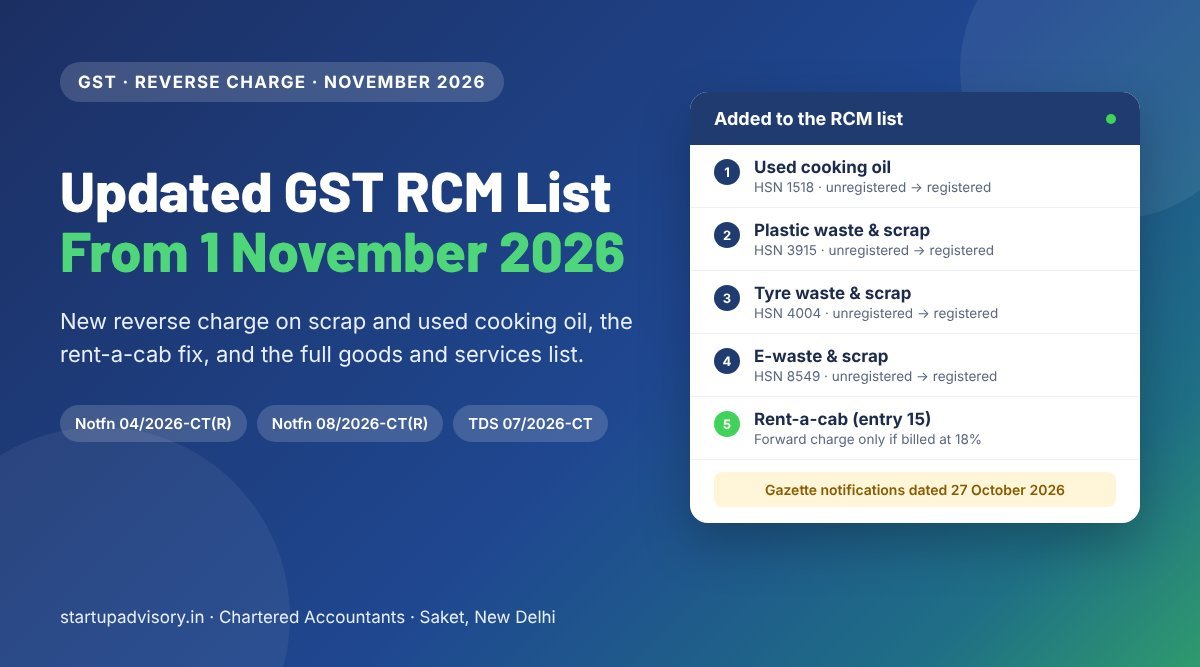
- List every inward supply on which you pay tax under reverse charge: notified goods and services, purchases of notified goods from unregistered persons, and import of services. Note that the reverse-charge list changed from 1 November 2026; see our updated RCM list.
- Reverse-charge tax must be paid in cash, and the ITC on it claimed in Table 4(A)(2) or 4(A)(3) cannot exceed what is supported by Table 3.1(d) and the RCM Liability/ITC Statement on the portal.
ITC: from GSTR-2B to eligible credit
- Reconcile GSTR-2B with the purchase register. GSTR-2B is generated on the 14th of the following month. Match it invoice by invoice with your purchase register. Our free GSTR-2B vs books reconciliation tool does the first pass.
- Remember what GSTR-2B does not prove. Under rule 36(4) and section 16(2)(aa), ITC needs the invoice to be reported by the supplier and communicated in GSTR-2B. That is necessary, but it is not enough. You also need a valid tax invoice, actual receipt of goods or services, tax actually paid by the supplier, your own return filed, and payment to the supplier within 180 days of the invoice date.
- Blocked credits. Remove credits blocked by section 17(5), such as most motor vehicles, food and beverages, club memberships, works contracts for immovable property, and goods for personal use.
- Reversals. Reverse common credit attributable to exempt supplies or non-business use under rules 42 and 43. Reverse ITC where you have not paid the supplier within 180 days. Under rule 37A, reverse ITC by 30 November if the supplier had not filed GSTR-3B for that period by 30 September following the financial year.
- Reclaims. ITC you reverse temporarily goes in Table 4(B)(2) and is reclaimed later in Table 4(A)(5) and 4(D)(1). The portal tracks this in the Electronic Credit Reversal and Re-claimed Statement. GSTN said in December 2025 that excess reclaims beyond the available balance would soon be blocked, so check the statement’s closing balance before you reclaim.
- Imports and ISD credit. IGST on imported goods (Table 4(A)(1)) should be matched with the bills of entry. Credit distributed by an Input Service Distributor (Table 4(A)(4)) should be matched with the ISD’s distribution records.
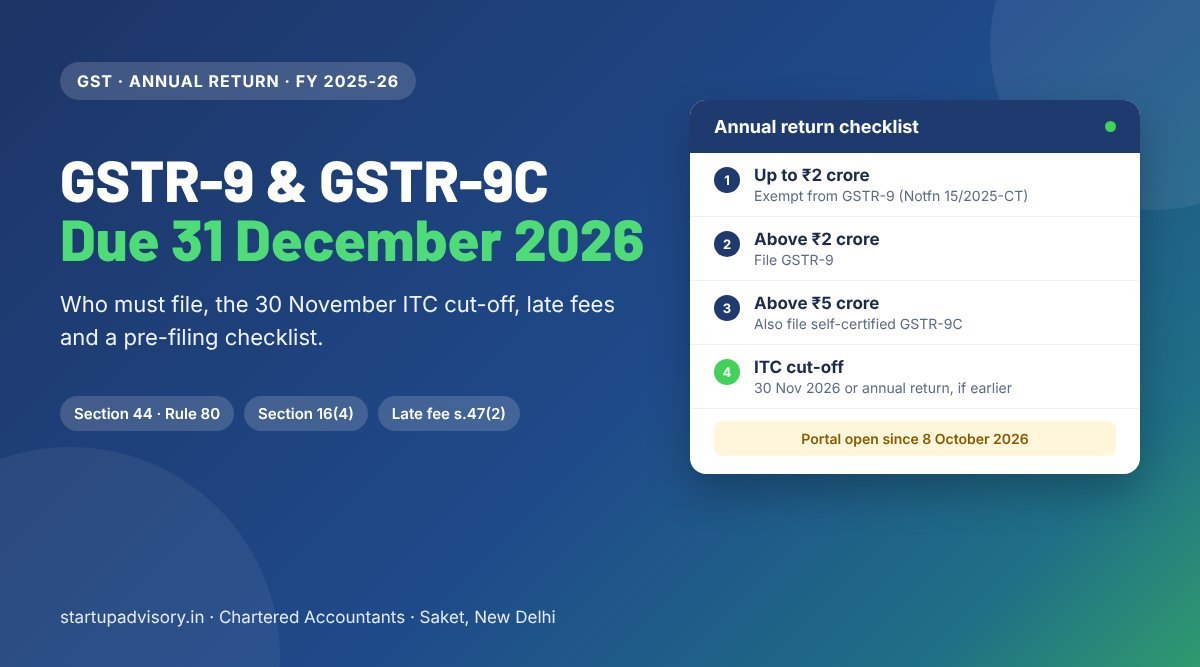
- Time limit. ITC for a financial year cannot be claimed after 30 November following that year, or the date you file the annual return if earlier (section 16(4)).
IMS: what to do this period
- Act before GSTR-3B. In IMS you can accept, reject or keep records pending. Records left without action are treated as accepted when GSTR-2B is generated. You can still change actions after the 14th until you file GSTR-3B, and then recompute GSTR-2B so that the updated ITC flows into GSTR-3B.
- Credit notes. Since the changes GSTN announced in September and October 2025, credit notes and certain downward amendments can be kept pending for one tax period only (one month for monthly filers, one quarter for quarterly filers). When you accept a credit note, you can declare the ITC actually to be reduced, for example where you never claimed the credit on the original invoice.
- Rejections. Reject only with a reason you can document, such as a duplicate invoice, a wrong GSTIN or goods not received, and tell the supplier. If you reject a record by mistake and have filed GSTR-3B, GSTN’s June 2025 FAQ says the supplier can report the same record again through GSTR-1A or a later GSTR-1 amendment, which you then accept.
- Acceptance is not eligibility. Accepting a record in IMS moves the credit into GSTR-2B. Whether you are entitled to it is still decided by sections 16 and 17.
Ledgers, payment, interest and late fee
- Credit ledger and utilisation. Under rule 88A, IGST credit must be used first, for IGST and then for CGST or SGST in any order. CGST and SGST credit can be used only after IGST credit is fully used. CGST credit cannot pay SGST, and SGST credit cannot pay CGST.
- Cash. Reverse-charge tax, interest and late fee are paid in cash. Deposit the challan early enough that the money reaches the electronic cash ledger before you offset.
- Interest. Interest under section 50 runs on tax paid late. For a late return it is charged on the part paid in cash. From the January 2026 tax period, the portal computes interest on a delayed GSTR-3B, allowing for the minimum balance in your cash ledger (rule 88B), and auto-fills it in Table 5.1 of the next return. You cannot reduce that figure. You can increase it if your own working shows more is due. Our GST interest calculator helps you check it.
- Late fee. A late fee under section 47 applies for each day of delay in GSTR-1 and GSTR-3B, at reduced and capped amounts notified by the Government, which depend on turnover and on whether the return is nil. Use our GST late fee calculator for an estimate. The GST Council recommended at its 57th meeting a late-fee waiver for smaller taxpayers who file within the month of the due date; that waiver applies only once it is notified.
- Negative liability and prior-period adjustments. GSTR-3B does not accept negative tax figures. Where credit notes exceed supplies in a period, the excess is not lost; the portal carries it forward for set-off against later liability. We could not find a current GSTN advisory that sets out how this works in detail, so check the position on your return dashboard, and keep your own working of any amount carried forward. For tax relating to an earlier period, the tax liability breakup described above drives the interest calculation.
6. What to do when figures do not match
The difference between correcting before filing and after filing is the most important idea here. Before GSTR-3B is filed, GSTR-1A lets you fix the same period, and the liability updates. Once GSTR-3B is filed, the return stays as it is. The correction goes into a later period’s GSTR-1 and GSTR-3B, with interest where tax was short-paid, or through Form DRC-03 for a voluntary payment. Sections 37(3) and 39(9) stop these corrections after 30 November following the end of the financial year, or the annual return date if earlier.
| Mismatch | What to investigate | Appropriate corrective action | When to act |
|---|---|---|---|
| Books show more sales than GSTR-1 | Invoices not uploaded, e-invoices not auto-filled, branch invoices missed | Before GSTR-3B: add them through GSTR-1A. After GSTR-3B: report in the next GSTR-1 and pay the tax with interest | Same period if possible |
| GSTR-1 shows more than the books | Duplicate uploads, cancelled invoices reported, wrong taxable value or rate | Before GSTR-3B: amend through GSTR-1A. After: amend in a later GSTR-1 or issue a credit note where the conditions are met | Before GSTR-3B |
| Wrong customer GSTIN | Typo, old GSTIN, wrong branch | Amend in the next period’s GSTR-1. GSTR-1A cannot change the recipient GSTIN | Next GSTR-1 |
| IGST charged instead of CGST + SGST, or the reverse | Place of supply, billing vs shipping address | Correct the reporting (GSTR-1A or later amendment) and pay under the correct head; take advice on refund of the tax paid under the wrong head | As soon as found |
| GSTR-3B liability differs from GSTR-1 after filing | Liability reported in the wrong period, missed amendments | Adjust in the next return with interest. A large gap can trigger an intimation in DRC-01B under rule 88C, which blocks the next GSTR-1 until you pay or reply | Next return; reply to any DRC-01B promptly |
| Purchase in books but not in GSTR-2B | Supplier has not filed GSTR-1, wrong GSTIN given, invoice in a later GSTR-2B | Do not claim yet. Follow up with the supplier. Claim when it appears in GSTR-2B, within the section 16(4) time limit | Track monthly |
| In GSTR-2B but not in the books | Not your purchase, invoice not received, booked under a different number | Investigate. Reject in IMS if it is not yours. Do not claim ITC for goods or services not received | Before GSTR-3B |
| Supplier’s credit note in IMS | Whether the discount or return is agreed, and whether you took the original credit | Accept, or keep pending for one tax period, and declare the actual ITC to be reduced | Within the pending window |
| ITC in GSTR-3B exceeds GSTR-2B | Claims made without GSTR-2B support, imports or ISD credit | Reverse unsupported credit. A large gap can trigger DRC-01C under rule 88D, which also blocks GSTR-1 until you pay or explain | Before filing, or in the next return |
| Excess ITC claimed in a filed GSTR-3B | Blocked credit, duplicate claim, credit on an unpaid supplier invoice | Reverse in Table 4(B) of the next GSTR-3B or pay through DRC-03, with interest if the credit was used | Next return |
| ITC missed in a filed GSTR-3B | Invoice overlooked, IMS record kept pending | Claim in a later GSTR-3B | Before 30 November after the financial year |
| Supplier not paid in 180 days, or supplier has not filed GSTR-3B | Ageing of creditors; supplier’s return status | Reverse ITC with interest (180-day rule); reverse by 30 November under rule 37A; re-claim once the condition is met | When the trigger occurs |
The thresholds that trigger DRC-01B and DRC-01C are set in rules 88C and 88D. We could not read the current text of those rules from the official site for this article, so we have not quoted the numbers.
7. GSTR-1A explained
GSTR-1A was introduced by Notification No. 12/2024-Central Tax dated 10 July 2024 and has been available on the portal since August 2024 (starting with the July 2024 period). It sits in the proviso to rule 59(1) of the CGST Rules. In GSTN’s words, it lets a taxpayer add or amend supplies of the current tax period that were missed or wrongly reported in GSTR-1, before filing GSTR-3B for that period.
| Point | Position |
|---|---|
| Is it compulsory? | No. It is optional |
| How many times? | Once for a tax period |
| Opens (monthly filers) | From the GSTR-1 due date or the date GSTR-1 is actually filed, whichever is later |
| Opens (QRMP) | Quarterly, after the quarterly GSTR-1 is filed or its due date, whichever is later |
| Closes | When GSTR-3B for the same period is filed. There is no other cut-off date |
| What it can do | Add missed supplies, and amend invoice-wise and consolidated details and credit and debit notes of the current period, including (for QRMP) records uploaded through IFF in the first two months |
| What it cannot do | Change the recipient’s GSTIN (do that in a later GSTR-1); amend IFF records during the first two months of a quarter; be filed after GSTR-3B |
| Effect on your GSTR-3B | The net of GSTR-1 and GSTR-1A is auto-populated in GSTR-3B of the same period, including Table 3.2, and updates immediately |
| Effect on the recipient | Supplies added or amended through GSTR-1A appear in the recipient’s GSTR-2B for the next tax period |
That last row matters when you deal with customers. If you add a missed October invoice through GSTR-1A, your customer sees it in their November GSTR-2B, not October’s. Tell them, so they do not chase you or claim early.
8. Filing calendar
These are the normal statutory dates. The Government sometimes extends a date by notification, and recent extensions have applied only to certain states or districts. Always check the GST portal for the specific tax period and your taxpayer category before you rely on an extension.
Monthly filers
| Return | Due date | Example: November 2026 period |
|---|---|---|
| GSTR-1 | 11th of the next month | 11 December 2026 |
| GSTR-1A (optional) | After GSTR-1, before GSTR-3B | Between filing GSTR-1 and filing GSTR-3B |
| GSTR-2B generated | 14th of the next month | 14 December 2026 |
| GSTR-3B and payment | 20th of the next month (rule 61) | 20 December 2026 |
QRMP taxpayers
| Return | Due date | Example: October to December 2026 quarter |
|---|---|---|
| IFF (optional) for months 1 and 2 | 1st to 13th of the next month, up to ₹50 lakh of invoices a month (rule 59(2)) | October: 13 November 2026. November: 13 December 2026 |
| PMT-06 tax payment for months 1 and 2 | 25th of the next month (rule 61(3)) | 25 November 2026 and 25 December 2026 |
| GSTR-1 (quarterly) | 13th of the month after the quarter | 13 January 2027 |
| GSTR-1A (optional) | After quarterly GSTR-1, before quarterly GSTR-3B | From 13 January 2027 (or GSTR-1 filing, if later) |
| GSTR-3B (quarterly) | 22nd or 24th of the month after the quarter, by state (rule 61) | 22 January 2027 for the southern and western states listed in rule 61, such as Maharashtra, Gujarat, Karnataka, Kerala and Tamil Nadu. 24 January 2027 for the others, including Delhi |
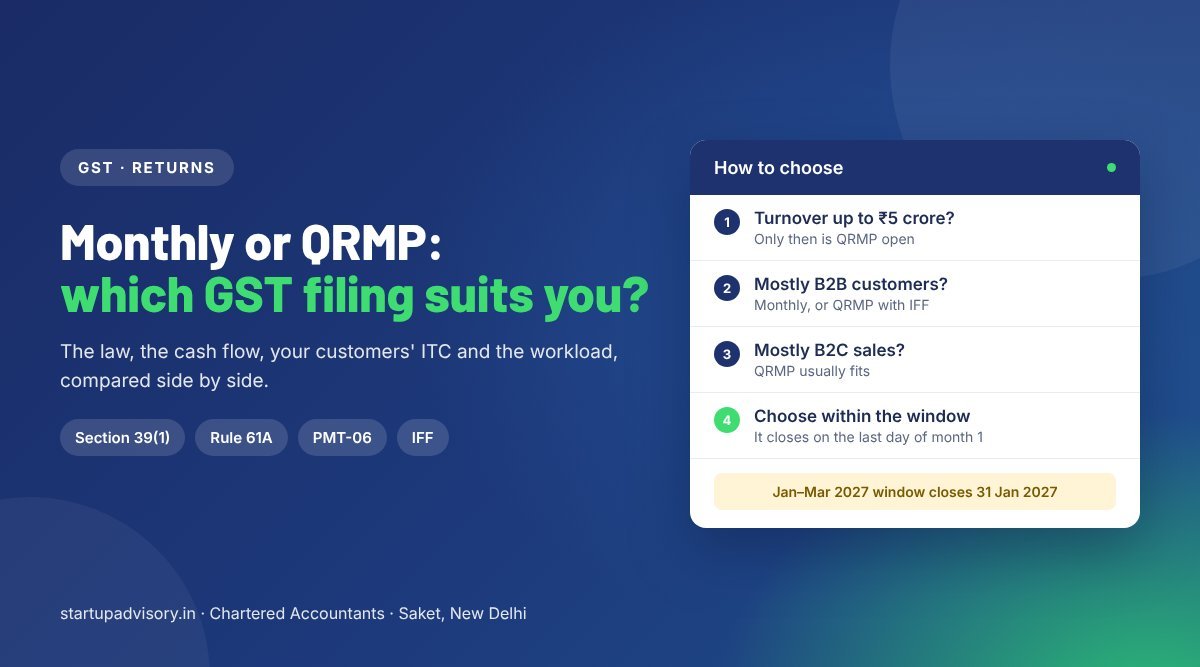
Also keep in mind: GSTR-1 cannot be filed while the previous period’s GSTR-3B is pending (rule 59(6)), GSTR-3B cannot be filed before that period’s GSTR-1 (section 39(10)), and from the July 2025 tax period returns cannot be filed at all once three years have passed from their due date (sections 37(5) and 39(11)). For the full year’s dates, see our GST and TDS compliance calendar. Not sure whether monthly filing or QRMP suits you? See our monthly vs QRMP guide.
9. Final review and post-filing records
- Review the preview. Download the draft GSTR-1 and the system-generated GSTR-3B summary. Compare them with your working papers line by line, especially the auto-populated liability, Table 3.2, ITC, interest and late fee.
- Get approval. The person responsible, such as the finance head, a partner or a director, reviews the reconciliation and the open items list and approves the figures in writing or by email before filing.
- File and confirm. File with DSC or EVC. Check that the status shows “Filed” on the return dashboard and that the payment has been offset. A saved draft is not a filed return.
- Save the evidence. Keep the ARN, the filed GSTR-1, GSTR-1A and GSTR-3B PDFs, the GSTR-2B used, the IMS action report, challans and ledger statements for the period.
- Keep the workings. File the reconciliations (books vs GSTR-1, GSTR-2B vs purchases, ITC computation) and update the unresolved-items tracker with anything carried forward: invoices to follow up, credit notes pending in IMS, reversals to reclaim, and amounts to pay with interest.
10. Common mistakes
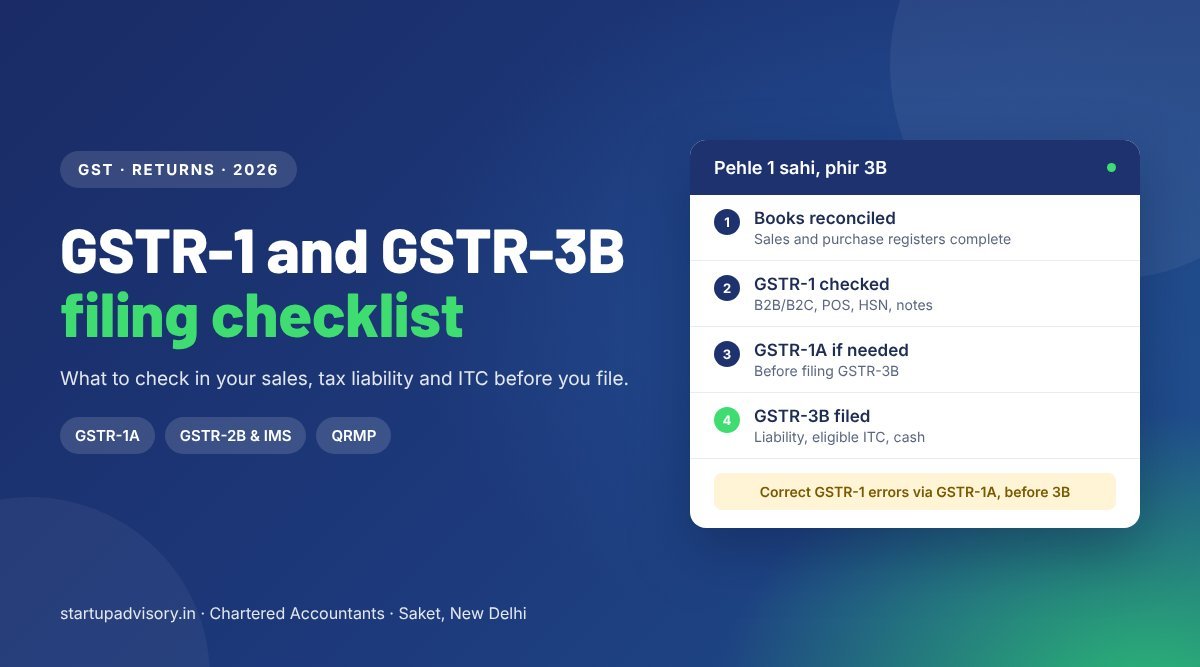
- Filing GSTR-1 in a hurry and planning to “fix it in 3B”. That stopped working with the July 2025 lock. Pehle 1 sahi, phir 3B.
- Forgetting GSTR-1A exists, then carrying a known error into GSTR-3B.
- Treating GSTR-2B as proof of eligibility and claiming blocked credits or credit on goods never received.
- Leaving IMS untouched every month, so wrong invoices are deemed accepted.
- Accepting a credit note in IMS and letting the full GST be reduced when no ITC was ever taken on the original invoice.
- Paying reverse-charge tax from the credit ledger, or claiming RCM credit before paying the tax.
- Reporting a customer’s wrong GSTIN and trying to fix it in GSTR-1A, which cannot change it.
- Relying on an extension announced for other states or districts.
- Not keeping the ARN, reconciliations and the open-items tracker, and then struggling to answer a DRC-01B, DRC-01C or scrutiny notice a year later.
- GSTN, Advisory for FORM GSTR-1A (26 July 2024)
- GSTN, Hard-locking of auto-populated liability in GSTR-3B (17 October 2024) and Advisory regarding non-editable auto-populated liability in GSTR-3B (7 June 2025)
- GSTN, Advisory on reporting values in Table 3.2 of GSTR-3B (5 December 2025)
- GSTN, Barring of GST return on expiry of three years (7 June 2025)
- GSTN, New changes in IMS (23 September 2025), Important advisory on IMS (8 October 2025), Pending option for credit notes (17 October 2025) and Handling of inadvertently rejected records (19 June 2025)
- GSTN, HSN codes in Table 12 and documents in Table 13 (1 May 2025)
- GSTN, Electronic Credit Reversal and Re-claimed Statement and RCM Liability/ITC Statement (29 December 2025)
- GSTN, Interest collection and related enhancements in GSTR-3B (30 January 2026) and Confirmation of tax liability breakup in GSTR-3B (16 March 2026)
- CBIC, CGST Act, 2017: sections 16, 34, 37, 39 and 50; CGST Rules, 2017: rules 36, 37A, 59, 61 and 88A, read on taxinformation.cbic.gov.in on 15 November 2026
This article is general information, not tax advice. It reflects the CGST Act and Rules and GSTN advisories as read on 15 November 2026. Portal functionality changes often, so check the latest advisories on the GST portal before you file.
How Startup Advisory Can Help
Startup Advisory, in association with KNAP Advisory Private Limited, is a CA-led firm in Saket, New Delhi that runs GST compliance for businesses, freelancers and finance teams across Delhi NCR:
- Monthly or quarterly returns: GSTR-1, GSTR-1A, IFF and GSTR-3B prepared from your books and filed on time.
- Reconciliation: books vs GSTR-1, GSTR-2B and IMS vs purchases, with an open-items tracker you can see.
- Notices: replies to DRC-01B, DRC-01C and scrutiny notices, with the working papers to back them.
Call 9311972982 or book a free consultation.