
Virtual CFO
Startup Financial Model: What Investors Check Before a Term Sheet

Most founders build a financial model because an investor asked for one. Most investors open it for a different reason: to see how well the founders understand their own business. A model that is tidy but disconnected from the books, or that grows revenue faster than the team could possibly sell, raises more questions than it answers.
This guide sets out what an investor typically tests, in roughly the order they test it, and what you can fix before you send the file. It is written for Indian startups raising a seed, pre-Series A or Series A round, and it complements our due diligence checklist for startup fundraising, which covers the legal and secretarial side.
1. What is a startup financial model, and what should it contain?
A startup financial model is a spreadsheet that turns your assumptions about customers, pricing, costs and hiring into a projected profit and loss account, balance sheet and cash flow. Every output should be calculated from an input, so that changing one assumption flows through to cash.
A model an investor can work with usually has these sheets:
| Sheet | What it holds | What the investor looks for |
|---|---|---|
| Assumptions (drivers) | Leads, conversion, price, churn, salaries, hiring dates, payment terms | Every number in one place, with a note on where it comes from |
| Revenue build | Customers or orders by month, multiplied by price, by product or channel | Revenue calculated bottom up, not typed in as a growth percentage |
| Headcount and costs | Hiring plan by role, salaries, marketing, rent, tools | Costs that rise with the plan; the hiring plan matches the use of funds |
| Profit and loss | Monthly and annual P&L | Gross margin and contribution margin, not just EBITDA |
| Cash flow and balance sheet | Collections, payments, GST and TDS timing, closing cash | A balance sheet that balances and a cash line that drives runway |
| Actuals | The last 12 to 24 months from your books | Projections that start from where you really are |
| Cap table and round | Shareholding before and after the round, ESOP pool | Dilution that matches the term sheet you are asking for |
2. What do investors check first?
The assumptions, because everything else depends on them. An experienced investor will often skip the summary and open the drivers sheet to ask three questions: where does each number come from, does it match the actuals, and how sensitive is the result to it?
- Revenue drivers tie to evidence. If you assume a 3% website conversion rate, your analytics should show something close to it. If you assume enterprise deals close in 60 days, your last few deals should support that.
- Price and volume are separate. Revenue should be customers or orders multiplied by price, so an investor can test each one.
- Growth has a cause. More revenue needs more sales people, more marketing spend or more capacity. If revenue triples and costs stay flat, expect a hard question.
- The first months match the books. If the model's opening cash or last quarter's revenue differs from your accounts, the investor stops trusting the rest.
3. Which numbers do investors test most closely?
The ones that show whether growth creates value or burns it. The exact list depends on your business model, but these come up in almost every Indian early-stage raise:
| Metric | What it shows | What raises a flag |
|---|---|---|
| Gross margin | Revenue left after direct costs (cloud, delivery, payment gateway, cost of goods) | Margin that improves sharply in the projection with no reason given |
| Customer acquisition cost (CAC) | Sales and marketing spend per new customer | CAC calculated on paid channels only, leaving out salaries and agency fees |
| CAC payback | Months of gross profit needed to recover CAC | Payback longer than a typical customer stays |
| Retention and churn | How many customers, or how much revenue, you keep each month | No cohort data behind the churn assumption |
| Net burn | Cash going out minus cash coming in each month | Burn that falls in the plan just as hiring rises |
| Runway | Months until cash runs out at the planned burn | A round that does not reach the next milestone with a buffer |
| Working capital | Days to collect from customers and pay suppliers | Every invoice assumed to be collected in the month it is raised |
Define each metric once, in writing, and use the same definition in the deck, the model and your monthly MIS. Investors notice when “revenue” in the deck is gross merchandise value and “revenue” in the model is net of discounts and GST.
4. How should the model connect the round to runway and milestones?
Directly. The amount you are raising should come out of the model, not go into it. Investors want to see that the cash from the round, at the planned burn, gets the company to a specific milestone with room to spare.
- Start from the milestone. Decide what the next round needs to see, for example a revenue run rate, a number of paying customers or a product launch, and work out when the plan reaches it.
- Add a buffer. Fundraising takes time, so the cash should last well beyond the milestone date. State the buffer you have assumed.
- Show the use of funds. Split the round into hiring, marketing, product and working capital, and make the split match the cost sheets month by month.
- Show cash out dates. A simple chart of closing cash by month in each scenario answers most runway questions before they are asked.
5. What scenarios should the model show?
At least three: a base case you expect to deliver, a downside case and an upside case. The downside case matters most, because it shows the investor you know what you would cut and when.
| Scenario | What usually changes | The question it answers |
|---|---|---|
| Base | Your planned drivers | Does the round reach the milestone with a buffer? |
| Downside | Slower customer growth, longer sales cycles, higher churn, later collections | How long does the cash last, and which costs would you cut first? |
| Upside | Faster growth with the extra hiring and working capital it needs | Does faster growth need more cash sooner? |
Build scenarios with a switch on the assumptions sheet rather than separate copies of the file. One model with a scenario selector is easier to check and keeps the outputs consistent.
6. How does the model connect to valuation and the cap table?
The model supports the valuation story, but it is not the valuation. The price of the round is negotiated with the investor; the projections are what the investor tests to decide whether the price is reasonable.
Two places where the model and the legal paperwork meet:
- Dilution. The cap table sheet should show shareholding before and after the round, including any ESOP pool the term sheet asks for. As a simple illustration, if investors put in ₹10 crore at a pre-money valuation of ₹40 crore, the post-money valuation is ₹50 crore and the new investors hold 20% (10 ÷ 50). If the term sheet also asks for a new ESOP pool to be created before the round, the founders’ dilution is larger than 20%.
- Foreign investors and the pricing floor. When an unlisted Indian company issues shares to a person resident outside India, para 8.1.1 of the RBI Master Direction – Foreign Investment in India (updated up to 15 June 2026) says the price should not be less than “the valuation of equity instruments done as per any internationally accepted pricing methodology for valuation on an arm's length basis duly certified by a Chartered Accountant or a SEBI registered Merchant Banker or a practicing Cost Accountant”. For convertible instruments, para 8.1.2 requires the price or conversion formula to be fixed upfront, and the conversion price cannot be lower than the fair value worked out at the time of issue.
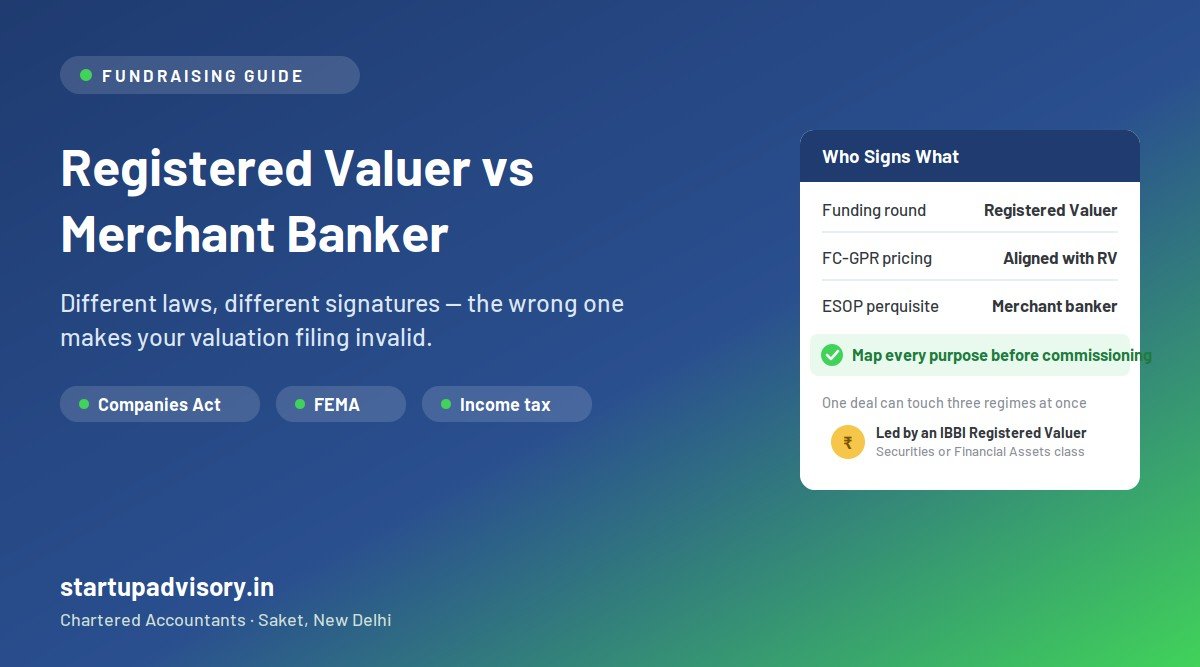
A valuer using a discounted cash flow method will usually ask for your projections, so a well-built model also makes the valuation report quicker and easier to defend. Which professional can sign which valuation is explained in registered valuer vs merchant banker.
7. What mistakes cost founders credibility?
Mostly mistakes of consistency rather than ambition. Investors expect optimism; they do not expect numbers that contradict each other.
- Hard-coded revenue. A growth rate typed into a cell instead of a revenue build from drivers.
- Costs without tax and statutory costs. Salaries without the employer’s provident fund and other statutory contributions, purchases without GST, and payments without TDS timing.
- Revenue counted as cash. No gap between invoicing and collection, which overstates runway, especially for B2B and government customers.
- Hiring that does not match salaries. A plan that adds 20 people while the salary line barely moves.
- No reconciliation to the books. Opening balances that differ from the last audited or management accounts.
- Too much detail in the wrong place. Fifty product lines projected for five years, but no monthly cash view for the next 18 months.
8. What should you check before sending the model to an investor?
Run through this list the day before you share the file, or ask someone outside the founding team to do it:
- The balance sheet balances in every month and every scenario.
- Opening cash, revenue and costs agree with your books for the latest closed month.
- Every input sits on the assumptions sheet, clearly marked, with a source note.
- Revenue, gross margin, burn and runway match the figures in your pitch deck.
- The round amount, use of funds and post-money cap table match the term sheet you are asking for.
- The downside scenario shows a cash-out date and the actions you would take.
- The file opens cleanly, with no broken links to other workbooks and no hidden sheets you would not want an investor to see.
Once the model is in the data room, keep it updated monthly with actuals. A monthly comparison of plan against actual is one of the first things an investor will ask for after the round, and it is much easier if the model and your books already talk to each other. For the wider preparation, see how a virtual CFO prepares a startup for fundraising.
How Startup Advisory can help
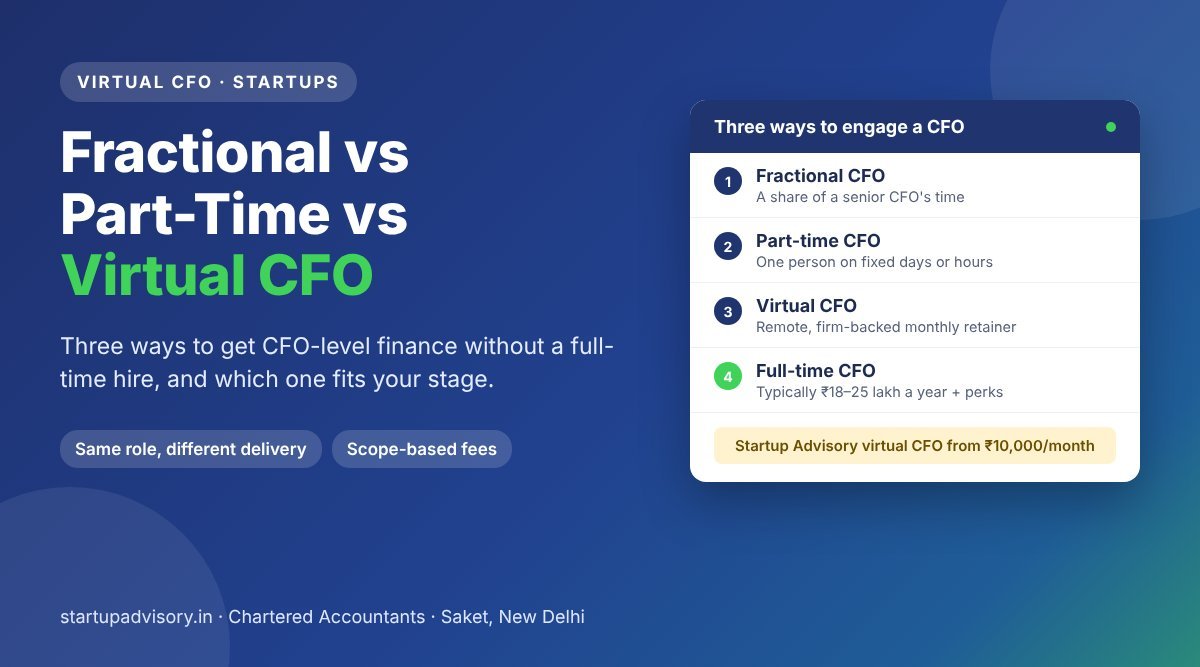
Startup Advisory is a CA-led firm in Saket, New Delhi. Our virtual CFO service builds investor-ready financial models for startups across Delhi, Gurugram, Noida, Greater Noida, Ghaziabad and Faridabad. The Fundraise & Scale tier, from ₹45,000 a month, includes the financial model and projections, the investor deck, data-room support and due-diligence support; the lower tiers and what moves a quote are explained in virtual CFO cost in India. If your books need work first, our bookkeeping team can bring them up to date. Book a free consultation or call 9311972982.
Sources and scope
- Reserve Bank of India, Master Direction – Foreign Investment in India (FED Master Direction No. 11/2017-18, updated up to 15 June 2026), paras 8.1.1 and 8.1.2 on pricing guidelines.
- Startup Advisory, Virtual CFO services: plans and pricing and published price list (Fundraise & Scale tier and inclusions).
Prepared 13 November 2026. The metrics, sheets and checks above describe common investor practice and are guidance, not legal requirements; each investor has its own process. The dilution example is a simple illustration, not a market benchmark. Prices are Startup Advisory’s published starting prices for Delhi NCR; the final fee depends on the agreed scope.