
Company Law / Share Capital
Mandatory Dematerialisation of Shares for Private Limited Companies: The Complete Rule 9B Guide (2026)
Reviewed by CA Neeraj Rohilla, FCA — Chartered Accountant, Startup Advisory, Saket, New Delhi.
- The law: Section 29 and Rule 9B
- Who is covered, and who is not
- Deadlines, including the extensions
- What the company and shareholders must do
- Rule 9A duties that now apply
- Step-by-step procedure
- Documents checklist
- Form PAS-6
- Penalty for non-compliance
- Advantages of demat
- Disadvantages and practical pain points
- Voluntary demat for small companies
- Grey areas to watch
For decades, a private limited company in India could run its whole share register on paper: printed certificates, a bound register of members, and a share transfer deed in Form SH-4 for every sale. That changed for most mid-sized private companies with a notification the Ministry of Corporate Affairs issued on 27 October 2023. Two and a half years on, many founders still find out about it only when an investor’s lawyer asks for the company’s ISIN, or when a shareholder’s sale cannot go through. This guide sets out the rule as it stands on 11 November 2026, checked against the notifications on the MCA website.
1. The law: Section 29 and Rule 9B
Section 29 of the Companies Act, 2013 governs the form in which securities are held. Section 29(1A) lets the Central Government prescribe classes of unlisted companies whose securities must be held and transferred only in dematerialised form under the Depositories Act, 1996. Section 29(2) lets any other company convert to demat if it chooses.
Using these powers, the MCA first made demat compulsory for unlisted public companies through Rule 9A (from 2 October 2018). It then extended the requirement to private companies through G.S.R. 802(E) dated 27 October 2023, the Companies (Prospectus and Allotment of Securities) Second Amendment Rules, 2023, which inserted Rule 9B, “Issue of securities in dematerialised form by private companies”. It came into force on publication in the Gazette, the same day.
Rule 9B has six sub-rules:
| Sub-rule | What it says (in plain terms) |
|---|---|
| 9B(1) | Every private company, other than a small company, must within the period in sub-rule (2) (a) issue securities only in dematerialised form, and (b) facilitate dematerialisation of all its securities, under the Depositories Act, 1996 and its regulations. |
| 9B(2) | A private company that, on the last day of a financial year ending on or after 31 March 2023, is not a small company as per its audited financial statements must comply within 18 months of the close of that financial year. Two provisos were added later: five years for producer companies (2024) and 30 June 2025 for companies not small on 31 March 2023 (2025). |
| 9B(3) | After its compliance date, before making any offer for issue of securities, a buy-back, a bonus issue or a rights offer, the company must ensure the entire holding of its promoters, directors and key managerial personnel is in demat. |
| 9B(4) | On or after the compliance date, a holder who wants to transfer securities must demat them first, and a holder who subscribes to any securities (private placement, bonus or rights) must first hold all existing securities in demat. |
| 9B(5) | Sub-rules (4) to (10) of Rule 9A (ISIN, fees, PAS-6, grievances and so on) apply to private companies mutatis mutandis. |
| 9B(6) | The rule does not apply to a Government company. |
2. Who is covered, and who is not
The whole rule turns on the definition of small company in Section 2(85) of the Act, read with Rule 2(1)(t) of the Companies (Specification of Definitions Details) Rules, 2014. A small company is a private company whose:
- paid-up share capital does not exceed ₹10 crore, and
- turnover (as per the last profit and loss account) does not exceed ₹100 crore.
These limits were raised from ₹4 crore and ₹40 crore by G.S.R. 880(E) dated 1 December 2025, effective on publication. Both tests must be met. So a company with ₹2 crore of capital and ₹120 crore of turnover is not small, and is covered.
Even inside the limits, Section 2(85) says these companies can never be small companies, so Rule 9B catches them whatever their size:
- a holding company or a subsidiary company, including the Indian subsidiary of a foreign parent and a startup that has set up its own subsidiary;
- a Section 8 company (with share capital);
- a company governed by a special Act.
Who is outside the rule: small companies (unless they opt in under Section 29(2)), Government companies (Rule 9B(6)), and unlisted public companies, which are covered by the older Rule 9A instead. Rule 9B has no separate carve-out for wholly owned subsidiaries; the Rule 9A(11) exemption for wholly owned subsidiaries is written for unlisted public companies and is not borrowed by Rule 9B(5), which applies only sub-rules (4) to (10).
3. Deadlines, including the extensions
The basic rule is 18 months from the close of the first financial year (ending on or after 31 March 2023) on which the company is not small, tested on audited financial statements. Two later notifications changed this:
- G.S.R. 583(E) dated 20 September 2024 (Companies (Prospectus and Allotment of Securities) Amendment Rules, 2024) gave producer companies five years from the close of the relevant financial year.
- G.S.R. 131(E) dated 12 February 2025 (Companies (Prospectus and Allotment of Securities) Amendment Rules, 2025) said that a private company, other than a producer company, which was not a small company as on 31 March 2023 may comply by 30 June 2025. The notification was given retrospective effect, which covered companies that had missed the original 30 September 2024 date.
| First year-end on which the company is not small | Last date to comply | Small company test used |
|---|---|---|
| 31 March 2023 | 30 June 2025 (originally 30 Sep 2024; extended by G.S.R. 131(E)) | ₹4 crore / ₹40 crore |
| 31 March 2024 | 30 September 2025 | ₹4 crore / ₹40 crore |
| 31 March 2025 | 30 September 2026 | ₹4 crore / ₹40 crore |
| 31 March 2026 | 30 September 2027 | ₹10 crore / ₹100 crore |
| Producer company, not small on 31 March 2023 | 31 March 2028 (five years) | ₹4 crore / ₹40 crore |
We checked the MCA’s notifications list on 11 November 2026. The latest amendment to the Prospectus and Allotment of Securities Rules is still G.S.R. 131(E) of 12 February 2025; no further extension has been notified. A company whose date has passed is therefore already in default and should complete the process now rather than wait for relief.
4. What the company and its shareholders must do
The company
- Issue every new security only in demat form from its compliance date. That covers equity shares, preference shares (including CCPS), debentures and any other “securities” it issues. Fresh allotments are credited to the allottees’ demat accounts; no physical certificate is printed.
- Facilitate demat of all existing securities, which in practice means obtaining an ISIN for each type of security, signing up with the depositories through an RTA, and telling shareholders how to convert.
- Get promoters, directors and KMP fully into demat before any further issue, buy-back, bonus or rights offer (Rule 9B(3)). The company is not obliged to force other shareholders to convert, but it cannot raise money until this group has.
The shareholders
- No transfer of physical shares after the compliance date. A seller must demat first; the buyer receives the shares in demat.
- No subscription while holding physical shares. A shareholder who wants to take up a rights issue, a private placement or even bonus shares must first convert all their existing holding.
- A shareholder who does nothing keeps valid physical shares, but they are frozen in practice: they can be held, not sold.
5. The Rule 9A duties that now apply to private companies
Rule 9B(5) imports sub-rules (4) to (10) of Rule 9A. In practice these are the continuing obligations:
| Rule 9A | Obligation |
|---|---|
| (4) | Apply to a depository and secure an ISIN for each type of security; inform all existing security holders of the facility. |
| (5) | Pay the depositories’ and RTA’s admission and annual fees on time; keep a security deposit of at least two years’ fees with them; follow SEBI and depository directions. |
| (6) | A company in default of (5) cannot issue securities, buy back, or make a bonus or rights issue until the dues are paid. |
| (7) | The Depositories Act, 1996, the SEBI (Depositories and Participants) Regulations and the SEBI RTA Regulations apply. |
| (8) | File Form PAS-6 with the Registrar within 60 days of the end of each half year, certified by a practising CS or CA. |
| (8A) | Immediately report to the depositories any difference between issued capital and capital held in demat. |
| (9)–(10) | Shareholder grievances go to the Investor Education and Protection Fund Authority, which acts against a depository, DP or RTA after consulting SEBI. |
6. Step-by-step procedure
From a standing start, the process usually takes four to eight weeks, most of it spent on record clean-up and the depositories’ review. Here is the sequence we follow:
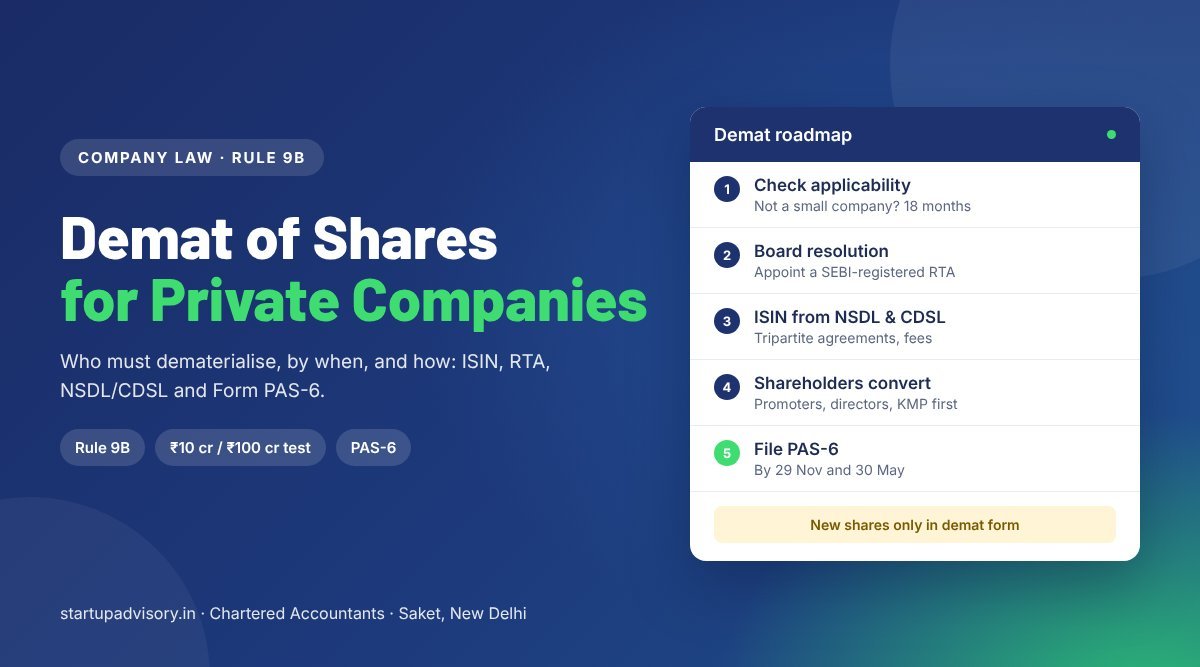
- Confirm applicability and your date. Take the audited balance sheet and profit and loss account for each year-end from 31 March 2023 and test paid-up capital, turnover and holding/subsidiary status. Note the first year-end on which the company was not small; your deadline is 18 months later (or 30 June 2025 for 31 March 2023).
- Board resolution. Approve dematerialisation of all securities, appointment of a SEBI-registered Registrar and Share Transfer Agent (RTA), ISIN applications to NSDL and CDSL, execution of the tripartite agreements, payment of fees and the security deposit, and the officers authorised to sign.
- Appoint the RTA and clean up the register. This is where most time goes. Reconcile the register of members with every allotment (PAS-3), transfer (SH-4), transmission and the shareholding reported in MGT-7. Fix mismatched names, missing PANs, unstamped transfer deeds and lost certificates (issue duplicates under your articles) before you apply.
- Review the articles of association. Private company restrictions on transfer (pre-emption, board approval, ROFR) survive demat, but the RTA has to know them. Some companies amend their articles to refer expressly to holding securities in depository mode and to the register of beneficial owners.
- Apply for ISIN. Through the RTA, file the application with each depository for every type of security (equity, each series of preference shares, debentures). Sign the tripartite agreement (company, depository, RTA) with NSDL and with CDSL, and pay the one-time admission fee, the annual fee and the security deposit. Both depositories publish their current fee schedules; ask your RTA for an all-in quote.
- ISIN allotted and activated. The depository allots a 12-character ISIN (it begins with “INE” for company securities) and activates it once the RTA has connectivity. Inform every security holder in writing of the ISIN and how to dematerialise, as Rule 9A(4) requires.
- Promoters, directors and KMP convert first. Each opens a demat account with any depository participant (a bank or broker), and submits a Demat Request Form (DRF) with the original certificates, defaced “Surrendered for Dematerialisation”. The DP sends the request electronically and the physical papers to the RTA, the RTA checks them against the register and confirms, and the shares are credited.
- Convert the remaining shareholders. Same process. For NRI shareholders, the DP account must be the right type (NRE/NRO or a foreign-investor account) consistent with FEMA reporting. Track who has converted and who has not.
- Allot new securities only in demat. Collect allottees’ demat details (DP ID and client ID) with the application, file PAS-3 as usual, then credit the shares through a corporate action processed by the RTA with the depositories.
- Reconcile and file PAS-6. Every half year, reconcile issued capital with holdings at NSDL, CDSL and in physical form, report any difference to the depositories, and file Form PAS-6 within 60 days.
7. Documents checklist for the ISIN application
Each depository and RTA has its own forms, but expect to provide:
- Certificate of incorporation, memorandum and articles of association, PAN and CIN;
- Latest audited financial statements and the shareholding pattern;
- Certified copy of the board resolution described above;
- Copies of return of allotment filings (PAS-3) and any capital changes (SH-7), so that issued capital ties up with the MCA record;
- Details of the authorised signatories, the compliance officer and contact persons, with KYC;
- Where the depository asks, a certificate from a practising CS or CA on the capital structure and on compliance with the Companies Act for each issue;
- The signed tripartite agreements and proof of fee and deposit payment.
8. Form PAS-6: the half-yearly reconciliation
PAS-6 is the reconciliation of share capital audit report. It shows, for each ISIN, the issued capital and how much of it is held in NSDL, in CDSL and in physical form, with reasons for any difference. It must be certified by a practising company secretary or chartered accountant and filed on the MCA portal with the normal fee.
| Half year | PAS-6 due |
|---|---|
| 1 April to 30 September | 29 November (next: 29 November 2026) |
| 1 October to 31 March | 30 May (next: 30 May 2027) |
A late PAS-6 attracts the MCA’s additional fees for delayed filing under the Companies (Registration Offices and Fees) Rules, 2014. File it on time even if very few shareholders have converted yet; the form records the position, it does not require 100% demat.
9. Penalty for non-compliance
Neither Section 29 nor Rule 9B carries its own penalty, so the residual penalty in Section 450 of the Companies Act, 2013 applies: ₹10,000 on the company and on every officer in default, plus ₹1,000 per day while the default continues, capped at ₹2 lakh for the company and ₹50,000 for each officer. Adjudication is by the Registrar of Companies.
The money is rarely the real problem. A non-compliant company cannot raise capital, issue ESOP shares, buy back or issue bonus or rights shares, and its shareholders cannot sell. That usually surfaces during investor due diligence, at the worst possible moment. See our due diligence checklist for startup fundraising.
10. Advantages of dematerialisation
- No lost, torn or forged certificates. Ownership sits in the depository system, and the depository’s record is the register of beneficial owners, deemed to be the register of members under Section 88(3).
- Faster, cleaner transfers. An off-market transfer is a delivery instruction between demat accounts, not a stamped SH-4 deed sent to the company.
- Lower stamp duty on transfers. Under the Indian Stamp Act as amended from 1 July 2020, stamp duty on an off-market transfer of demat securities is 0.015%, collected through the depository, against 0.25% on a physical share transfer deed.
- Investor readiness. Venture capital, private equity and most angel networks expect shares in demat. An ISIN already in place removes a condition precedent from the term sheet.
- Easier ESOPs, secondaries and pledges. ESOP allotments, buy-backs from early employees, secondary sales and share pledges for loans all run faster through a depository.
- Clean records and transparency. Half-yearly reconciliation forces the register, the MCA record and the depository record to agree, which helps in audits, valuations and FEMA filings.
- Easier transmission. Nominations recorded with the DP simplify passing shares on after a shareholder’s death.
11. Disadvantages and practical pain points
- Cost that recurs. RTA fees, depository admission and annual fees, the two-year security deposit and professional fees for PAS-6 certification twice a year. For a company with a handful of shareholders this is a noticeable fixed cost.
- Every shareholder needs a demat account. Elderly shareholders, NRIs, foreign investors and corporate holders all need DP accounts, and some will be slow to cooperate.
- Old record problems come to the surface. Unstamped or missing transfer deeds, unallotted share application money, lost certificates and deceased shareholders must be resolved before conversion.
- Fundraising takes a little longer. Allottees must have demat accounts, and the corporate action to credit shares adds a step after allotment.
- Transfer restrictions need active management. The depository system does not itself enforce a private company’s pre-emption or board-approval clauses, so the company and RTA must build in checks.
- An ongoing compliance calendar. PAS-6 every half year, reconciliation and fee payments do not end once conversion is done.
12. Voluntary dematerialisation for small companies
A small company is not required to demat, but Section 29(2) lets any company convert its securities into dematerialised form under the Depositories Act, 1996, or issue new securities in demat form, if it wishes. The process is the same as in section 6: board resolution, RTA, ISIN with NSDL and CDSL, and shareholder conversion.
When it makes sense to opt in early:
- A funding round is coming. Investors usually ask for demat shares, and getting an ISIN takes weeks. Do it before the term sheet, not after.
- You are likely to cross the limits of ₹10 crore paid-up capital or ₹100 crore turnover, or to set up a subsidiary or be acquired by a group, any of which ends small company status.
- ESOPs or frequent share movements are planned: allotments, buy-backs and secondaries are simpler in demat.
- Many shareholders, or shareholders spread across cities and countries, where paper certificates are hard to manage.
When it may not: a closely held company with two or three founder shareholders, no funding plans and no share movement may reasonably wait, since the recurring cost buys little. Remember that once you obtain an ISIN, the depositories’ fee and reconciliation requirements apply to you as to any other admitted company; ask your RTA which filings they will expect.
13. Grey areas to watch
- Falling back under the limits. Many companies that were not small under the ₹4 crore / ₹40 crore test became small after the December 2025 increase. Rule 9B does not say whether the obligation then lapses. The cautious view is that once triggered, it continues; some practitioners disagree. Do not unwind a demat set-up on the strength of the new limits without advice.
- Transmission. Rule 9B(4) speaks of transfer and subscription, not transmission on death. Transmission of physical shares to legal heirs is generally still processed, but the heir must demat before any later sale.
- Bonus shares to physical holders. Rule 9B(4)(b) expressly includes bonus shares, so a shareholder who still holds physical shares cannot receive a bonus allotment until they convert. Plan bonus issues after shareholder conversion.
- Dormant or untraceable shareholders. The rule offers no route to compulsorily dematerialise their shares. Keep a record of the notices you send them.
What we recommend
- If your company is a subsidiary or holding company, or crossed the small company limits on any year-end since 31 March 2023, assume Rule 9B applies and check your date in the table above today.
- If the date has passed, start the RTA appointment and record clean-up now; there is no pending extension.
- Diarise PAS-6 for 29 November 2026 if you already have an ISIN.
- If you are a small company planning to raise funds in the next 12 months, get the ISIN in place before the round.
- MCA notification G.S.R. 802(E) dated 27 October 2023, Companies (Prospectus and Allotment of Securities) Second Amendment Rules, 2023 (inserting Rule 9B), Gazette of India, Extraordinary, Part II, Section 3(i), No. 624
- MCA notification G.S.R. 583(E) dated 20 September 2024, Companies (Prospectus and Allotment of Securities) Amendment Rules, 2024 (five years for producer companies)
- MCA notification G.S.R. 131(E) dated 12 February 2025, Companies (Prospectus and Allotment of Securities) Amendment Rules, 2025 (30 June 2025 for companies not small on 31 March 2023)
- MCA notification G.S.R. 880(E) dated 1 December 2025, Companies (Specification of Definitions Details) Amendment Rules, 2025 (small company limits of ₹10 crore and ₹100 crore)
- All four read on the MCA notifications page, mca.gov.in, on 11 November 2026
- Companies Act, 2013: Sections 2(85), 29, 88(3) and 450; Companies (Prospectus and Allotment of Securities) Rules, 2014, Rules 9A and 9B and Form PAS-6
- Depositories Act, 1996
This article is general information, not legal advice. It reflects the Companies (Prospectus and Allotment of Securities) Rules, 2014 as amended up to G.S.R. 131(E) of 12 February 2025 and the small company limits notified by G.S.R. 880(E) of 1 December 2025, as checked on the MCA website on 11 November 2026. Depository and RTA procedures and fees change from time to time. Confirm your company’s position with a qualified professional before acting.
How Startup Advisory Can Help
Startup Advisory is a CA-led firm in Saket, New Delhi working with private limited companies and startups across Delhi NCR:
- Rule 9B applicability check: we test each year-end since 31 March 2023 and tell you your exact date.
- End-to-end demat: board resolutions, RTA coordination, register clean-up, ISIN with NSDL and CDSL, and shareholder conversion.
- PAS-6 and ongoing compliance: half-yearly reconciliation and filing, alongside your ROC annual filings.
- Fundraising readiness: demat, cap table and secretarial due diligence before a round, with a Virtual CFO for the numbers.
Call 9311972982 or book a free consultation.