
Company Law / Small Companies
Small Company Benefits You Lose as a Holding or Subsidiary Company (Even Within ₹10 Crore / ₹100 Crore)
Reviewed by CA Neeraj Rohilla, FCA — Chartered Accountant, Startup Advisory, Saket, New Delhi.
- The rule: the Section 2(85) proviso
- When is a company a holding or subsidiary?
- At a glance: what you lose, what you can save
- Cash flow statement
- Board meetings
- Annual return: MGT-7 instead of MGT-7A
- Abridged Board’s report
- Audit: CARO, IFC and auditor rotation
- Half penalties under Section 446B
- Fast-track merger: mostly still open
- Mandatory demat under Rule 9B
- Other group rules that start to bite
- Three worked examples
- What to do when you enter a group
When the MCA raised the small company limits to ₹10 crore of paid-up capital and ₹100 crore of turnover in December 2025, a large number of private companies became “small” overnight. We wrote about what that changed for FY 2025-26 audits in our guide to CARO and the cash flow statement under the new limits. This article is about the companies that the higher limits did not help: those that are part of a group. A two-founder startup that sets up a subsidiary, the Indian arm of a foreign company, a company owned by an LLP: none of them is a small company, and many of their founders do not know it. We checked every provision below against the Companies Act, 2013 and the notifications on the MCA website on 11 November 2026.
1. The rule: the proviso to Section 2(85)
Section 2(85) of the Companies Act, 2013 defines a small company as a company, other than a public company, whose paid-up share capital and turnover (as per the profit and loss account for the immediately preceding financial year) do not exceed the limits prescribed in Rule 2(1)(t) of the Companies (Specification of Definitions Details) Rules, 2014. Since G.S.R. 880(E) dated 1 December 2025, those limits are ₹10 crore and ₹100 crore, which is also the ceiling the Act itself allows.
The definition then carves out three kinds of company:
The carve-out is absolute. There is no size test, no exception for wholly owned subsidiaries and no exception for dormant parents. If the company is a holding or a subsidiary company, it is not a small company, and every provision of the Act that gives relief to “a small company” stops applying to it. Note that both sides of the relationship lose the status: the parent and the subsidiary.
2. When is a company a holding or subsidiary company?
Under Section 2(87), company B is a subsidiary of company A if A:
- controls the composition of B’s Board of Directors, or
- exercises or controls more than one-half of B’s total voting power, either on its own or together with one or more of its subsidiaries.
Section 2(46) then makes A the holding company of B. Points that catch people out:
- Foreign parents count. The Explanation to Section 2(87) says “company” includes any body corporate. The Indian private company of a foreign group is a subsidiary, so it is never small.
- LLP parents count too. An LLP is a body corporate, so a private company in which an LLP holds more than half the voting power is a subsidiary.
- Step-down subsidiaries count. Control through another subsidiary is enough (Explanation (a)), so every company in a chain is a holding or subsidiary company.
- Board control alone is enough. A minority shareholder company with the right to appoint or remove a majority of directors makes the company its subsidiary.
- Individuals do not create the relationship. If the same two founders personally own two companies, neither is a subsidiary of the other, and both can be small companies.
- Associates and 50:50 joint ventures are not subsidiaries, unless there is board control. Exactly 50% is not “more than one-half”.
3. At a glance: what you lose and what you can save
This table compares a small company with a private holding or subsidiary company that is inside the ₹10 crore / ₹100 crore limits.
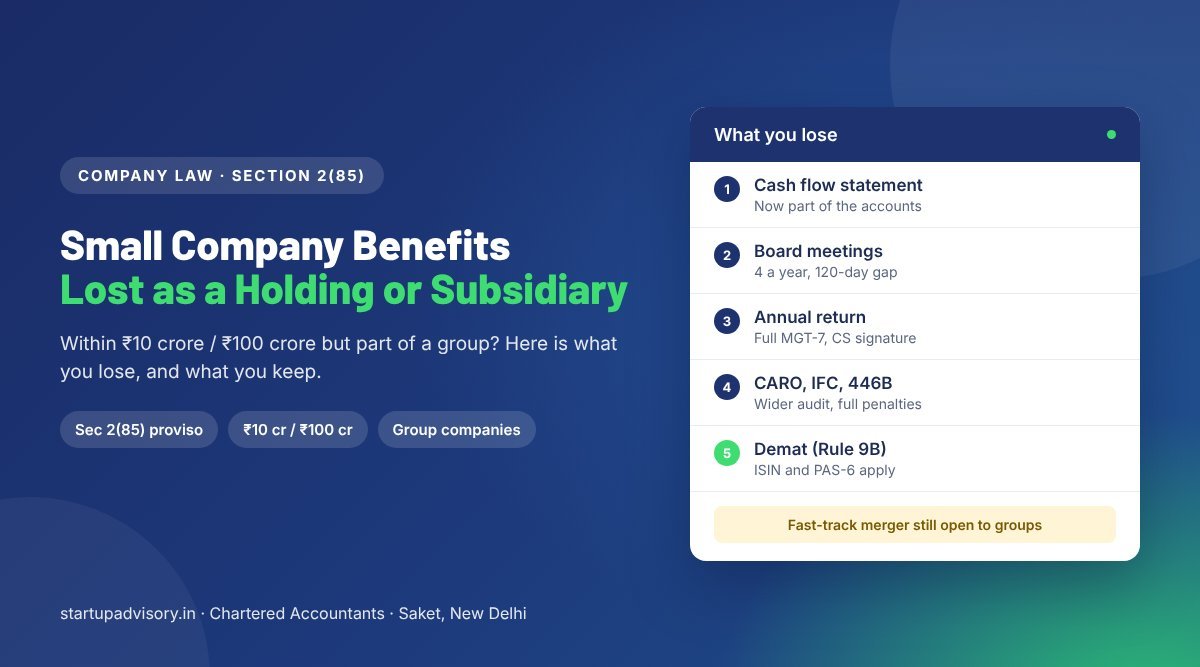
| Benefit | Law | Small company | Holding / subsidiary within the limits | Other route that may save it |
|---|---|---|---|---|
| No cash flow statement | s.2(40) proviso | Exempt | Must prepare one | DPIIT start-up (G.S.R. 583(E), 2017); dormant company |
| Two board meetings a year | s.173(5) | One per half-year, 90-day gap | Four a year, max 120-day gap | DPIIT start-up (G.S.R. 583(E), 2017) |
| Abridged annual return | s.92(1); Rule 11(1) | Form MGT-7A | Full Form MGT-7 | None |
| Annual return signed by a director alone (where no CS) | s.92(1) proviso | Director can sign | Director + CS, or a CS in practice | DPIIT start-up (G.S.R. 583(E), 2017) |
| Abridged Board’s report | Rule 8A, Accounts Rules | Allowed | Full report under s.134(3) | None (OPCs and small companies only) |
| No CARO 2020 report | CARO para 1(2) | Excluded | Applies | Private company not linked to a public company, within ₹1 cr / ₹1 cr / ₹10 cr |
| No IFC opinion | s.143(3)(i) | Exempt | Depends on size | Private company with turnover < ₹50 cr and borrowings < ₹25 cr |
| No auditor rotation | s.139(2); Rule 5 | Excluded | Only if Rule 5 thresholds are met | Most small subsidiaries are below them anyway |
| Half penalties | s.446B | Half, capped at ₹2 lakh / ₹1 lakh | Full penalty | DPIIT start-up or producer company |
| Fast-track merger | s.233; Rule 25 | Small with small | Group routes | Holding–subsidiary and fellow-subsidiary routes (G.S.R. 603(E), 2025) |
| No mandatory demat | Rule 9B, PAS Rules | Exempt | Demat within 18 months of year-end | None (only Government companies are excluded) |
4. Cash flow statement
Section 2(40) says a financial statement includes a cash flow statement. Its proviso lets a One Person Company, small company and dormant company leave it out. The MCA’s private company exemption notification, G.S.R. 583(E) dated 13 June 2017, substituted that proviso for private companies to add a private company that is a start-up recognised by DPIIT.
A subsidiary or holding company is not a small company, so it must include a cash flow statement in its financial statements (and the auditor reports on it), unless it qualifies through one of the other limbs:
- it is a DPIIT-recognised start-up, or
- it has been granted dormant company status under Section 455.
One condition attaches to the start-up route: paragraph 2A of the 2015 notification, inserted by the same 2017 amendment, makes all private company exemptions available only to a private company that has not defaulted in filing its financial statements (Section 137) or annual return (Section 92).
5. Board meetings
Section 173(1) requires every company to hold its first board meeting within 30 days of incorporation and then at least four board meetings every year, with not more than 120 days between two consecutive meetings. Section 173(5) deems a One Person Company, small company or dormant company to comply if it holds one meeting in each half of the calendar year, with a gap of not less than 90 days. G.S.R. 583(E) of 2017 extended Section 173(5) to private companies that are start-ups.
So a subsidiary that is not a recognised start-up must move from two meetings to four, and plan them so that no gap exceeds 120 days. A missed meeting is a default under Section 173, and, as discussed below, the penalty is no longer halved. Virtual meetings are allowed, which makes four meetings easier to run for a small team.
6. Annual return: Form MGT-7 instead of MGT-7A
Three small company reliefs in the annual return disappear:
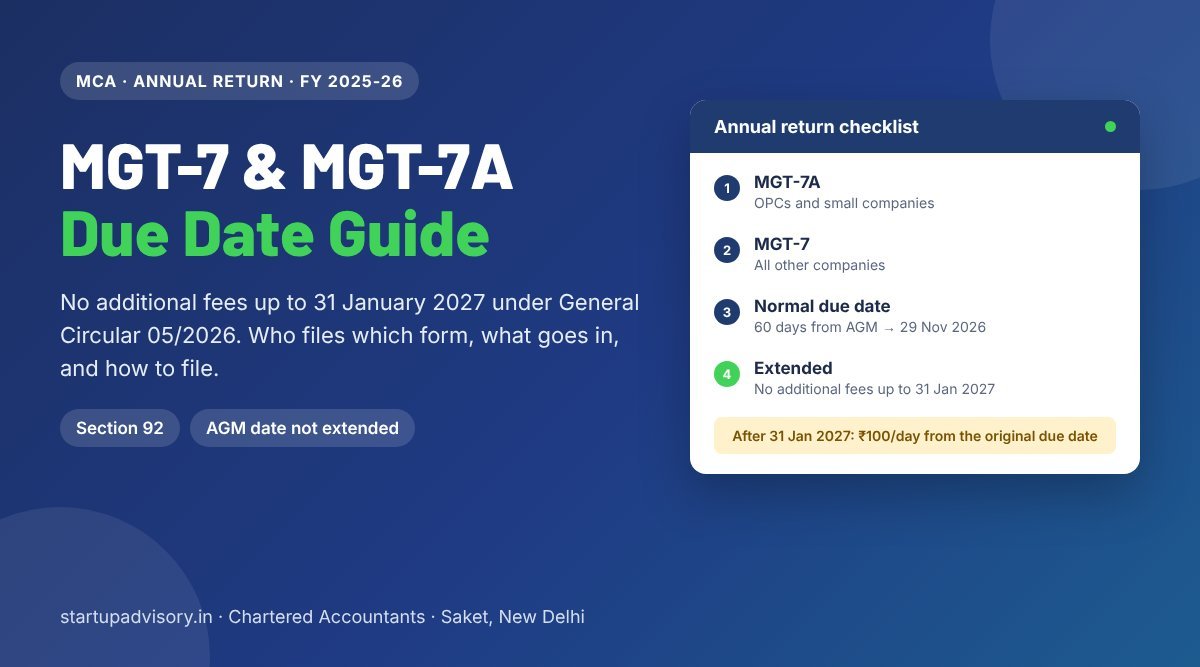
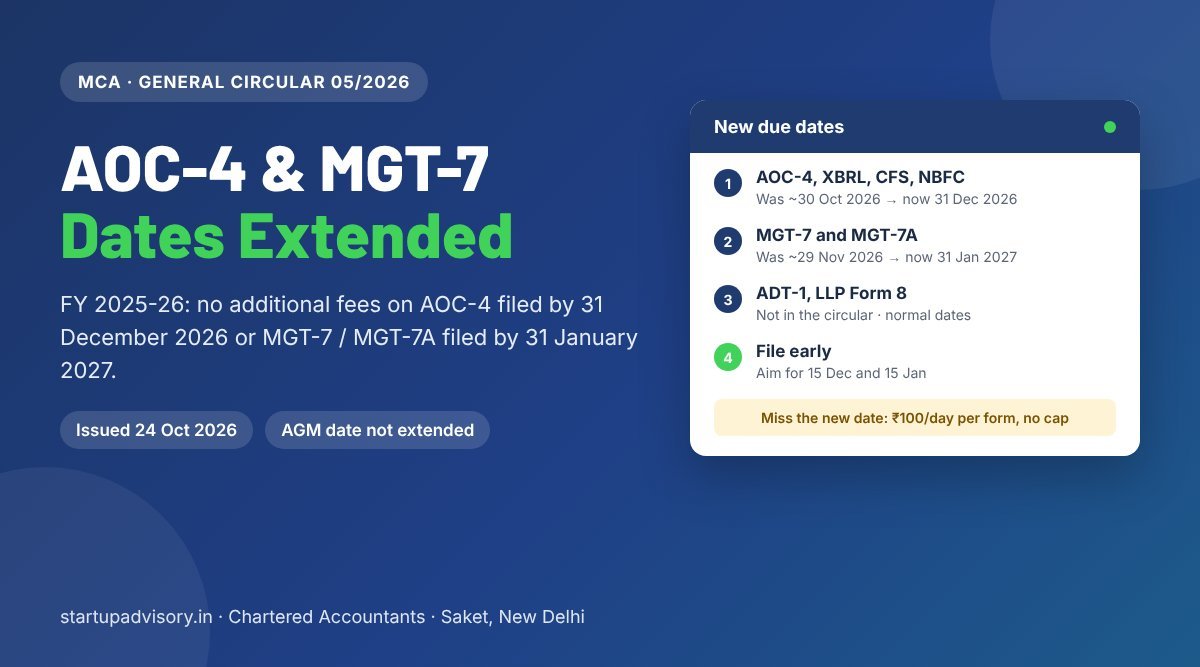
- The form. Rule 11(1) of the Companies (Management and Administration) Rules, 2014 gives OPCs and small companies the abridged Form MGT-7A. A holding or subsidiary company files the full Form MGT-7, which asks for more detail on shareholders, meetings, directors and KMP. See our guide to MGT-7 and MGT-7A for FY 2025-26; the due date for FY 2025-26 is 31 January 2027 after the MCA’s extension.
- Who signs. Section 92(1) requires the annual return to be signed by a director and the company secretary, or, where there is no company secretary, by a company secretary in practice. Its proviso lets a small company (and OPC) have it signed by the director alone where it has no company secretary. A group company without a whole-time CS therefore needs a practising CS to sign every year. Private start-ups keep the relaxation under G.S.R. 583(E) of 2017.
- Directors’ remuneration. The same notification lets small private companies report only the aggregate remuneration drawn by directors under Section 92(1)(g).
7. Abridged Board’s report
Rule 8A of the Companies (Accounts) Rules, 2014 allows a One Person Company and a small company to prepare a short Board’s report covering a limited list of matters. A holding or subsidiary company must prepare the full report under Section 134(3) and Rule 8, including the conservation of energy and technology absorption disclosures, the details of related party contracts in Form AOC-2 and, for a holding company, the performance of its subsidiaries. There is no start-up equivalent for Rule 8A.
8. Audit: CARO, internal financial controls and auditor rotation
CARO 2020
Paragraph 1(2) of the Companies (Auditor’s Report) Order, 2020 excludes, among others, a small company. A group company loses that exclusion. But the same paragraph has a second exclusion that is worth checking: a private company that is not a holding or subsidiary company of a public company, with paid-up capital plus reserves and surplus of not more than ₹1 crore, borrowings from banks or financial institutions of not more than ₹1 crore at any time in the year, and total revenue of not more than ₹10 crore. A small subsidiary of an Indian private company can still fall within it; a subsidiary of an Indian public company cannot.
Internal financial controls (IFC)
Section 143(3)(i) asks the auditor to report on the adequacy and operating effectiveness of internal financial controls. G.S.R. 583(E) of 2017 switched this off for a private company that is (i) an OPC or small company, or (ii) has turnover below ₹50 crore as per its latest audited financial statements and aggregate borrowings from banks, financial institutions or any body corporate below ₹25 crore at all times in the year. The word “and” comes from the MCA’s corrigendum S.O. 2218(E) dated 13 July 2017, which replaced the original “or”. A private subsidiary within both limits therefore keeps the IFC exemption, provided it has no default in filing its financial statements or annual return. Watch inter-company loans from the parent: they are borrowings from a body corporate and count towards ₹25 crore.
Auditor rotation
Section 139(2) rotation applies only to listed companies and the classes in Rule 5 of the Companies (Audit and Auditors) Rules, 2014, which for private companies means paid-up capital of ₹50 crore or more, or public borrowings from banks, financial institutions or public deposits of ₹50 crore or more. Rule 5 excludes OPCs and small companies. In practice a subsidiary inside the ₹10 crore capital limit only gets caught if its borrowings reach ₹50 crore, so this loss rarely bites.
What does not change: the statutory audit itself, the audit trail requirement and the auditor’s Rule 11(g) reporting, which apply to small and group companies alike. Our statutory audit preparation checklist covers the rest.
9. Half penalties under Section 446B
Section 446B, as substituted by the Companies (Amendment) Act, 2020, says that where a penalty is payable by a One Person Company, small company, start-up company or Producer Company, or its officer in default, the penalty shall be not more than one-half of the penalty specified, subject to a maximum of ₹2 lakh for the company and ₹1 lakh for an officer or other person. A “start-up company” here means a private company recognised as a start-up by DPIIT.
A holding or subsidiary company that is not a recognised start-up or producer company pays the full penalty. That matters most for continuing defaults, where daily penalties run up quickly: late board meetings, a missed MGT-7, a delayed register update or a missed Rule 9B deadline.
10. Fast-track merger: mostly still open to groups
Section 233 lets certain companies merge without going to the NCLT: two or more small companies, a holding company and its wholly-owned subsidiary, and other classes prescribed in Rule 25(1A) of the Companies (Compromises, Arrangements and Amalgamations) Rules, 2016. A group company cannot use the small company route, but it usually does not need to. G.S.R. 603(E) dated 4 September 2025 added these classes to Rule 25(1A):
- one or more unlisted companies (other than Section 8 companies) merging with each other, where each has aggregate outstanding loans, debentures or deposits of up to ₹200 crore and no default in repaying them, backed by an auditor’s certificate in Form CAA-10A;
- a holding company and a subsidiary company (not only a wholly-owned one), where the transferor is not listed;
- one or more subsidiaries of the same holding company, where the transferors are not listed; and
- a foreign holding company merging into its Indian wholly-owned subsidiary under Rule 25A(5).
So for most unlisted groups, the loss of small company status does not close the fast-track route. The approval thresholds (90% of shares, majority in value of creditors, declarations of solvency) still apply.
11. Mandatory demat under Rule 9B
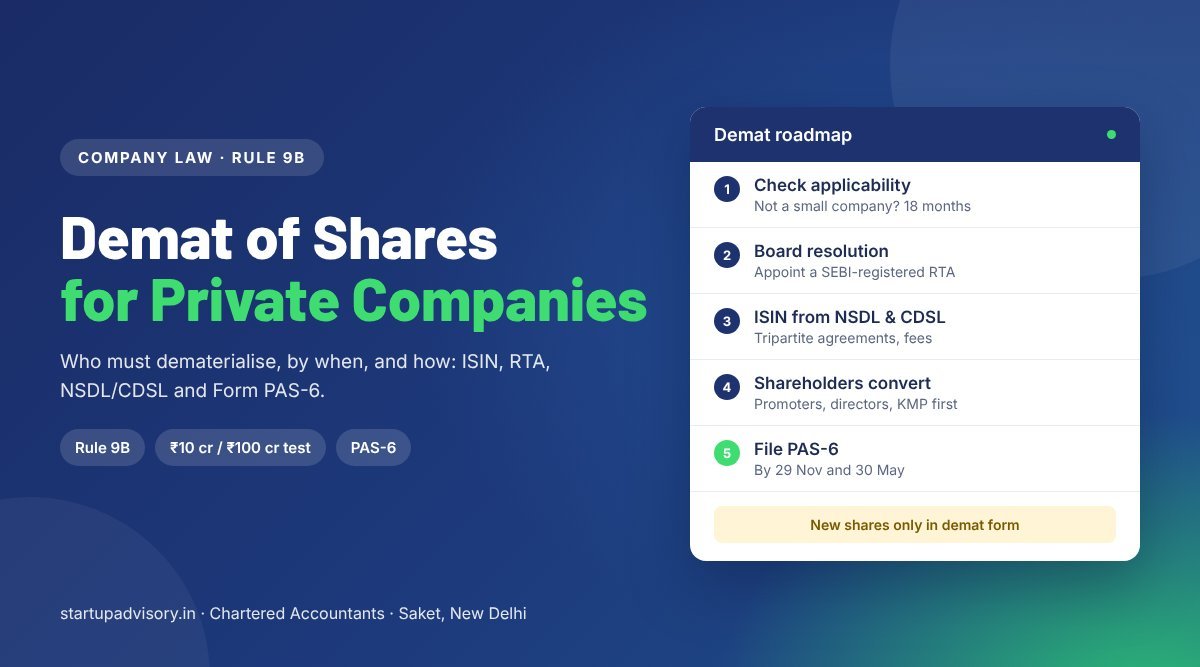
Rule 9B of the Companies (Prospectus and Allotment of Securities) Rules, 2014 requires every private company other than a small company (and a Government company) to issue securities only in demat form and facilitate dematerialisation of all its securities within 18 months of the close of the financial year on which it is not a small company. A holding or subsidiary company is never small, so the clock starts from the first year-end (on or after 31 March 2023) on which the relationship existed. There is no carve-out for wholly-owned subsidiaries.
This is the costliest loss for most small group companies: an RTA, ISINs from NSDL and CDSL, shareholder conversion and a half-yearly Form PAS-6. Our complete Rule 9B demat guide sets out the deadlines, the step-by-step process and the penalty.
12. Other group rules that start to bite
These are not small company exemptions as such, but they arrive with the holding or subsidiary relationship and belong on the same checklist:
- Consolidated financial statements. A holding company must prepare consolidated financial statements under Section 129(3), subject to the limited exemptions in Rule 6 of the Companies (Accounts) Rules, 2014 for certain intermediate unlisted subsidiaries.
- Related party transactions. The parent, the subsidiary and fellow subsidiaries are related parties under Section 2(76), so inter-company sales, loans, shared staff and cost recharges need Section 188 and Section 186 analysis and disclosure.
- Deposits from members. Under the private company exemption notification, one of the routes to accept deposits from members without the Section 73(2) conditions is closed to a company that is an associate or subsidiary of another company; the other routes (within 100% of capital and reserves, or a start-up within five years) remain.
- Accounting Standards. Under the Companies (Accounting Standards) Rules, 2021, a company that is a holding or subsidiary of a company that is not a Small and Medium-sized Company (SMC) cannot itself be an SMC, so the Indian subsidiary of a large group may lose the SMC relaxations even though its own numbers are small.
- Layers. The Companies (Restriction on Number of Layers) Rules, 2017 limit holding companies to two layers of subsidiaries, with exceptions.
13. Three worked examples
| Company | Facts | Small company? | What applies |
|---|---|---|---|
| A Pvt Ltd | ₹1 crore capital, ₹20 crore turnover, 99.9% owned by a Singapore company | No (subsidiary of a body corporate) | Cash flow statement, four board meetings, MGT-7 signed by a director and a CS or practising CS, full Board’s report, full penalties, Rule 9B demat. CARO: likely applies (turnover above ₹10 crore). IFC: exempt (turnover below ₹50 crore, if borrowings, including any parent loan, stay below ₹25 crore). |
| B Pvt Ltd and its new subsidiary B Labs Pvt Ltd | B: ₹10 lakh capital, ₹6 crore turnover, owned by two founders. B Labs: 100% owned by B, no revenue yet | No for both | Both lose the small company reliefs from the date B Labs became a subsidiary. B Labs may still fall within the CARO ₹1 crore / ₹1 crore / ₹10 crore exclusion because B is a private company. B prepares consolidated financial statements. Both start the Rule 9B clock from the first 31 March on which the relationship exists. A future merger can use the fast-track route. |
| C Pvt Ltd | Subsidiary of an LLP, DPIIT-recognised start-up, all filings up to date | No | Keeps the cash flow statement exemption, two board meetings a year, the director-only signature on the annual return and half penalties, all through the start-up limb. Still files full MGT-7, full Board’s report and is covered by Rule 9B demat. |
14. What to do when your company enters a group
- Confirm the relationship. Map who holds more than half the voting power, or controls the Board, of your company and of every company your company has invested in. Include foreign companies and LLPs.
- Record the date it began. The allotment, transfer or board change that created the relationship tells you which financial year and which meetings are affected.
- Check the start-up route. If the company is, or can become, a DPIIT-recognised start-up, the cash flow statement, board meeting, annual return signature and Section 446B reliefs come back. Keep every ROC filing on time, because a filing default switches off the private company exemptions.
- Reset the board calendar to four meetings a year with no gap over 120 days.
- Brief your auditor on the cash flow statement, CARO, IFC and, for a holding company, consolidation, before the year-end, not at signing.
- Switch to MGT-7 and arrange a CS or practising CS signature for the annual return.
- Diarise the Rule 9B deadline: 18 months from the first year-end on which the company was a holding or subsidiary company.
- Review inter-company arrangements for related party approvals, loan limits and transfer pricing, and document them.
What we recommend
- Before you set up a subsidiary or accept a corporate investor with more than 50%, add the compliance cost of losing small company status to the business case. For many early-stage groups the demat and audit costs alone change the answer.
- If your company is already in a group and has been running small company compliance, fix FY 2025-26 now: the AOC-4 due date is 31 December 2026 and MGT-7 is due by 31 January 2027.
- If your group company is a DPIIT-recognised start-up, protect that status and your filing record, because it rescues four of the reliefs.
- Companies Act, 2013: Sections 2(40), 2(46), 2(85), 2(87), 92(1), 173(1) and (5), 233 and 446B, read on the MCA Acts e-book, mca.gov.in, on 11 November 2026
- MCA notification G.S.R. 583(E) dated 13 June 2017, amending the private company exemption notification G.S.R. 464(E) of 5 June 2015 (start-up limb for Sections 2(40), 92(1) and 173(5); IFC exemption under Section 143(3)(i); paragraph 2A filing-default condition)
- MCA corrigendum S.O. 2218(E) dated 13 July 2017 (“statement and” for “statement or” in the IFC exemption)
- MCA notification G.S.R. 603(E) dated 4 September 2025, Companies (Compromises, Arrangements and Amalgamations) Amendment Rules, 2025 (new Rule 25(1A) fast-track classes)
- MCA notification G.S.R. 880(E) dated 1 December 2025, Companies (Specification of Definitions Details) Amendment Rules, 2025 (small company limits of ₹10 crore and ₹100 crore)
- All notifications read on the MCA notifications page, mca.gov.in, on 11 November 2026
- Companies (Management and Administration) Rules, 2014, Rule 11; Companies (Accounts) Rules, 2014, Rules 6 and 8A; Companies (Audit and Auditors) Rules, 2014, Rule 5; Companies (Auditor’s Report) Order, 2020, paragraph 1(2); Companies (Prospectus and Allotment of Securities) Rules, 2014, Rule 9B; Companies (Accounting Standards) Rules, 2021
This article is general information, not legal advice. It reflects the Companies Act, 2013 and the rules and notifications listed above as checked on the MCA website on 11 November 2026. Whether a company is a holding or subsidiary company depends on its full shareholding, voting and board rights, including those of foreign and LLP shareholders. Confirm your company’s position with a qualified professional before acting.
How Startup Advisory Can Help
Startup Advisory is a CA-led firm in Saket, New Delhi working with private limited companies, startups and Indian subsidiaries of foreign groups across Delhi NCR:
- Small company status check: we map your group, test each year-end and tell you exactly which exemptions you have and which you have lost.
- Group company compliance: board meeting calendar, MGT-7, full Board’s report and ROC annual filings.
- Audit readiness: cash flow statement, CARO and IFC scoping, consolidation and statutory audit.
- Demat and start-up recognition: Rule 9B demat end to end, and DPIIT start-up recognition where it rescues reliefs.
Call 9311972982 or book a free consultation.