
Startup India / DPIIT
DPIIT Recognition Benefits (2026): What You Actually Get, and What You Don't
Reviewed by CA Neeraj Rohilla, FCA — Chartered Accountant, Startup Advisory, Saket, New Delhi.
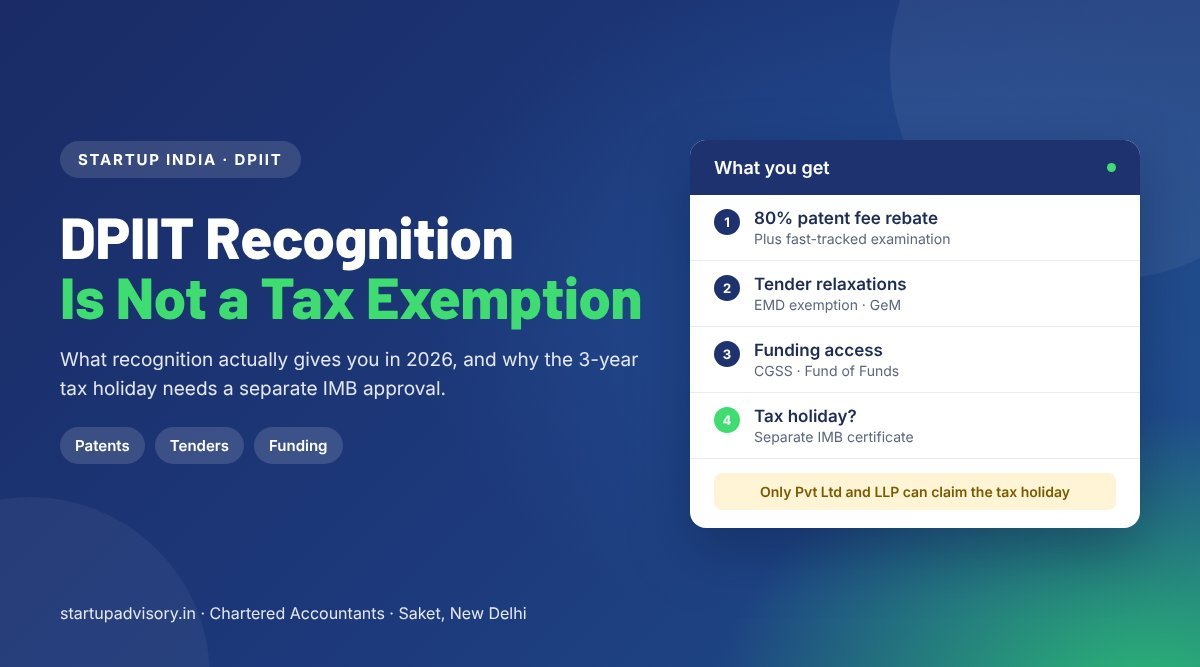
The most common question we hear after a founder gets the DPIIT certificate is: “Is my tax now zero?”
The answer is no. Recognition opens several doors. The tax holiday is a separate door with its own key.
This guide lists what recognition actually gives you, what it does not, and how the tax holiday works next to it. If you want to know who qualifies as a startup under the 2026 rules (the ₹200 crore limit, Deep Tech and cooperatives), read our guide to DPIIT’s new startup definition, G.S.R. 108(E). For the application itself, see how to get DPIIT recognition.
1. Benefits that come with DPIIT recognition
1. Patents and other IP
Startup India says recognised startups get:
- an 80% rebate on patent filing fees compared with other companies,
- fast-tracked examination of patent applications, so you get a decision sooner, and
- government-paid facilitators empanelled by the Controller General of Patents, Designs and Trademarks. The government pays the facilitator’s fee; you pay only the statutory fees.
Startup India’s June 2026 schemes playbook also lists a 50% rebate on trademark and design fees. Check the fee schedule on the IP India portal on the day you file, because fees change.
Tip: claim the startup rate before you file. It is much harder to fix after the application has gone in at the normal rate.
2. Government tenders
- Prior turnover and prior experience: many central government tenders relax these conditions for startups. Startup India’s scheme page ties this to startups in manufacturing that have their own manufacturing facility in India, so read each tender’s terms.
- EMD / bid security: DPIIT-recognised startups are exempt from paying Earnest Money Deposit (Rule 170 of the General Financial Rules, 2017).
- GeM: you can register on the Government e-Marketplace as a seller and get the Startup India badge.
These rules bind central ministries, departments and their PSUs. State governments may follow their own procurement norms.
3. Access to government-backed funding
- Credit Guarantee Scheme for Startups (CGSS): only DPIIT-recognised startups can use it. It guarantees loans from banks and other lenders, up to ₹20 crore per borrower.
- Fund of Funds for Startups: the government does not invest in startups directly. It puts money into SEBI-registered Alternative Investment Funds (AIFs), which then invest in startups. A second fund, Startup India Fund of Funds 2.0, was approved in February 2026 with a corpus of ₹10,000 crore.
- State schemes: many state startup policies ask for DPIIT recognition before you apply.
The Startup India Seed Fund Scheme took its last startup applications on 31 May 2026, so do not count on it. See what funding is still open in 2026.
4. Self-certification and fewer inspections
Recognised startups can self-certify compliance with certain labour and environmental laws through a simple online process. In practice this means fewer routine inspections in the early years. Most of the old labour Acts have now been folded into the Labour Codes, so check the current position on the Startup India portal before you rely on this.
5. Faster winding up
If things do not work out, startups with simple debt structures (or that meet certain income criteria) can be wound up under the fast-track route of the Insolvency and Bankruptcy Code. Startup India says this can be done within 90 days of filing the application.
2. The tax holiday is a separate approval
Getting DPIIT recognition is step one. To get the tax holiday, you apply again, this time to the Inter-Ministerial Board (IMB), and the tests are different.
| Point | DPIIT recognition | Tax holiday |
|---|---|---|
| Who gives it | DPIIT (Startup India portal / NSWS) | Inter-Ministerial Board (IMB) certificate |
| Who can get it | Pvt Ltd company (including OPC), LLP, registered partnership firm, cooperative society | Only Pvt Ltd company and LLP |
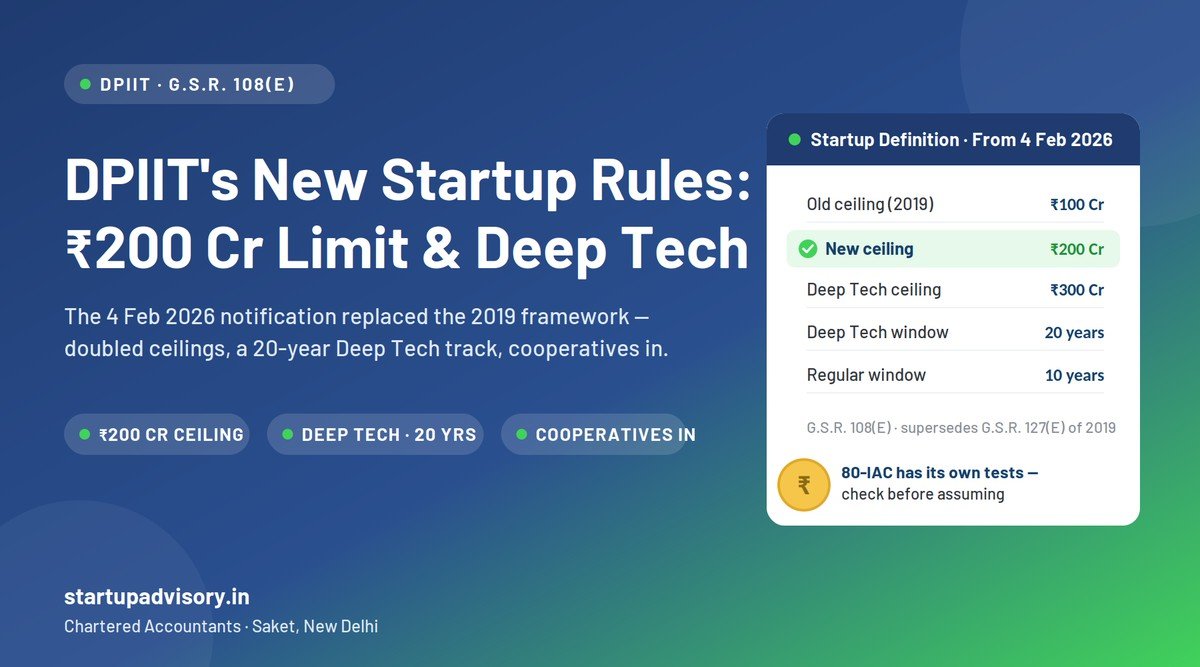
| Turnover test | Up to ₹200 crore in any financial year (₹300 crore for Deep Tech), under G.S.R. 108(E) | Its own test under the income-tax law: up to ₹300 crore in the year of claim from Tax Year 2026-27 (₹100 crore for earlier years). See our 80-IAC guide |
| Incorporation date | Within the last 10 years (20 for Deep Tech) | On or after 1 April 2016 and before 1 April 2030 |
| What you get | The benefits listed above | 100% deduction of business profits for any 3 consecutive years out of the first 10 |
| Law | DPIIT notification G.S.R. 108(E), 4 February 2026 | Section 80-IAC (Income-tax Act, 1961) up to FY 2025-26; Section 140 (Income-tax Act, 2025) from Tax Year 2026-27 |
Many IMB applications are rejected for a weak description of the innovation or missing documents. Read why 80-IAC applications get rejected before you apply.
3. What DPIIT recognition does NOT do
- It does not make your income tax-free. You pay tax as normal unless you also get the IMB certificate and claim the deduction.
- It does not exempt you from GST, TDS, ROC or ITR filing. Every return and payment stays due on its normal date.
- Angel tax is no longer a recognition benefit. Recognition used to protect startups from angel tax. The angel tax provision has since been abolished with effect from 1 April 2025, for everyone. See angel tax abolished: what it means.
4. Quick checklist after you get recognised
- Download the updated certificate (G.S.R. 108(E)) from the Startup India portal
- Check whether you meet the tax holiday conditions before applying to the IMB
- Use the patent rebate before filing any patent
- Register on GeM if you sell to government
- Keep funds away from the negative list (residential property, luxury assets, speculation)
- Keep normal compliance going: GST, TDS, ROC and ITR
- Startup India, Startup India Scheme (patent rebate, facilitators, fast-tracking, public procurement, self-certification, winding up within 90 days)
- Startup India, DPIIT Startup Recognition & Tax Exemption (no fee for recognition) and Public Procurement (GFR 2017 Rules 170 and 173, GeM)
- Startup India, Playbook of Government Schemes and Initiatives for Startups, June 2026 (SIPP: 50% rebate on trademark/design fees, p.13; SISFS last date 31 May 2026, p.32)
- Startup India, Credit Guarantee Scheme for Startups
- PIB, Cabinet approves Startup India Fund of Funds 2.0 (14 February 2026) and Government notifies Fund of Funds 2.0 (13 April 2026)
- DPIIT, Notification G.S.R. 108(E) dated 4 February 2026
Sources read on 17 November 2026. Tax holiday figures follow our Section 80-IAC guide.
Need DPIIT recognition or the tax holiday application done right?
We prepare the DPIIT application, the IMB tax holiday application and the innovation write-up that most rejections turn on, and keep your GST, TDS and ROC filings on time.
Startup India registration Book a consultation
General information; every startup is different. Speak to your CA for your case.