
GST / Returns
Monthly vs QRMP GST Return Filing: Which Scheme Suits Your Business?
Reviewed by CA Neeraj Rohilla, FCA — Chartered Accountant, Startup Advisory, Saket, New Delhi.
1. The two options in brief
Monthly filing is the default under section 39(1) of the CGST Act. You file GSTR-1 (your outward supplies) by the 11th and GSTR-3B (summary return and tax payment) by the 20th of the following month. Twelve of each, every year.
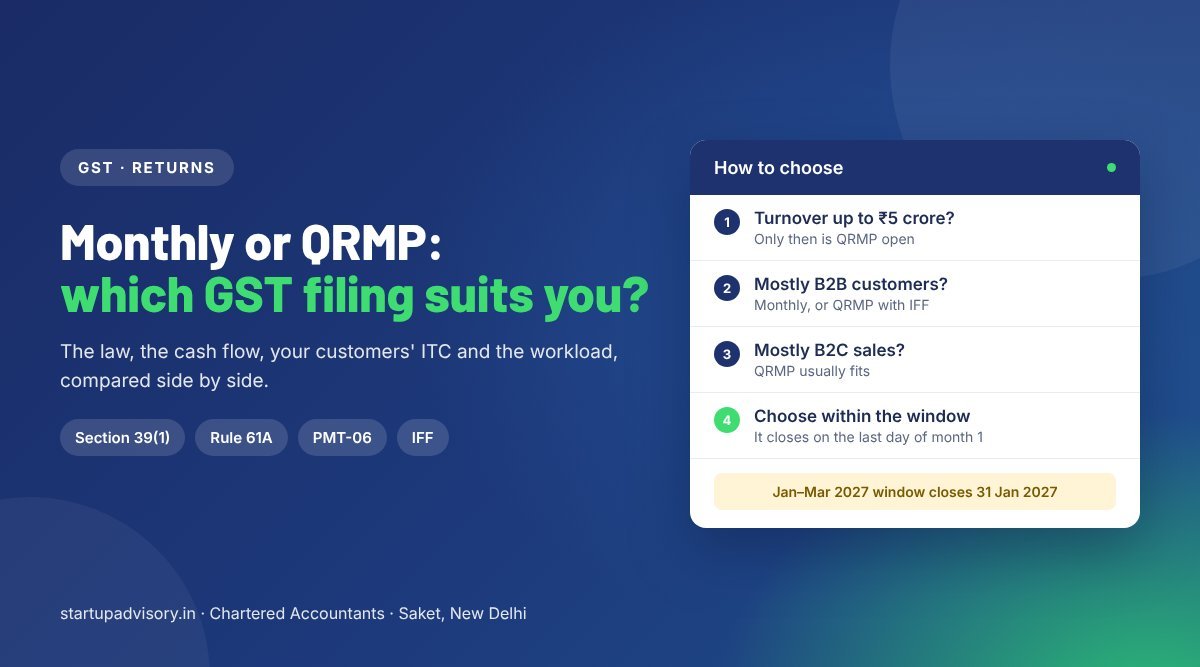
QRMP was introduced from 1 January 2021 for smaller taxpayers. You file GSTR-1 and GSTR-3B for the quarter, but for the first two months of each quarter you deposit tax through Form GST PMT-06 by the 25th of the next month. If you have B2B customers, you can also upload their invoices monthly through the optional Invoice Furnishing Facility (IFF).
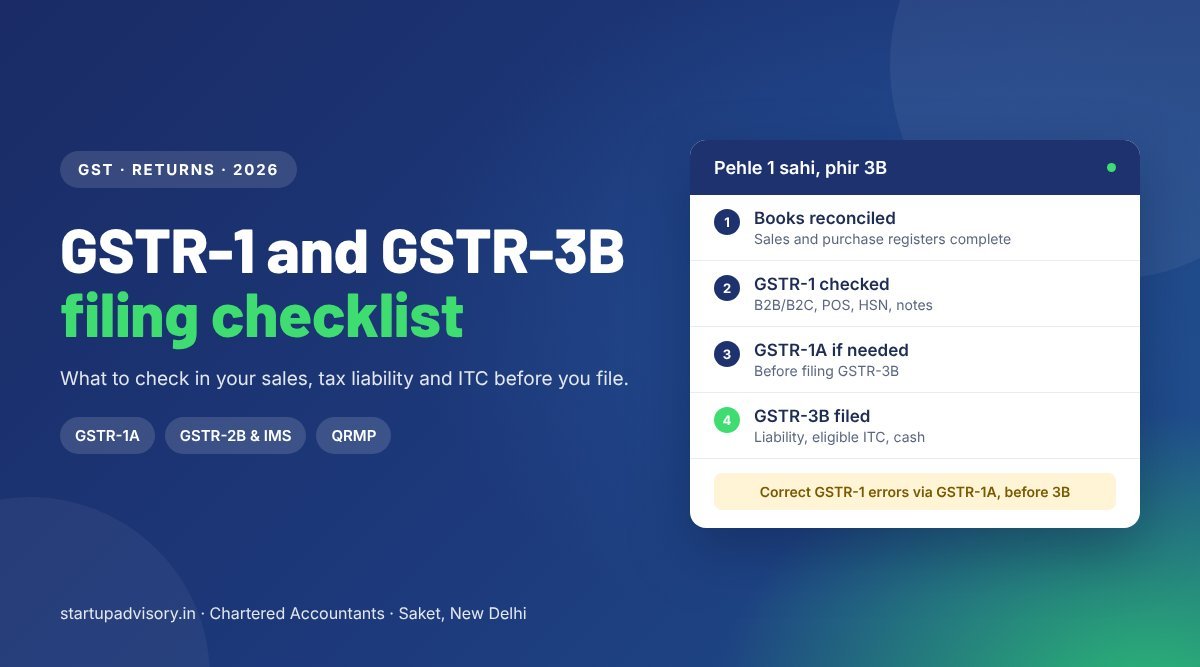
The reconciliation work is the same under both options. You still need to match your books with GSTR-1, check GSTR-2B and IMS for purchases, and get GSTR-1 right before GSTR-3B. Our GSTR-1 and GSTR-3B filing checklist walks through those checks. What changes is how often you file, and when your customers see your invoices.
2. Legal basis
| Provision | What it does |
|---|---|
| Section 39(1), CGST Act, and its proviso | Every registered person files a return for every month. The proviso lets the Government, on the GST Council’s recommendation, notify classes of persons who file a return “for every quarter or part thereof”. Sub-sections (1) to (3) were substituted by the Finance (No. 2) Act, 2019 and brought into force by Notification No. 81/2020-Central Tax. |
| Proviso to section 39(7) | A quarterly filer must still pay tax every month, either the actual tax due for the month or an amount worked out in a prescribed manner (the fixed sum). This proviso was substituted with effect from 1 October 2022 by the Finance Act, 2022. |
| Notification No. 84/2020-Central Tax (10 November 2020) | Notifies the class of persons who may file quarterly: registered persons with aggregate turnover up to ₹5 crore in the preceding financial year who opt for it. |
| Notification No. 85/2020-Central Tax (10 November 2020) | Special procedure for paying tax in the first two months of a quarter: the fixed sum method and the self-assessment method. |
| Rule 61A, CGST Rules | Manner of opting for quarterly returns, including the opt-in and opt-out window. |
| Rule 59(1) to (6) | GSTR-1 for the month or quarter. Rule 59(2) creates IFF: up to ₹50 lakh a month, from the 1st to the 13th of the next month. Rule 59(6)(b) blocks a quarterly filer’s GSTR-1 or IFF if GSTR-3B for the preceding tax period is pending. |
| Rule 61(1)(ii), (3) and (4) | Quarterly GSTR-3B due by the 22nd or 24th of the month after the quarter depending on the state. PMT-06 deposit by the 25th for each of the first two months. PMT-06 money is debited when the quarterly GSTR-3B is filed, and any refund of it is allowed only after that return is filed. |
| Section 50 | Interest on tax paid late, at a notified rate not exceeding 18% a year. For a late return, interest is charged on the part of the tax paid in cash. |
| Section 47 | Late fee for late returns. Under QRMP it applies to the quarterly returns, not to PMT-06. |
| CBIC Circular No. 143/13/2020-GST (10 November 2020) | Explains the scheme in detail: eligibility, the GSTIN-wise option, the window, both payment methods, IFF, interest and late fee, with illustrations. |
3. Who can choose QRMP
- Turnover test. A registered person who has to file GSTR-3B and whose aggregate turnover in the preceding financial year was up to ₹5 crore. The portal works this out from the returns filed for that year. Aggregate turnover under section 2(6) is counted on an all-India basis for all GSTINs under the same PAN.
- GSTIN by GSTIN. The option is exercised for each GSTIN separately. A business with registrations in Delhi and Haryana can, for example, keep one on monthly filing and put the other on QRMP, provided the PAN-level turnover is within ₹5 crore.
- Crossing ₹5 crore during the year. If aggregate turnover crosses ₹5 crore in any quarter of the current year, you are no longer eligible from the next quarter and must file monthly from then on.
- New registrations. A person who registers during a quarter can choose QRMP for that quarter.
- Last return filed. You can opt in only if you have filed the last return due on the date you exercise the option.
- Who is outside this choice. Composition taxpayers (GSTR-4), input service distributors, non-resident taxable persons, and TDS and TCS deductors have their own returns and are outside this choice.
4. When and how to opt in or out
Rule 61A and Circular 143 set one window for both opting in and opting out: from the first day of the second month of the preceding quarter to the last day of the first month of the quarter.
| Quarter you want to change | Window to opt in or out |
|---|---|
| January to March 2027 | 1 November 2026 to 31 January 2027 |
| April to June 2027 | 1 February 2027 to 30 April 2027 |
| July to September 2027 | 1 May 2027 to 31 July 2027 |
| October to December 2027 | 1 August 2027 to 31 October 2027 |
- Where on the portal. After logging in, look for the “Opt-in for Quarterly Return” option under Returns, choose the financial year and quarter, and select quarterly or monthly.
- The option carries forward. You do not need to choose every quarter. The portal keeps you on your chosen option for later quarters until you change it, or until turnover crosses ₹5 crore.
- No mid-quarter switch. The choice applies to a whole quarter. A change made on or before 31 January 2027 applies to January to March 2027. A change made from 1 February 2027 applies from April to June 2027.
5. Monthly payment: fixed sum or self-assessment
For each of the first two months of a quarter, a QRMP taxpayer deposits tax through PMT-06 by the 25th of the next month. Rule 61(3) allows you to take the existing balance in your electronic cash ledger into account. For the second month, that balance is counted after setting aside the tax due for the first month. You can use either method below, and you can use a different method in each month.
| Fixed sum method | Self-assessment method | |
|---|---|---|
| How much | A system-generated amount: 35% of the tax paid in cash in the previous quarter’s GSTR-3B if you filed quarterly, or 100% of the cash tax paid for the last month of the previous quarter if you filed monthly | The actual tax due for the month on outward and inward supplies, after the ITC available, using the GSTR-2B generated for that month |
| Challan | Pre-filled on the portal (reason: “Monthly payment for quarterly taxpayer”) | You compute the amount and generate PMT-06 |
| Effort | Low. No monthly computation needed | A monthly working of output tax and ITC |
| When nothing is needed | No deposit is needed where the balance in the cash or credit ledger is enough for the month’s tax, or where the liability is nil. For the second month, the test is the combined amount for months one and two. | |
| Who cannot use it | A person who has not filed a return for a complete tax period yet, such as a business registered mid-quarter, cannot use the fixed sum method | Available to all QRMP taxpayers |
| Suits | Steady businesses whose tax does not swing much from quarter to quarter | Seasonal businesses, businesses with large ITC in some months, and those whose sales fell compared with last quarter |
The PMT-06 money sits in your cash ledger until you file the quarterly GSTR-3B, when it is used against that quarter’s tax (rule 61(4)). Any surplus can be used later or refunded, but a refund is allowed only after the quarterly GSTR-3B is filed.
6. IFF and your customers’ ITC
This is the point that decides the choice for most B2B suppliers. Your customer’s ITC depends on your invoice appearing in their GSTR-2B (section 16(2)(aa) and rule 36(4)). A monthly filer’s invoices reach customers every month. A QRMP filer’s invoices reach them only when the quarterly GSTR-1 is filed, unless the supplier uses IFF.
- What IFF is. An optional facility under rule 59(2) to upload B2B invoices, and debit and credit notes on them, for the first and second months of a quarter.
- Window and limit. From the 1st to the 13th of the following month, up to a cumulative value of ₹50 lakh in each month. B2C sales are not reported through IFF.
- Effect. Invoices in IFF flow into the customer’s GSTR-2A and GSTR-2B for that month, so the customer can claim ITC on the same cycle as from a monthly filer.
- No repetition. Invoices uploaded in IFF are not reported again in the quarterly GSTR-1 (rule 59(3)).
- No late fee for IFF. Circular 143 does not provide a late fee for IFF. If you miss the 13th, the invoices simply go into the quarterly GSTR-1, and your customer gets the ITC later.
- Precondition. IFF, like the quarterly GSTR-1, cannot be filed if GSTR-3B for the preceding tax period is pending (rule 59(6)(b)).
Without IFF, an invoice you issue on 5 October reaches your customer only after your quarterly GSTR-1 for October to December is filed by 13 January, and it then appears in their GSTR-2B generated in January. For a customer who files monthly, that is a delay of about two months in their ITC. With IFF filed by 13 November, it appears in their October GSTR-2B as usual.
7. Interest and late fee
Interest
- Fixed sum method. Circular 143 says no interest is payable if you pay the system-calculated amount by the 25th for months one and two, and then pay the full quarter’s tax in the quarterly GSTR-3B by its due date. This holds even if your actual tax for month one or two was higher than the fixed sum. Interest arises if the fixed sum is paid after the 25th (for the period of delay), or if the quarterly GSTR-3B is filed late.
- Self-assessment method. Interest under section 50 is payable on any tax for months one or two (net of ITC) that is not paid, or paid short, by the 25th, until the date it is paid.
- Rate and how it is paid. Section 50(1) caps interest at 18% a year, and the rate notified under it (Notification No. 13/2017-Central Tax) is 18%. Interest is paid in the quarterly GSTR-3B. For a late return, section 50(1) charges interest on the part of tax paid in cash, so ITC used for the payment does not attract interest.
Late fee
- Section 47 late fees apply to late filing of GSTR-1 and GSTR-3B, monthly or quarterly. A QRMP filer has 8 returns a year that can attract a late fee, against 24 for a monthly filer.
- Circular 143 states that no late fee applies for delay in payment of tax in the first two months of a quarter. Late PMT-06 costs interest, not a late fee.
- The per-day late fee amounts and caps are notified separately and depend on turnover and whether the return is nil. Use our GST late fee calculator for an estimate.
8. Side-by-side comparison
| Monthly filing | QRMP | |
|---|---|---|
| Who can use it | Everyone (compulsory above ₹5 crore) | Aggregate turnover up to ₹5 crore in the preceding year, by choice |
| Returns a year | 12 GSTR-1 + 12 GSTR-3B = 24 | 4 GSTR-1 + 4 GSTR-3B = 8, plus optional IFF |
| Tax payment | Monthly, with GSTR-3B by the 20th | Monthly: PMT-06 by the 25th for months one and two; quarterly GSTR-3B for month three |
| GSTR-1 due | 11th of the next month | 13th of the month after the quarter; IFF 1st to 13th for months one and two |
| GSTR-3B due | 20th of the next month | 22nd or 24th of the month after the quarter (24th for Delhi, Haryana, Uttar Pradesh and the other states in that group) |
| Customers’ ITC | Monthly | Monthly with IFF (up to ₹50 lakh a month); quarterly without it |
| Your ITC claim | Monthly in GSTR-3B | Quarterly in GSTR-3B; can be used in the monthly self-assessed payment |
| GSTR-1A | Once a month, before GSTR-3B | Once a quarter, before the quarterly GSTR-3B |
| Late fee exposure | 24 returns | 8 returns; none on PMT-06 |
| Cash flow | Pay the actual tax each month | Fixed sum may be lower or higher than actual tax in months one and two; balance settled at quarter end |
| Error detection | Problems surface every month | Problems can build up over a quarter if books are not reconciled monthly |
For the full calendar of due dates under both options, with examples for the current quarter, see our GSTR-1 and GSTR-3B filing checklist and the GST and TDS compliance calendar.
9. Pros and cons
QRMP
| Pros | Cons |
|---|---|
| 8 returns a year instead of 24, so less filing time and lower professional fees in many cases | Tax is still paid monthly, so the saving is in filing, not in payment discipline |
| Fixed sum method needs no monthly computation | Fixed sum is based on last quarter’s cash tax, so in a slow quarter you may pay more than needed until the quarter-end return |
| Fewer returns that can attract a late fee; no late fee on PMT-06 | B2B customers get ITC late unless you file IFF every month, which brings back some monthly work |
| No interest under the fixed sum method if amounts and the quarterly return are paid and filed on time | IFF is capped at ₹50 lakh of invoices a month |
| Fewer nil returns for businesses with occasional sales | PMT-06 deposits are locked in the cash ledger until the quarterly GSTR-3B is filed, and refunds wait until then |
| Option is GSTIN-wise, so a group can mix and match | Errors can pile up over three months if the books are only looked at quarterly |
Monthly filing
| Pros | Cons |
|---|---|
| Customers get ITC every month with no extra steps, which large corporate buyers often expect | 24 returns a year, each a separate deadline and late-fee risk |
| Monthly reconciliation catches mismatches early, before they reach DRC-01B or DRC-01C territory | More filing time and cost |
| You pay only the actual tax each month, with no fixed-sum estimate | A nil return is still needed in months with no business |
| One simple routine, no switching between IFF, PMT-06 and quarterly returns | Shorter time to file after month end (11th and 20th, against 13th and 22nd/24th after the quarter) |
10. Which suits which business
| Your business | Usually suits | Why |
|---|---|---|
| Retail shop, restaurant, salon, clinic or other mainly B2C business | QRMP | Customers do not claim ITC, so upload timing does not matter, and the workload drops by two-thirds |
| Freelancer or small consultant with a few B2B clients | QRMP with IFF, or monthly | IFF keeps clients’ ITC monthly. If clients are large companies with strict vendor reconciliation, monthly may be simpler |
| Trader or manufacturer selling mostly to registered businesses | Monthly, or QRMP with IFF if B2B sales are under ₹50 lakh a month | Buyers watch GSTR-2B closely; a missed IFF means a two-month ITC delay for them |
| Seasonal business (festive goods, tourism, education) | QRMP with self-assessment | Pay the actual tax in slow months instead of a fixed sum based on the busy quarter |
| Business with turnover near ₹5 crore and growing | Monthly | You will be moved to monthly once you cross ₹5 crore anyway; changing routines mid-year adds work |
| Early-stage startup with few or irregular invoices | QRMP | Fewer nil or near-nil returns. Use self-assessment until you have filed a full tax period |
| Business that has had DRC-01B or DRC-01C intimations, or messy books | Monthly, at least for now | Monthly reconciliation catches errors before they grow |
| Exporter or supplier with regular refund claims | Discuss with your CA | Refunds of PMT-06 deposits wait for the quarterly return; check how your refund cycle fits the return period |
11. Worked examples
Example 1: B2C café in Delhi, fixed sum method
A café in Saket with aggregate turnover of ₹1.2 crore last year files under QRMP. In its GSTR-3B for July to September 2026 it paid ₹1,20,000 in cash.
- Fixed sum for October and November: 35% × ₹1,20,000 = ₹42,000 each, paid through the pre-filled PMT-06 by 25 November and 25 December 2026.
- Actual cash tax for the October to December quarter turns out to be ₹1,30,000 (the festive season was busy).
- In the quarterly GSTR-3B, due by 24 January 2027 (Delhi), the café pays the balance: ₹1,30,000 − ₹84,000 = ₹46,000.
- Interest: none, according to Circular 143, because both fixed sums were paid by the 25th and the quarterly return is filed on time, even though October’s actual tax was more than ₹42,000.
The café files 8 returns a year instead of 24, and its customers are consumers, so nobody waits for ITC. QRMP is a good fit.
Example 2: Seasonal trader, self-assessment method with a shortfall
A trader on QRMP works out its October 2026 tax after ITC at ₹30,000 but deposits only ₹20,000 through PMT-06 by 25 November. The ₹10,000 shortfall is paid with the quarterly GSTR-3B on 24 January 2027.
- Days late: 26 November 2026 to 24 January 2027 = 60 days.
- Interest under section 50 at 18%: ₹10,000 × 18% × 60 ÷ 365 = about ₹296.
Our GST interest calculator does this working for you. The lesson is not to avoid self-assessment; it is often the better method for a seasonal business. Just compute the month’s tax carefully before the 25th.
Example 3: IT consultant with corporate clients
A software consultant with turnover of ₹80 lakh bills three corporate clients about ₹6 lakh a month in total. The clients file monthly and reconcile vendor invoices with GSTR-2B every month.
- QRMP without IFF: an invoice raised on 5 October first reaches the clients after the quarterly GSTR-1 is filed by 13 January, so they claim the ITC about two months late. Expect follow-up emails, and possibly payments held back.
- QRMP with IFF: October invoices uploaded through IFF by 13 November appear in the clients’ October GSTR-2B. Billing is well within ₹50 lakh a month, so IFF works.
- Monthly: the same outcome as IFF with a single routine.
Both QRMP with IFF and monthly filing work here. If the consultant is going to file IFF every month anyway, the extra saving from QRMP is the quarterly GSTR-3B: 8 fewer GSTR-3B returns a year, with PMT-06 challans instead.
Example 4: Crossing ₹5 crore mid-year
A distributor on QRMP had turnover of ₹4.6 crore in 2025-26. By the end of September 2026 its turnover for 2026-27 has reached ₹5.1 crore. It is no longer eligible from the next quarter, so it files monthly from October 2026: GSTR-1 for October by 11 November and GSTR-3B by 20 November. The July to September 2026 quarter is still filed quarterly.
12. Common mistakes
- Thinking QRMP means paying tax quarterly. Tax is paid every month; only the returns are quarterly.
- Missing the PMT-06 deadline because “there is no return this month”. The 25th still applies.
- Choosing QRMP for a B2B business and not filing IFF, then facing customers whose ITC is stuck.
- Uploading more than ₹50 lakh of invoices in a month through IFF. The excess has to go in the quarterly GSTR-1.
- Using the fixed sum method in a slow quarter and paying far more than the actual tax, which then sits in the cash ledger until the quarter-end return.
- Trying to opt in or out after the last day of the first month of the quarter. The change will only apply from the next quarter.
- Trying to opt in while a return is pending. File it first.
- Reconciling books only at quarter end. Reconcile monthly even under QRMP, so the quarterly returns are quick and accurate.
- Assuming each GSTIN follows the PAN’s choice. The option is GSTIN-wise, so check each registration.
- CBIC, CGST Act, 2017: section 39 (provisos to sub-sections (1) and (7)) and section 50, read on taxinformation.cbic.gov.in on 16 November 2026
- CBIC, CGST Rules, 2017: rule 59 and rule 61 (both substituted from 1 January 2021 by Notification No. 82/2020-Central Tax), read on 16 November 2026
- CBIC, Circular No. 143/13/2020-GST dated 10 November 2020, “Quarterly Return Monthly Payment Scheme” (explains rule 61A and Notification Nos. 84/2020 and 85/2020-Central Tax)
This article is general information, not tax advice. It reflects the CGST Act, the CGST Rules and CBIC Circular No. 143/13/2020-GST as read on 16 November 2026. Where this article describes rule 61A and Notification Nos. 84/2020 and 85/2020, it relies on the circular’s explanation of them. Portal functionality and procedures change, so check the latest advisories on the GST portal before you exercise or change your option.
How Startup Advisory Can Help
Startup Advisory, in association with KNAP Advisory Private Limited, is a CA-led firm in Saket, New Delhi that runs GST compliance for businesses, freelancers and finance teams across Delhi NCR:
- Choosing the right option: we look at your customers, turnover and tax pattern and recommend monthly or QRMP for each GSTIN.
- Monthly and quarterly returns: GSTR-1, IFF, PMT-06, GSTR-1A and GSTR-3B prepared from your books and filed on time.
- Reconciliation: books vs GSTR-1, GSTR-2B and IMS vs purchases, every month, whichever option you choose.
Call 9311972982 or book a free consultation.