
Virtual CFO / MIS
5 Numbers Every Founder Should Check Every Month (Free 1-Page MIS Format)
Reviewed by CA Neeraj Rohilla, FCA — Chartered Accountant, Startup Advisory, Saket, New Delhi.
Running a business by looking only at the bank balance is like driving by looking only in the rear-view mirror. You see where you have been, not what is coming.
Most first-time founders open the banking app, see a healthy number and feel fine. Then one month a big customer pays late, a GST payment falls due and salaries have to go out on the same day, and the healthy number is suddenly not so healthy.
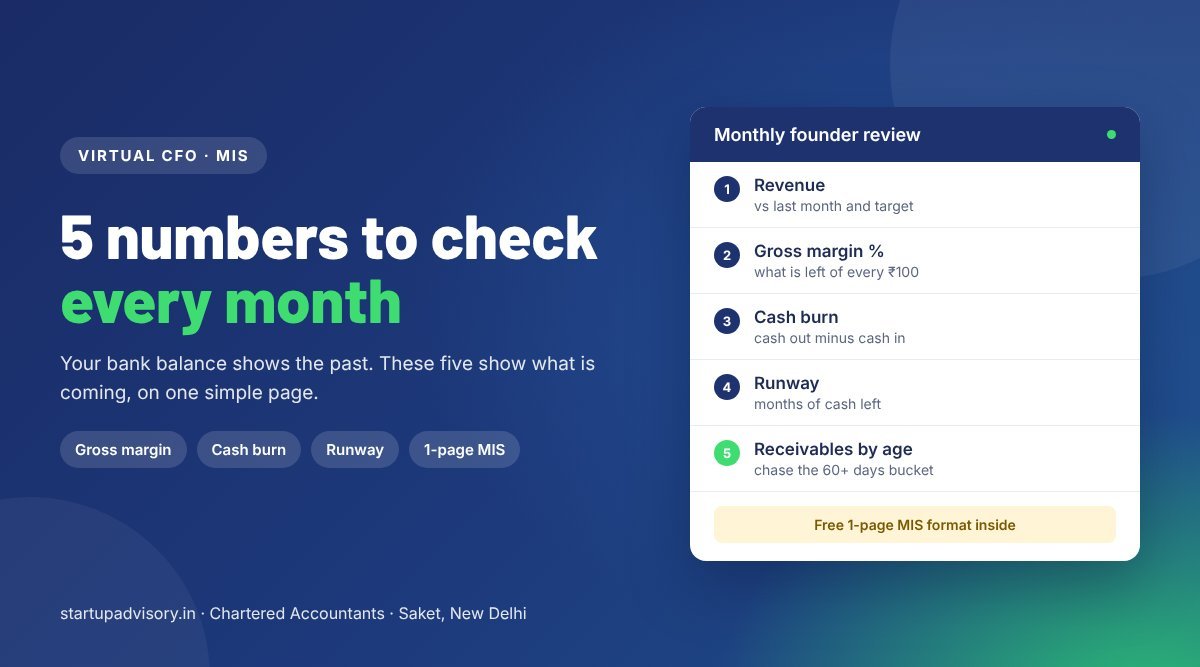
You do not need a finance degree to avoid this. Five numbers, checked once a month, give a founder the view ahead. This guide explains each one in plain words and gives you a 1-page MIS format to put them together.
1. Why bank balance alone is not enough
Your bank balance is a single point in time. It tells you how much money is in the account today. It does not tell you:
- whether sales are growing or slipping,
- whether each sale actually makes money after its direct costs,
- how fast cash is going out every month, or
- how much money customers still owe you.
And one more thing worth knowing early: profit and cash are not the same thing. We explain why below.
2. The 5 numbers
For each number: what it is, how to work it out, and what to watch for.
1. Revenue (and how it moved vs last month)
Revenue is your total sales for the month. On its own it means little, so put it next to two other figures: last month’s revenue and your target for this month. Also note your top 3 customers or products and how much of the month’s sales came from each.
What to look for: revenue falling for two or more months in a row, or too much of your revenue coming from one customer. If that one customer leaves or delays payment, the whole business feels it.
2. Gross margin
Gross margin tells you how much is left out of every ₹100 of sales after paying the direct cost of delivering that sale. Direct costs are the costs that rise and fall with each sale: materials, direct labour, delivery, payment gateway or marketplace fees, and similar.
What to look for: margin falling while sales rise. That usually means you are buying growth with discounts, or your input costs have gone up and your prices have not.
3. Cash burn
Cash burn is about real money moving in and out of the bank this month. There are two versions:
- Gross burn = total cash out in the month.
- Net burn = cash out − cash in.
Use actual bank figures, not the profit and loss account. The P&L can include sales that have not been paid for yet and leave out payments like loan repayments, so it does not show what really happened to your cash. If cash in is more than cash out, you are not burning cash that month, which is a good place to be.
What to look for: net burn creeping up month after month without a matching rise in revenue.
4. Runway
Runway tells you how many months the business can keep going at its current burn before the bank account reaches zero, if nothing else changes.
Use an average of the last three months of net burn rather than a single month, so one unusual month does not distort the answer. This is the same formula we use in our cash flow management playbook for startups, which also notes that many startups aim to keep around 12 to 18 months of runway, especially just after a raise. The right buffer depends on how predictable your revenue is.
What to look for: runway shrinking month after month. Plan fundraising or cost cuts well before it gets short, because both take longer than founders expect. If you are preparing to raise, see what investors check in a startup financial model.
5. Receivables (and how old they are)
Receivables are money customers owe you for invoices you have already raised. The total is useful, but the age of that money matters more. Split it into three buckets:
- 0–30 days old
- 31–60 days old
- 60+ days old
What to look for: the 60+ days bucket growing. That money already shows as profit in your accounts, but it is not cash in your bank. Follow up those invoices first.
3. Profit is not cash
Your accounts record a sale when it is invoiced. This is called accrual accounting. But the cash arrives only when the customer actually pays, which may be 30, 60 or 90 days later.
Many other items also move cash without matching the P&L in the same month:
- buying stock that has not been sold yet,
- advance payments to suppliers,
- loan repayments (only the interest part is an expense), and
- GST and TDS payments.
So a business can show a profit and still run out of cash. That is why numbers 3, 4 and 5 (burn, runway and receivables) sit right next to profit in the monthly review.
4. The 1-page monthly MIS: 6 blocks
A founder does not need a 20-page report. One page, ready by about the 10th of the next month, is enough to review the business in 5 minutes. The 10th is a suggestion, not a rule; pick a date that works with how quickly your books get closed, and stick to it.
| Block | What to show | Example line |
|---|---|---|
| 1. Sales | This month vs last month vs target; top 3 customers/products | Revenue ₹__ (last month ₹__, target ₹__) |
| 2. Margin | Gross margin % and top 3 expenses | GM __%; top costs: __ |
| 3. Cash flow | Opening cash, cash in, cash out, closing cash | Opening __ + In __ − Out __ = Closing __ |
| 4. Burn & runway | Net burn and runway in months | Net burn __/month; runway __ months |
| 5. Receivables & payables | Amounts by age bucket (0–30, 31–60, 60+ days) | Receivable __ (60+ days: __); Payable __ |
| 6. Compliance | GST, TDS, PF/ESI, ROC: paid / filed / pending this month | GSTR-3B filed; TDS paid; __ pending |
Prefer to build your own? Copy the table above into a spreadsheet and fill one column per month, so you can see the trend at a glance.
5. How to set this up in 30 minutes
- Keep books up to date monthly. Every sale, purchase and expense recorded before you start. If you are new to this, start with our bookkeeping basics for first-time founders.
- Reconcile the bank every month. Match the bank statement with the books so your cash figures are real.
- Fill the 6 blocks from the books and the bank statement. For the compliance block, use our GST and TDS compliance calendar to see what was due this month.
- Review it once a month with your co-founder or CA, and write down 3 actions for next month. Next month, start by checking whether those actions happened.
6. Quick monthly checklist
- Revenue compared with last month and target
- Gross margin % calculated
- Net cash burn worked out from the bank
- Runway in months updated
- Receivables listed by age, 60+ days followed up
- GST / TDS / ROC status checked
- 3 actions written for next month
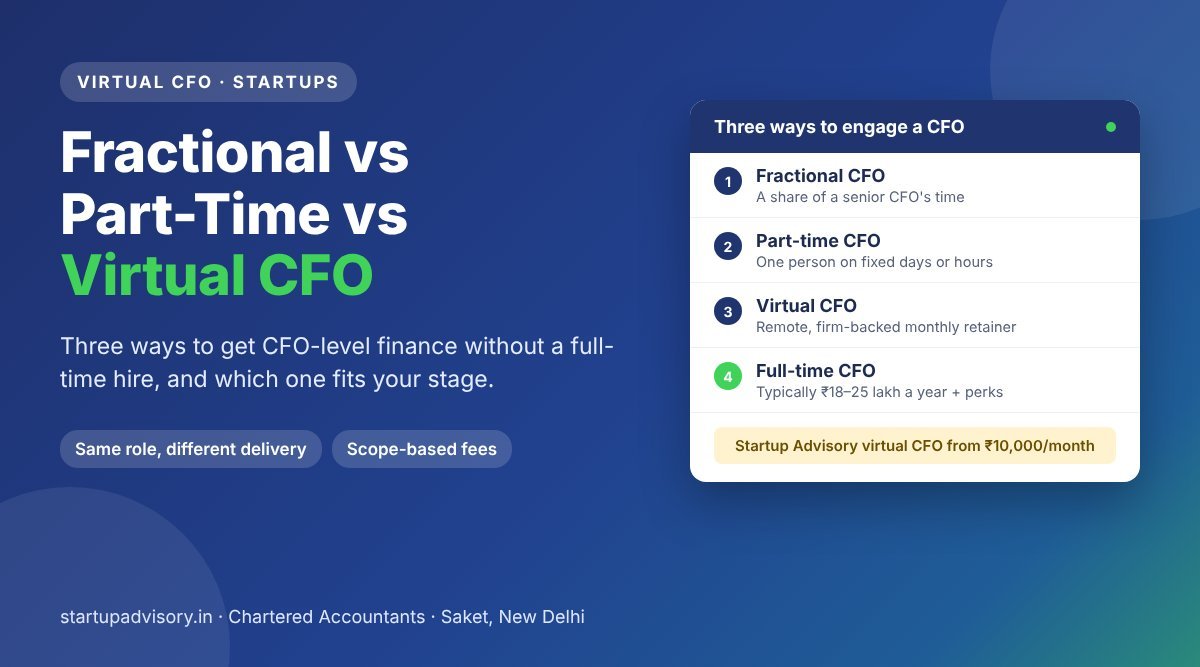
Wondering when this becomes too much to handle yourself? Read what a Virtual CFO actually does and when to hire a Virtual CFO.
Want this MIS prepared for you every month?
Our Virtual CFO team prepares monthly MIS, cash-flow tracking and compliance oversight, so you get this page on your desk every month without building it yourself.
Explore Virtual CFO services Book a consultation
General information; every business is different. Speak to your CA for advice on your case.