
Income Tax / Foreign Assets
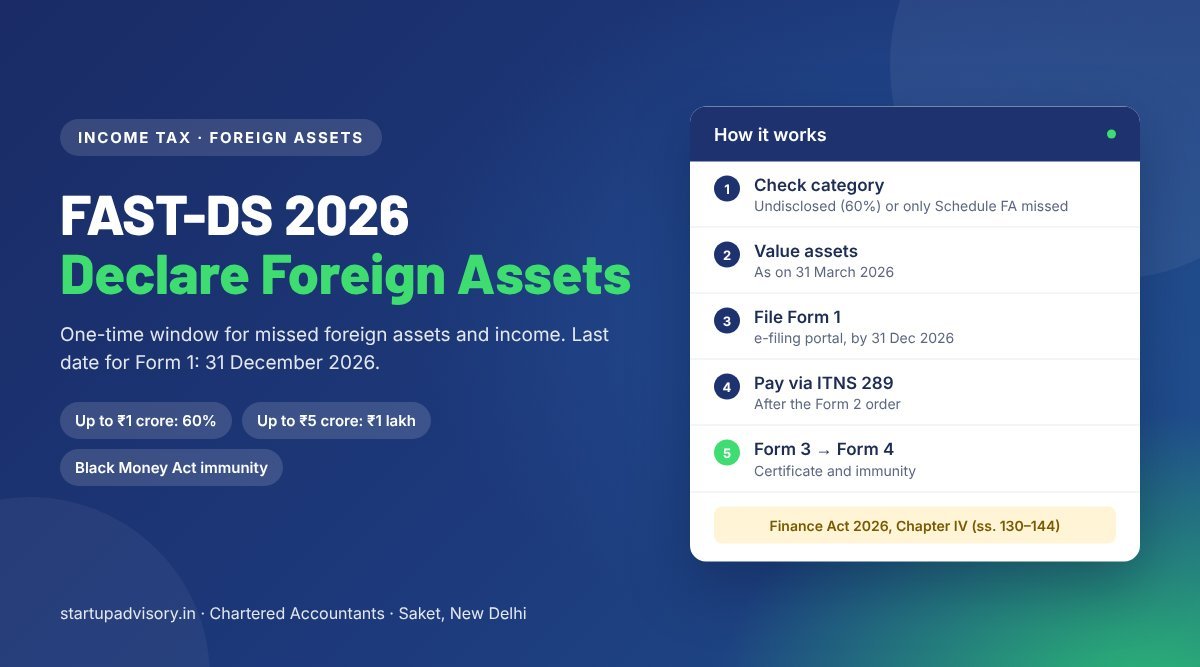
FAST-DS 2026: The One-Time Scheme to Disclose Foreign Assets and Income (Last Date 31 December 2026)
Reviewed by CA Neeraj Rohilla, FCA — Chartered Accountant, Startup Advisory, Saket, New Delhi.
- What is FAST-DS?
- Key dates
- Who can declare
- The two categories and limits
- How much you pay (calculator)
- How assets are valued
- How to file: Forms 1 to 4
- Payment timeline and interest
- Immunity you get
- Who is excluded
- Common situations
- RSUs: revised return or FAST-DS?
- How the RSU sale gain is taxed
- The ₹20 lakh carve-out
- Before you file: checklist
Many Indians hold something abroad that never made it to their tax return: a US bank account opened during a master’s degree, RSUs from a foreign parent company, a brokerage account bought through an app, a small flat or a deposit left behind after a posting overseas. Every resident and ordinarily resident individual is expected to report such holdings in Schedule FA of the ITR every year, even where there is no income. Missing it falls under the Black Money (Undisclosed Foreign Income and Assets) and Imposition of Tax Act, 2015, which carries heavy tax, penalty and prosecution provisions.
FAST-DS is the government’s answer for the smaller cases. This guide explains the scheme from the Income Tax Department’s own FAQs, the e-filing portal pages and the Form 1 user manual (sources are listed at the end).
1. What is the FAST-DS scheme?
FAST-DS is a time-bound disclosure scheme in Chapter IV (sections 130 to 144) of the Finance Act, 2026, read with the Foreign Assets of Small Taxpayers – Disclosure Scheme Rules, 2026, which CBDT notified when the scheme came into force on 16 August 2026. It is administered online by the Principal Director General or Director General of Income-tax (Systems).
You can use it if, for any earlier year, you:
- did not file an income-tax return at all under section 139 of the Income-tax Act, 1961;
- filed a return before the scheme started but did not disclose the foreign asset or income in it; or
- had the foreign asset or income escape assessment (section 147).
A declaration can relate to any previous year, subject to the category table and monetary limits in section 133.
2. What are the key FAST-DS dates?
| Event | Date or time limit |
|---|---|
| Scheme opens | 16 August 2026 |
| Valuation date (assets valued as on) | 31 March 2026 |
| Last date to file Form 1 (declaration) | 31 December 2026 – no declaration after this |
| Form 2 (order with amount payable) | Issued within 1 month from the end of the month in which Form 1 is filed |
| Payment | Within 2 months from the end of the month in which Form 2 is received |
| Late payment | Up to 2 further months, with simple interest at 1% per month or part |
| Form 3 (payment intimation) | Filed by you within the payment period, with proof of payment |
| Form 4 (certificate) | Issued within 1 month from the end of the month in which Form 3 is received |
3. Who can declare under FAST-DS?
The scheme is open to:
- A person resident in India (section 6 of the Income-tax Act, 1961) in the relevant previous year; and
- A person who is non-resident or not ordinarily resident today, if they were resident in India either in the year to which the undisclosed foreign income relates, or in the year the undisclosed foreign asset was acquired. Your residential status for that year is stated in Form 1.
So a professional who worked in India, opened a foreign account while resident and has since moved abroad can still use the scheme for that account.
4. What are the two FAST-DS categories and their limits?
Section 133 has a two-line table. Which line you fall under decides both the limit and the cost.
| Category 1 (Table Sl. No. 1) | Category 2 (Table Sl. No. 2) | |
|---|---|---|
| What it covers | An undisclosed asset located outside India, or foreign income not offered to tax | A foreign asset that was already offered to tax, or was acquired while you were a non-resident, but was not shown in the relevant return schedule (Schedule FA) |
| Monetary limit | Undisclosed foreign assets (value as on 31 March 2026) + undisclosed foreign income together up to ₹1 crore | Aggregate value of assets outside India up to ₹5 crore |
| Amount payable | Tax at 30% + additional amount equal to 100% of that tax = 60% | Flat fee of ₹1,00,000 |
| Typical case | Foreign account funded with money never taxed in India; foreign interest or dividends never reported | RSUs/ESOPs taxed through salary but missing from Schedule FA; savings from a job abroad kept in an account after returning |
The FAQs define an undisclosed foreign asset as an asset (including a financial interest in any entity) located outside India, held in your name or as beneficial owner, for which you have no explanation of the source of investment, or the explanation is not satisfactory to the Assessing Officer. Undisclosed foreign income is income from a source outside India that was chargeable to tax in India but not offered to tax.
One ₹1 lakh fee covers the whole Category 2 declaration, meaning every eligible asset and every year of omission in it. You do not pay ₹1 lakh per asset or per year.
If your foreign assets exceed ₹5 crore, you cannot use FAST-DS at all.
5. How much do you pay under FAST-DS?
On the portal, Part D of Form 1 calculates item 5 as 60% of the Category 1 aggregate, item 6 as nil or ₹1,00,000 for Category 2, and item 7 as the total.
FAST-DS amount estimator
Estimate only, using the rates in the FAQs. It does not value assets for you or check other eligibility conditions.
6. How are foreign assets valued under FAST-DS?
All assets are valued as on 31 March 2026 and reported in rupees. The general rule is the higher of cost of acquisition and fair market value on that date.
| Asset | Value to declare |
|---|---|
| Foreign bank account | Total of all deposits from opening to 31 March 2026, excluding deposits made out of withdrawals from the same account. If declared earlier under Chapter VI of the Black Money Act, only later deposits count. Not the closing balance. |
| Listed shares | Higher of cost and the average of the lowest and highest price on 31 March 2026 (or the nearest earlier trading day) |
| Unlisted equity shares | Higher of cost and the prescribed book-value formula |
| Other unlisted securities | Higher of cost and open-market price |
| Immovable property abroad | Higher of cost and open-market price per a valuer recognised in that country |
| Jewellery, bullion, precious stones, art | Higher of cost and open-market price |
| Interest in a firm, AOP or LLP | Share of net assets as on the valuation date, allocated first by capital and then by profit-sharing ratio |
| Any other asset | Higher of cost and arm’s-length open-market price |
- No market valuation done? The indexed cost of acquisition is deemed to be the fair market value.
- Proceeds reinvested? The old asset’s value is reduced by the amount reinvested, and the new asset is valued separately, so the same money is not counted twice.
- Currency conversion: a designated currency converts at the RBI reference rate on 31 March 2026; other currencies convert first to US dollars at the local central bank’s rate and then to rupees at the RBI rate.
- Variance: for assets other than bank accounts, a difference of up to 20% from the declared value does not by itself make the declaration invalid (Rule 5(2)).
If you need a valuation report for property, unlisted shares or other assets, our registered valuer services can help with the Indian side of the paperwork.
7. How do you file a FAST-DS declaration (Forms 1 to 4)?
- Gather documents. PAN registered on the e-filing portal, documents showing how each asset was acquired or the income earned, valuation reports where needed (PDF or ZIP, up to 5 MB per attachment), and an e-verification mode: Aadhaar OTP, DSC, or EVC through a bank or demat account.
- Open Form 1. On incometax.gov.in go to e-File > Income Tax Forms > File Income Tax Forms, then under Forms as per other Acts choose “Foreign Assets of Small Taxpayers’ Disclosure Scheme 2026 (Form 1 of FADS 2026)”.
- Fill the parts. Part A (basic details, optional passport number), Part B (pick the categories that apply), the annexures for each asset type (bank account, immovable property, jewellery, artistic work, shares and securities, other assets, and income), then Parts C and D, which compute the amount payable. Several assets can be added by repeating the relevant sections.
- Verify and submit. Preview, download a copy and e-verify. Filing Form 1 again makes the earlier one non-actionable, so get it right first time.
- Receive Form 2. The department issues the order stating the amount payable, within one month from the end of the month of filing.
- Pay through Challan ITNS 289. Go to e-File > e-Pay Tax > Income Tax Act, 1961 > New Payment and choose the FAST-DS 2026 (ITNS 289) tile (or pay pre-login with PAN and mobile OTP). The assessment year (2026-27) and minor head (115 for companies, 116 for others) fill in automatically. One challan covers tax and fee. Payments made under the wrong head cannot be corrected or refunded.
- File Form 3 with proof of payment (including any interest).
- Get Form 4, the certificate, once the payment matches Form 2. Keep it safe: it is your proof of the declaration.
8. What is the payment timeline, and what if you pay late?
You get two months from the end of the month in which you receive Form 2. After that, up to two further months are allowed with simple interest at 1% for every month or part of a month. If the amount is still not paid within that outer limit, the declaration becomes void and is treated as never made, and you lose the scheme’s protection for it.
9. What immunity does FAST-DS give?
Once the declaration is valid and the amount is paid:
- No further tax or penalty, and no prosecution, under the Black Money Act, 2015 for the declared asset or income.
- The declared income or investment is not included in total income under the Income-tax Act, 1961 or the Black Money Act.
- If an assessment is pending, the Assessing Officer must take the declaration into account.
The trade-off: you cannot claim rectification, revision, set-off or other relief on any assessment already made, or in a related appeal, for the declared items.
10. Who cannot use FAST-DS?
- Anyone whose aggregate foreign assets exceed ₹5 crore.
- Category 1 cases where undisclosed assets and income together exceed ₹1 crore.
- Assets or income that represent proceeds of crime under investigation or proceedings under the Prevention of Money-laundering Act, 2002.
- Income or assets for an assessment year already assessed under the Black Money Act.
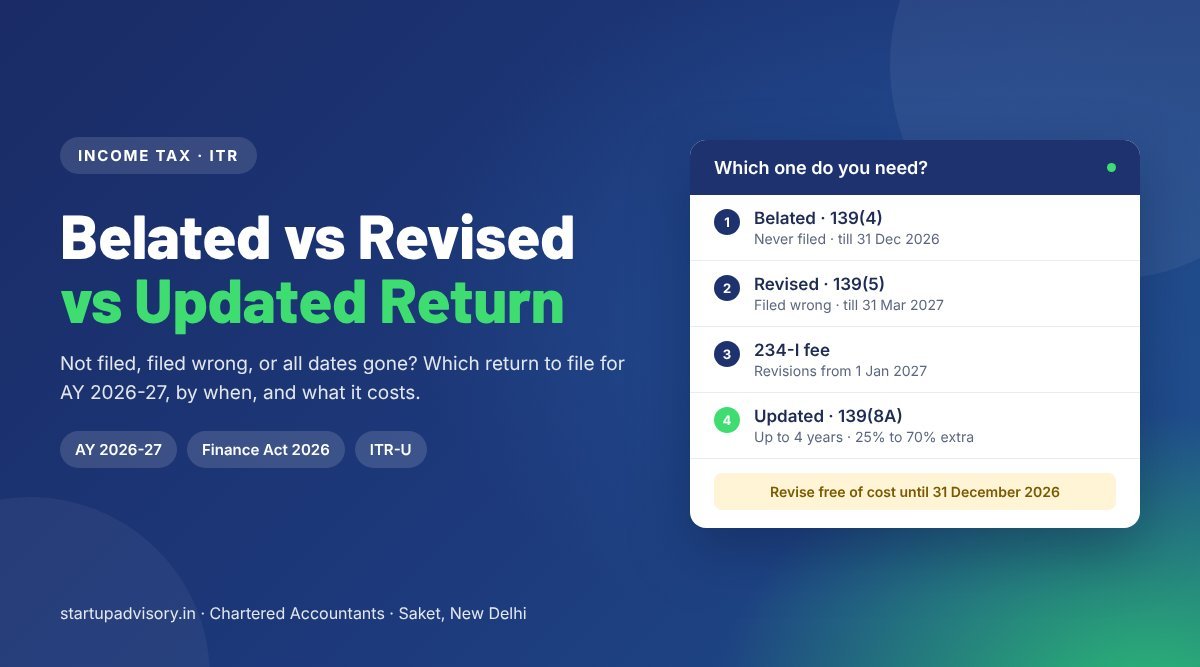
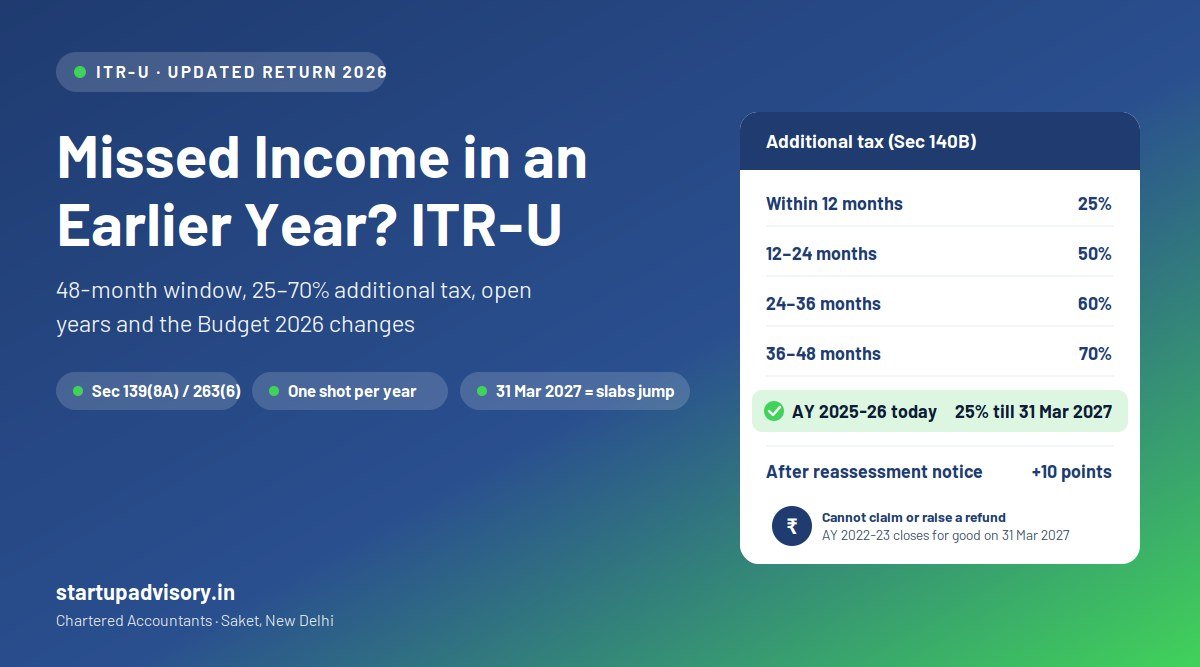
If FAST-DS is not available, a revised return (s.139(5), AY 2026-27 by 31 December 2026) or an updated return (s.139(8A), up to 48 months from the end of the assessment year, with additional tax of 25% to 70%) may still regularise foreign income. Neither gives Black Money Act immunity. Our guide on belated, revised and updated returns explains both.
11. Which category fits common situations?
These are typical fact patterns, not rulings. The category depends on whether the money or income was ever taxed in India, so check your facts with a CA.
| Situation | Likely category | Why |
|---|---|---|
| RSUs or ESOP shares of a foreign parent; perquisite taxed through your Indian salary, but shares never shown in Schedule FA | Category 2 (₹1 lakh) | The asset came from income already offered to tax; only the schedule was missed |
| Bank account opened while working abroad as a non-resident, kept after returning to India and not reported | Category 2 (₹1 lakh) | Acquired while non-resident; check that any interest earned after becoming resident was taxed |
| Foreign dividends or interest received while resident and never offered to tax | Category 1 (60%) | Foreign income chargeable in India but not taxed |
| Overseas brokerage account funded from Indian savings that were taxed, but the holding was never reported | Often Category 2, but the source of each remittance must be explained | If the source is explained and taxed, the gap is disclosure only; any unreported gains or dividends are foreign income (Category 1) |
| Foreign assets totalling more than ₹5 crore | Not eligible | Outside the scheme’s limit |
One holding can have parts in both categories, for example taxed RSU shares (Category 2) plus dividends on them that were never reported (Category 1). Form 1 lets you select more than one category. For background on reporting foreign shares and setting up abroad correctly, see our guides on ODI compliance and taxation of foreign dividends.
11A. I got RSUs, missed Schedule FA and the sale gain. Revised return or FAST-DS?
For most salaried RSU holders, the answer is both, for different years:
| Year (Schedule FA = calendar year) | ITR | What to use | Why |
|---|---|---|---|
| CY 2025 | AY 2026-27 (FY 2025-26) | Revised return u/s 139(5) by 31 Dec 2026: add Schedule FA and the capital gain | You pay normal tax plus interest. Putting the same gain into FAST-DS Category 1 costs 60% |
| CY 2024 and earlier | AY 2025-26 and earlier | FAST-DS Category 2 (₹1 lakh), if the omission is FA-only | Those returns can no longer be revised. An updated return cannot be filed just to correct Schedule FA, because it must increase tax |
| Any year with unreported dividends or gains | Earlier AYs | FAST-DS Category 1 (60%) or updated return u/s 139(8A) | Compare the cost. An updated return allows foreign tax credit but gives no Black Money Act immunity |
Why the revised return comes first for FY 2025-26
- Tax on the gain at normal rates is far below 60%.
- The Black Money Act penalty under s.43 (₹10 lakh) targets omissions in a return under s.139(1)/(4)/(5). A revised return under s.139(5) replaces the original, so you have a strong argument that the omission is cured. It is not a statutory immunity.
- Foreign tax credit (Form 67) is available in the ITR. The FAST-DS FAQs and Form 1 make no provision for foreign tax credit.
11B. How is the gain on RSU shares taxed?
- Cost: the fair market value already taxed as a perquisite on vesting (s.49(2AA)). Take it from the payslip or Form 16.
- Holding period: from the vest/allotment date to the sale date, worked out lot by lot.
- Long-term: if held for more than 24 months, because the shares are not listed in India. Tax is 12.5% without indexation (s.112) for sales on or after 23 July 2024. The surcharge on this gain is capped at 15%.
- Short-term: taxed at slab rates. The 20% rate under s.111A does not apply because no STT is paid.
- No ₹1.25 lakh exemption: that exemption is under s.112A and needs STT.
- US tax: the US generally does not tax a non-resident’s share-sale gain. Dividends usually suffer 25% US withholding. Report them in Schedule FSI/TR and file Form 67 by the end of the assessment year (Rule 128(9)).
Example (FY 2025-26 sale, gain ₹8,00,000):
| Long-term (held > 24 months) | Short-term (30% slab) | |
|---|---|---|
| Tax | ₹1,00,000 | ₹2,40,000 |
| Health & education cess 4% | ₹4,000 | ₹9,600 |
| Total (before surcharge and s.234B/234C interest) | ₹1,04,000 | ₹2,49,600 |
11C. Do I even need FAST-DS? The ₹20 lakh carve-out
- The Black Money Act penalty for not reporting a foreign asset is ₹10 lakh (s.42 / s.43).
- From 1 October 2024, that penalty does not apply where the foreign assets, other than immovable property, total ₹20 lakh or less (Finance (No. 2) Act, 2024).
- The section speaks of the aggregate value of all such assets without fixing a date. Schedule FA asks for the peak value, so the safe test is the highest value during the year, added up across all foreign assets, including the broker’s cash account, not the closing value.
- Before 1 October 2024, only bank accounts with up to ₹5 lakh were protected, so the carve-out may not cover CY 2023 and earlier.
Example: RSUs allotted in FY 2023-24, ₹8 lakh gain on sale in FY 2025-26
| Value of RSUs | What to file |
|---|---|
| Peak around ₹19 lakh, first held in CY 2024 | Revised return for AY 2026-27 is usually enough |
| Peak around ₹19 lakh, already held in CY 2023 | Revised return plus FAST-DS Category 2 (₹1 lakh) to cover CY 2023 |
| Peak around ₹25 lakh | Revised return plus FAST-DS Category 2 (₹1 lakh). The carve-out fails in every year held |
12. Before you file: FAST-DS checklist
- List every foreign asset you held at any time: bank and brokerage accounts, shares, RSUs/ESOPs, property, insurance, crypto exchange accounts, interests in entities
- Note your residential status in the year each was acquired and each year income arose
- Check which ITRs showed the asset in Schedule FA and which income was taxed
- Remember that Schedule FA works on the calendar year (January–December). Report an asset held at any time in the year, even if it was sold before 31 December, with its initial, peak and closing values and the sale proceeds.
- If the asset was sold before 31 March 2026, check with your CA before declaring it. The FAST-DS FAQ values assets held on that date and does not deal with assets already sold; if the sale money sits in a foreign bank account, that account is valued by the deposits rule.
- Decide the category for each item (Category 1, Category 2, or both)
- Value each asset as on 31 March 2026; for bank accounts, total the deposits from opening
- Confirm Category 1 total is within ₹1 crore and all foreign assets within ₹5 crore
- Get valuation reports where needed and scan acquisition documents
- Check e-verification works (Aadhaar-linked mobile, DSC or bank/demat EVC)
- Keep funds ready: payment is due soon after Form 2
- From now on, report all foreign assets in Schedule FA every year
- Income Tax Department, FAST-DS: FAQs (Chapter IV, sections 130–144 of the Finance Act, 2026 and the FAST-DS Rules, 2026)
- Income Tax e-filing portal, Foreign Assets of Small Taxpayers Disclosure Scheme 2026 page, payment FAQs (ITNS 289) and the payment and Form 1 user manuals
- All India Radio News, CBDT’s FAST-DS 2026 scheme for small taxpayers comes into force, 16 August 2026
Need help with a FAST-DS declaration?
Our CAs review your foreign holdings, decide the right category, work out the values under the FAST-DS rules, file Form 1 and follow through to the Form 4 certificate. We also set up correct Schedule FA reporting in your future returns.
Explore ITR advisory Book a consultation
General information based on the Income Tax Department’s published FAQs and portal guidance as on 24 November 2026; it is not legal advice. Every case is different, so speak to your CA before filing.