
GST / Input Tax Credit
Blocked Input Tax Credit Under GST: Section 17(5) List, Version by Version (2017 to 2026)
Reviewed by CA Neeraj Rohilla, FCA — Chartered Accountant, Startup Advisory, Saket, New Delhi.
1. Blocked credit list: pick a version
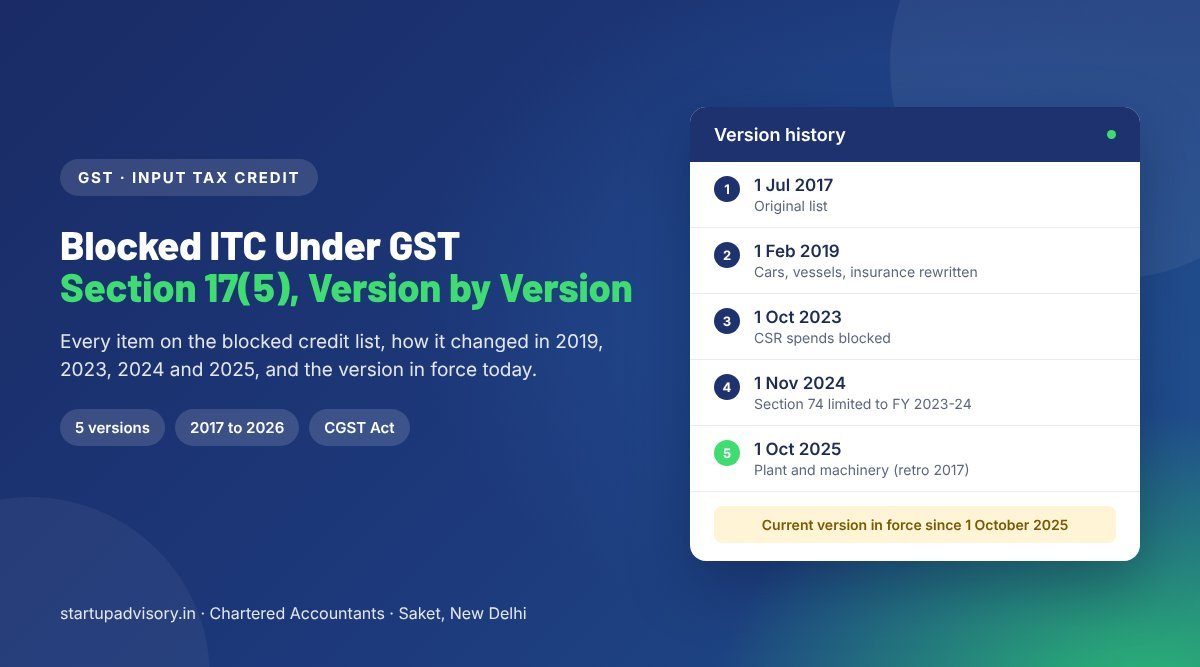
The list opens on the latest version. Type an item in the search box to check whether it is blocked, or use the tabs, the drop-down or a date to see an older version. Each version shows when it took effect, the date the next version replaced it and what changed. Rows marked New or Changed differ from the previous version.
Section 17(5) blocked credit list
Version 5: Plant and machinery (retrospective)
- Effective from
- 1 October 2025
- In force till
- Till date (current)
- Next version from
- None yet
- Amending law
- Finance Act, 2025 (7 of 2025), section 124; in force from 1 October 2025 by Notification No. 16/2025-Central Tax dated 17 September 2025, with the substitution deemed to have been made from 1 July 2017
- Clause (d): “plant or machinery” replaced by “plant and machinery”, deemed from 1 July 2017. This reverses the Supreme Court’s Safari Retreats reading (October 2024).
- The construction Explanation becomes Explanation 1, and a new Explanation 2 overrides any court judgment, decree or order on the point.
| Clause | ITC blocked on | ITC still allowed when |
|---|---|---|
| 17(5)(a) | Motor vehicles for carrying people (up to 13 seats) Motor vehicles for transportation of persons with an approved seating capacity of not more than 13 persons (including the driver). | When used for further supply of such motor vehicles, transportation of passengers, or imparting training on driving such motor vehicles. Goods carriages and vehicles seating more than 13 are outside this block. |
| 17(5)(aa) | Vessels and aircraft Vessels and aircraft. | When used (i) for further supply of such vessels or aircraft, transportation of passengers, imparting training on navigating such vessels or imparting training on flying such aircraft; or (ii) for transportation of goods. |
| 17(5)(ab) | Insurance, servicing, repair and maintenance of those vehicles Services of general insurance, servicing, repair and maintenance, so far as they relate to the motor vehicles, vessels or aircraft covered by (a) or (aa). | Where those vehicles, vessels or aircraft are used for the permitted purposes in (a) or (aa); or where received by a taxable person engaged in manufacturing such vehicles, vessels or aircraft, or supplying general insurance services for those insured by him. |
| 17(5)(b)(i) | Food, catering, beauty, health, cosmetic, vehicle hire, life and health insurance Food and beverages, outdoor catering, beauty treatment, health services, cosmetic and plastic surgery, leasing, renting or hiring of motor vehicles, vessels or aircraft covered by (a) or (aa) (except when used for the permitted purposes), life insurance and health insurance. | Where the inward supply is used to make an outward taxable supply of the same category, or as an element of a taxable composite or mixed supply. Also allowed where it is obligatory for an employer to provide it to employees under any law in force (second proviso to clause (b)). |
| 17(5)(b)(ii) | Club and gym membership Membership of a club, health and fitness centre. | Where it is obligatory for an employer to provide it to employees under any law in force. |
| 17(5)(b)(iii) | Employee holiday travel Travel benefits extended to employees on vacation, such as leave or home travel concession. | Where it is obligatory for an employer to provide it to employees under any law in force. |
| 17(5)(c) | Works contract for immovable property Works contract services supplied for construction of an immovable property (other than plant and machinery). | Where it is an input service for further supply of works contract service. |
| 17(5)(d) | Construction of immovable property on own account Changed Goods or services received for construction of an immovable property (other than “plant and machinery”) on your own account, even when it is used in the course or furtherance of business. Explanation 1: “construction” includes re-construction, renovation, additions, alterations or repairs, to the extent of capitalisation. Explanation 2 (new): notwithstanding any judgment, decree or order of any court, tribunal or authority, every reference to “plant or machinery” is to be read, and always to have been read, as “plant and machinery”. | No exception |
| 17(5)(e) | Composition tax Goods or services on which tax has been paid under section 10 (composition levy). | No exception |
| 17(5)(f) | Non-resident taxable person Goods or services received by a non-resident taxable person. | Goods imported by him. |
| 17(5)(fa) | CSR spends Goods or services received and used, or intended to be used, for activities relating to obligations under corporate social responsibility (CSR) referred to in section 135 of the Companies Act, 2013. | No exception |
| 17(5)(g) | Personal consumption Goods or services used for personal consumption. | No exception |
| 17(5)(h) | Lost, stolen, destroyed, written off, gifts and free samples Goods lost, stolen, destroyed, written off, or disposed of by way of gift or free samples. | No exception |
| 17(5)(i) | Tax paid on fraud demands up to FY 2023-24 Any tax paid in accordance with section 74 in respect of any period up to Financial Year 2023-24. Sections 129 and 130 are no longer named. | No exception |
Version 4: Clause (i) limited to section 74 up to FY 2023-24
- Effective from
- 1 November 2024
- In force till
- 30 September 2025
- Next version from
- 1 October 2025
- Amending law
- Finance (No. 2) Act, 2024 (15 of 2024), section 119, substituting clause (i); in force from 1 November 2024 by Notification No. 17/2024-Central Tax dated 27 September 2024
- Clause (i) now blocks only tax paid under section 74 for periods up to FY 2023-24. Sections 129 and 130 are dropped. Demands for FY 2024-25 onwards are raised under the new section 74A, which clause (i) does not mention.
| Clause | ITC blocked on | ITC still allowed when |
|---|---|---|
| 17(5)(a) | Motor vehicles for carrying people (up to 13 seats) Motor vehicles for transportation of persons with an approved seating capacity of not more than 13 persons (including the driver). | When used for further supply of such motor vehicles, transportation of passengers, or imparting training on driving such motor vehicles. Goods carriages and vehicles seating more than 13 are outside this block. |
| 17(5)(aa) | Vessels and aircraft Vessels and aircraft. | When used (i) for further supply of such vessels or aircraft, transportation of passengers, imparting training on navigating such vessels or imparting training on flying such aircraft; or (ii) for transportation of goods. |
| 17(5)(ab) | Insurance, servicing, repair and maintenance of those vehicles Services of general insurance, servicing, repair and maintenance, so far as they relate to the motor vehicles, vessels or aircraft covered by (a) or (aa). | Where those vehicles, vessels or aircraft are used for the permitted purposes in (a) or (aa); or where received by a taxable person engaged in manufacturing such vehicles, vessels or aircraft, or supplying general insurance services for those insured by him. |
| 17(5)(b)(i) | Food, catering, beauty, health, cosmetic, vehicle hire, life and health insurance Food and beverages, outdoor catering, beauty treatment, health services, cosmetic and plastic surgery, leasing, renting or hiring of motor vehicles, vessels or aircraft covered by (a) or (aa) (except when used for the permitted purposes), life insurance and health insurance. | Where the inward supply is used to make an outward taxable supply of the same category, or as an element of a taxable composite or mixed supply. Also allowed where it is obligatory for an employer to provide it to employees under any law in force (second proviso to clause (b)). |
| 17(5)(b)(ii) | Club and gym membership Membership of a club, health and fitness centre. | Where it is obligatory for an employer to provide it to employees under any law in force. |
| 17(5)(b)(iii) | Employee holiday travel Travel benefits extended to employees on vacation, such as leave or home travel concession. | Where it is obligatory for an employer to provide it to employees under any law in force. |
| 17(5)(c) | Works contract for immovable property Works contract services supplied for construction of an immovable property (other than plant and machinery). | Where it is an input service for further supply of works contract service. |
| 17(5)(d) | Construction of immovable property on own account Retro change, see note Goods or services received for construction of an immovable property (other than “plant or machinery”) on your own account, even when it is used in the course or furtherance of business. Explanation: “construction” includes re-construction, renovation, additions, alterations or repairs, to the extent of capitalisation to the property. | No exception |
| 17(5)(e) | Composition tax Goods or services on which tax has been paid under section 10 (composition levy). | No exception |
| 17(5)(f) | Non-resident taxable person Goods or services received by a non-resident taxable person. | Goods imported by him. |
| 17(5)(fa) | CSR spends Goods or services received and used, or intended to be used, for activities relating to obligations under corporate social responsibility (CSR) referred to in section 135 of the Companies Act, 2013. | No exception |
| 17(5)(g) | Personal consumption Goods or services used for personal consumption. | No exception |
| 17(5)(h) | Lost, stolen, destroyed, written off, gifts and free samples Goods lost, stolen, destroyed, written off, or disposed of by way of gift or free samples. | No exception |
| 17(5)(i) | Tax paid on fraud demands up to FY 2023-24 Changed Any tax paid in accordance with section 74 in respect of any period up to Financial Year 2023-24. Sections 129 and 130 are no longer named. | No exception |
Retrospective note on clause (d): this version was printed with “plant or machinery”. Section 124 of the Finance Act, 2025, in force from 1 October 2025, substituted “plant and machinery” with effect from 1 July 2017. So for this period too, clause (d) is now read as “plant and machinery”: a building or civil structure is not plant, whatever its function.
Version 3: CSR spends blocked
- Effective from
- 1 October 2023
- In force till
- 31 October 2024
- Next version from
- 1 November 2024
- Amending law
- Finance Act, 2023 (8 of 2023), section 139, inserting clause (fa); in force from 1 October 2023 by Notification No. 28/2023-Central Tax dated 31 July 2023
- New clause (fa): goods or services used or intended to be used for CSR obligations under section 135 of the Companies Act, 2013 are blocked.
| Clause | ITC blocked on | ITC still allowed when |
|---|---|---|
| 17(5)(a) | Motor vehicles for carrying people (up to 13 seats) Motor vehicles for transportation of persons with an approved seating capacity of not more than 13 persons (including the driver). | When used for further supply of such motor vehicles, transportation of passengers, or imparting training on driving such motor vehicles. Goods carriages and vehicles seating more than 13 are outside this block. |
| 17(5)(aa) | Vessels and aircraft Vessels and aircraft. | When used (i) for further supply of such vessels or aircraft, transportation of passengers, imparting training on navigating such vessels or imparting training on flying such aircraft; or (ii) for transportation of goods. |
| 17(5)(ab) | Insurance, servicing, repair and maintenance of those vehicles Services of general insurance, servicing, repair and maintenance, so far as they relate to the motor vehicles, vessels or aircraft covered by (a) or (aa). | Where those vehicles, vessels or aircraft are used for the permitted purposes in (a) or (aa); or where received by a taxable person engaged in manufacturing such vehicles, vessels or aircraft, or supplying general insurance services for those insured by him. |
| 17(5)(b)(i) | Food, catering, beauty, health, cosmetic, vehicle hire, life and health insurance Food and beverages, outdoor catering, beauty treatment, health services, cosmetic and plastic surgery, leasing, renting or hiring of motor vehicles, vessels or aircraft covered by (a) or (aa) (except when used for the permitted purposes), life insurance and health insurance. | Where the inward supply is used to make an outward taxable supply of the same category, or as an element of a taxable composite or mixed supply. Also allowed where it is obligatory for an employer to provide it to employees under any law in force (second proviso to clause (b)). |
| 17(5)(b)(ii) | Club and gym membership Membership of a club, health and fitness centre. | Where it is obligatory for an employer to provide it to employees under any law in force. |
| 17(5)(b)(iii) | Employee holiday travel Travel benefits extended to employees on vacation, such as leave or home travel concession. | Where it is obligatory for an employer to provide it to employees under any law in force. |
| 17(5)(c) | Works contract for immovable property Works contract services supplied for construction of an immovable property (other than plant and machinery). | Where it is an input service for further supply of works contract service. |
| 17(5)(d) | Construction of immovable property on own account Retro change, see note Goods or services received for construction of an immovable property (other than “plant or machinery”) on your own account, even when it is used in the course or furtherance of business. Explanation: “construction” includes re-construction, renovation, additions, alterations or repairs, to the extent of capitalisation to the property. | No exception |
| 17(5)(e) | Composition tax Goods or services on which tax has been paid under section 10 (composition levy). | No exception |
| 17(5)(f) | Non-resident taxable person Goods or services received by a non-resident taxable person. | Goods imported by him. |
| 17(5)(fa) | CSR spends New Goods or services received and used, or intended to be used, for activities relating to obligations under corporate social responsibility (CSR) referred to in section 135 of the Companies Act, 2013. | No exception |
| 17(5)(g) | Personal consumption Goods or services used for personal consumption. | No exception |
| 17(5)(h) | Lost, stolen, destroyed, written off, gifts and free samples Goods lost, stolen, destroyed, written off, or disposed of by way of gift or free samples. | No exception |
| 17(5)(i) | Tax paid on fraud demands, detention and confiscation Any tax paid in accordance with sections 74 (demand involving fraud, wilful misstatement or suppression), 129 (detention of goods in transit) and 130 (confiscation). | No exception |
Retrospective note on clause (d): this version was printed with “plant or machinery”. Section 124 of the Finance Act, 2025, in force from 1 October 2025, substituted “plant and machinery” with effect from 1 July 2017. So for this period too, clause (d) is now read as “plant and machinery”: a building or civil structure is not plant, whatever its function.
Version 2: Vehicles, vessels and insurance rewritten
- Effective from
- 1 February 2019
- In force till
- 30 September 2023
- Next version from
- 1 October 2023
- Amending law
- CGST (Amendment) Act, 2018 (31 of 2018), section 9, substituting clauses (a) and (b); in force from 1 February 2019 by Notification No. 02/2019-Central Tax dated 29 January 2019
- Clause (a) narrowed to motor vehicles for carrying people with up to 13 seats. Goods vehicles and larger buses are no longer blocked.
- New clause (aa) for vessels and aircraft, and new clause (ab) for general insurance, servicing, repair and maintenance of blocked vehicles, vessels and aircraft.
- Clause (b) rewritten: rent-a-cab replaced by leasing, renting or hiring of blocked vehicles; life and health insurance moved into (b)(i); a general proviso allows credit where an employer is obliged by law to provide the item to employees.
| Clause | ITC blocked on | ITC still allowed when |
|---|---|---|
| 17(5)(a) | Motor vehicles for carrying people (up to 13 seats) Changed Motor vehicles for transportation of persons with an approved seating capacity of not more than 13 persons (including the driver). | When used for further supply of such motor vehicles, transportation of passengers, or imparting training on driving such motor vehicles. Goods carriages and vehicles seating more than 13 are outside this block. |
| 17(5)(aa) | Vessels and aircraft New Vessels and aircraft. | When used (i) for further supply of such vessels or aircraft, transportation of passengers, imparting training on navigating such vessels or imparting training on flying such aircraft; or (ii) for transportation of goods. |
| 17(5)(ab) | Insurance, servicing, repair and maintenance of those vehicles New Services of general insurance, servicing, repair and maintenance, so far as they relate to the motor vehicles, vessels or aircraft covered by (a) or (aa). | Where those vehicles, vessels or aircraft are used for the permitted purposes in (a) or (aa); or where received by a taxable person engaged in manufacturing such vehicles, vessels or aircraft, or supplying general insurance services for those insured by him. |
| 17(5)(b)(i) | Food, catering, beauty, health, cosmetic, vehicle hire, life and health insurance Changed Food and beverages, outdoor catering, beauty treatment, health services, cosmetic and plastic surgery, leasing, renting or hiring of motor vehicles, vessels or aircraft covered by (a) or (aa) (except when used for the permitted purposes), life insurance and health insurance. | Where the inward supply is used to make an outward taxable supply of the same category, or as an element of a taxable composite or mixed supply. Also allowed where it is obligatory for an employer to provide it to employees under any law in force (second proviso to clause (b)). |
| 17(5)(b)(ii) | Club and gym membership Changed Membership of a club, health and fitness centre. | Where it is obligatory for an employer to provide it to employees under any law in force. |
| 17(5)(b)(iii) | Employee holiday travel Changed Travel benefits extended to employees on vacation, such as leave or home travel concession. | Where it is obligatory for an employer to provide it to employees under any law in force. |
| 17(5)(c) | Works contract for immovable property Works contract services supplied for construction of an immovable property (other than plant and machinery). | Where it is an input service for further supply of works contract service. |
| 17(5)(d) | Construction of immovable property on own account Retro change, see note Goods or services received for construction of an immovable property (other than “plant or machinery”) on your own account, even when it is used in the course or furtherance of business. Explanation: “construction” includes re-construction, renovation, additions, alterations or repairs, to the extent of capitalisation to the property. | No exception |
| 17(5)(e) | Composition tax Goods or services on which tax has been paid under section 10 (composition levy). | No exception |
| 17(5)(f) | Non-resident taxable person Goods or services received by a non-resident taxable person. | Goods imported by him. |
| 17(5)(g) | Personal consumption Goods or services used for personal consumption. | No exception |
| 17(5)(h) | Lost, stolen, destroyed, written off, gifts and free samples Goods lost, stolen, destroyed, written off, or disposed of by way of gift or free samples. | No exception |
| 17(5)(i) | Tax paid on fraud demands, detention and confiscation Any tax paid in accordance with sections 74 (demand involving fraud, wilful misstatement or suppression), 129 (detention of goods in transit) and 130 (confiscation). | No exception |
Retrospective note on clause (d): this version was printed with “plant or machinery”. Section 124 of the Finance Act, 2025, in force from 1 October 2025, substituted “plant and machinery” with effect from 1 July 2017. So for this period too, clause (d) is now read as “plant and machinery”: a building or civil structure is not plant, whatever its function.
Version 1: Original list
- Effective from
- 1 July 2017
- In force till
- 31 January 2019
- Next version from
- 1 February 2019
- Amending law
- CGST Act, 2017 (12 of 2017), as enacted
- The original blocked credit list that applied from the day GST began.
| Clause | ITC blocked on | ITC still allowed when |
|---|---|---|
| 17(5)(a) | Motor vehicles and other conveyances All motor vehicles and other conveyances: cars, buses, trucks, vessels, aircraft and so on. | When used (i) for making these taxable supplies: further supply of such vehicles or conveyances, transportation of passengers, or imparting training on driving, flying or navigating them; or (ii) for transportation of goods. |
| 17(5)(b)(i) | Food, catering, beauty, health and cosmetic services Food and beverages, outdoor catering, beauty treatment, health services, cosmetic and plastic surgery. | Where a registered person uses the inward supply to make an outward taxable supply of the same category, or as an element of a taxable composite or mixed supply. |
| 17(5)(b)(ii) | Club and gym membership Membership of a club, health and fitness centre. | No exception |
| 17(5)(b)(iii) | Rent-a-cab, life insurance and health insurance Rent-a-cab, life insurance and health insurance. | (A) Where the Government notifies the service as obligatory for an employer to provide to its employees under any law; or (B) where the inward supply is used to make an outward taxable supply of the same category, or as part of a taxable composite or mixed supply. |
| 17(5)(b)(iv) | Employee holiday travel Travel benefits extended to employees on vacation, such as leave or home travel concession. | No exception |
| 17(5)(c) | Works contract for immovable property Works contract services supplied for construction of an immovable property (other than plant and machinery). | Where it is an input service for further supply of works contract service. |
| 17(5)(d) | Construction of immovable property on own account Retro change, see note Goods or services received for construction of an immovable property (other than “plant or machinery”) on your own account, even when it is used in the course or furtherance of business. Explanation: “construction” includes re-construction, renovation, additions, alterations or repairs, to the extent of capitalisation to the property. | No exception |
| 17(5)(e) | Composition tax Goods or services on which tax has been paid under section 10 (composition levy). | No exception |
| 17(5)(f) | Non-resident taxable person Goods or services received by a non-resident taxable person. | Goods imported by him. |
| 17(5)(g) | Personal consumption Goods or services used for personal consumption. | No exception |
| 17(5)(h) | Lost, stolen, destroyed, written off, gifts and free samples Goods lost, stolen, destroyed, written off, or disposed of by way of gift or free samples. | No exception |
| 17(5)(i) | Tax paid on fraud demands, detention and confiscation Any tax paid in accordance with sections 74 (demand involving fraud, wilful misstatement or suppression), 129 (detention of goods in transit) and 130 (confiscation). | No exception |
Retrospective note on clause (d): this version was printed with “plant or machinery”. Section 124 of the Finance Act, 2025, in force from 1 October 2025, substituted “plant and machinery” with effect from 1 July 2017. So for this period too, clause (d) is now read as “plant and machinery”: a building or civil structure is not plant, whatever its function.
The tables summarise the statutory wording in plain English. For exact words, read section 17(5) of the CGST Act and the amending Acts listed under each version.
2. All versions at a glance
| Version | Effective from | In force till | Amending law and notification |
|---|---|---|---|
| Version 1 | 1 July 2017 | 31 January 2019 | CGST Act, 2017 (12 of 2017), as enacted |
| Version 2 | 1 February 2019 | 30 September 2023 | CGST (Amendment) Act, 2018 (31 of 2018), section 9, substituting clauses (a) and (b); in force from 1 February 2019 by Notification No. 02/2019-Central Tax dated 29 January 2019 |
| Version 3 | 1 October 2023 | 31 October 2024 | Finance Act, 2023 (8 of 2023), section 139, inserting clause (fa); in force from 1 October 2023 by Notification No. 28/2023-Central Tax dated 31 July 2023 |
| Version 4 | 1 November 2024 | 30 September 2025 | Finance (No. 2) Act, 2024 (15 of 2024), section 119, substituting clause (i); in force from 1 November 2024 by Notification No. 17/2024-Central Tax dated 27 September 2024 |
| Version 5 | 1 October 2025 | Current | Finance Act, 2025 (7 of 2025), section 124; in force from 1 October 2025 by Notification No. 16/2025-Central Tax dated 17 September 2025, with the substitution deemed to have been made from 1 July 2017 |
Only the Finance Act, 2025 change is retrospective. Every other amendment applies from its effective date only, so an older period keeps the older list. When the effective date and the version matter, look at when you received the goods or services.
3. Where the list sits in the law
Section 16(1) of the CGST Act gives a registered person the right to take credit of tax charged on supplies used in the course or furtherance of business. Section 17(5) opens with “notwithstanding anything contained in sub-section (1) of section 16 and sub-section (1) of section 18”, so it overrides that right. If an item is on the list and no exception applies, the GST on it is a cost, even though the purchase is a genuine business expense.
The IGST Act applies these provisions to integrated tax through section 20, and each state’s SGST Act has the same list. So the block applies equally to CGST, SGST, UTGST and IGST.
Two definitions matter. “Construction” in clauses (c) and (d) includes re-construction, renovation, additions, alterations or repairs, to the extent of capitalisation to the immovable property. “Plant and machinery”, defined in the Explanation at the end of section 17, means apparatus, equipment and machinery fixed to earth by foundation or structural support, used to make outward supplies, including that foundation and support. It excludes land, buildings and other civil structures, telecommunication towers and pipelines laid outside the factory premises.
4. Each blocked item explained
| Item (current clause) | Typical examples | Practical point |
|---|---|---|
| Passenger vehicles up to 13 seats (a) | Company cars, SUVs, staff cars | Goods vehicles, buses seating more than 13, and cars of dealers, taxi operators and driving schools are outside the block. Before 1 February 2019 the block covered all motor vehicles and conveyances, except those used for the listed supplies or for carrying goods. |
| Vessels and aircraft (aa) | Company jets, yachts | Allowed for airlines, shipping lines, flying and navigation schools, goods transport and resale. |
| Insurance, servicing, repair of those vehicles (ab) | Car insurance, service bills, spares fitted in servicing | Follows the vehicle: if the vehicle is blocked, so is its upkeep. Manufacturers of such vehicles and general insurers insuring them can claim. |
| Food and beverages, outdoor catering (b)(i) | Staff lunches, client meetings, event catering | Allowed for a caterer or hotel buying the same category, or when it is part of a taxable composite supply such as an event package, or when the law obliges you to provide it to employees. |
| Beauty, health, cosmetic and plastic surgery (b)(i) | Salon services, medical services for staff | Allowed only for the same category onward or a statutory obligation. |
| Hiring of blocked vehicles (b)(i) | Cab hire for employees, car leases | From 1 February 2019 this replaced “rent-a-cab”. Allowed if the vehicle would be outside the block, or for the same category, or where the law requires you to provide transport. |
| Life and health insurance (b)(i) | Group term cover, group mediclaim | Allowed where the law obliges the employer to provide it. From 22 September 2025, policies for individuals and families are exempt, so there may be no GST at all. |
| Club, health and fitness membership (b)(ii) | Gym, golf or club fees for directors | Allowed only where the law obliges the employer to provide it, which is rare. |
| Employee holiday travel (b)(iii) | Leave travel, home travel concession | Business travel is not covered by this clause. Only vacation travel benefits are blocked. |
| Works contract for immovable property (c) | Civil contractor building your office | Allowed for a works contractor who uses the service to supply works contract onward. Plant and machinery is outside the block. |
| Own-account construction (d) | Cement, steel, architect fees, interiors capitalised to a building | Repairs charged to profit and loss are not “construction”, because the definition covers repairs only to the extent capitalised. Buildings are never plant and machinery after the 2025 amendment. |
| Composition purchases (e) | Goods or services on which tax was paid under section 10 | A composition supplier issues a bill of supply, so there is normally no GST to claim. |
| Non-resident taxable person (f) | Foreign exhibitor registered for a trade fair | Credit is allowed on goods the non-resident imports. |
| CSR spends (fa), from 1 October 2023 | Goods donated or services bought for CSR projects | Applies to goods and services used or intended for CSR obligations under section 135 of the Companies Act, 2013. |
| Personal consumption (g) | Directors’ personal purchases booked in the company | Personal use is never business use, so credit fails under section 16 too. |
| Lost, stolen, destroyed, written off, gifts, free samples (h) | Diwali gifts, sample stock, inventory write-offs | Reverse credit already taken when the event happens. |
| Tax paid on fraud demands (i) | Tax paid after a section 74 order for FY 2023-24 or earlier | Before 1 November 2024 clause (i) also named sections 129 (detention) and 130 (confiscation). |
5. The 2025 retrospective change to clause (d)
Clause (c) always said “plant and machinery”, but clause (d) said “plant or machinery”. In Chief Commissioner of CGST v. Safari Retreats Pvt Ltd (October 2024), the Supreme Court held that the difference mattered. It said that under clause (d) a building could be “plant” if it was essential to the business, such as a mall built to be let out, and laid down a functionality test for each case.
Parliament responded through section 124 of the Finance Act, 2025. It substituted “plant and machinery” in clause (d), deemed to have been substituted from 1 July 2017, and inserted Explanation 2, which overrides “any judgment, decree or order of any court, tribunal or other authority”. Section 124 was brought into force on 1 October 2025 by Notification No. 16/2025-Central Tax dated 17 September 2025.
That is why the selector shows the 2025 change as Version 5, effective 1 October 2025, and also flags clause (d) in Versions 1 to 4. The older versions were printed with “plant or machinery”, but from 1 October 2025 they are read as “plant and machinery”. In practice, ITC on constructing a building on your own account is blocked for every period since GST began, whatever the building is used for.
6. Other ways ITC is denied (outside section 17(5))
Section 17(5) is the list of blocked items. Credit on items that are not on the list can still be lost for other reasons:
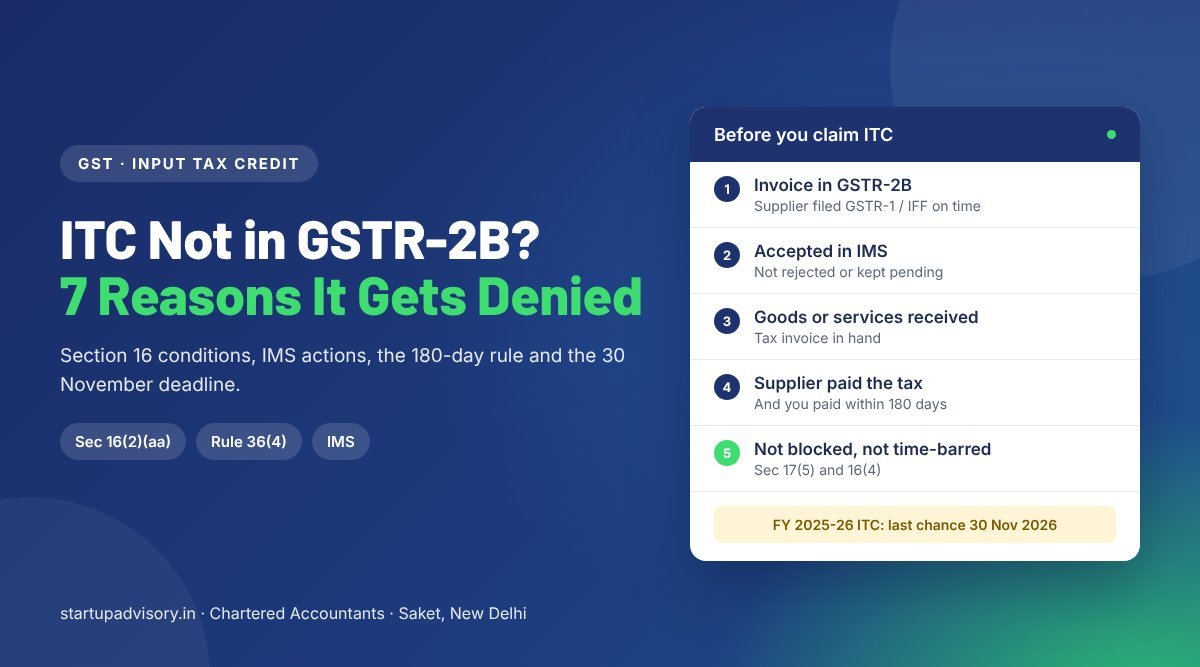
- Section 16(2) conditions: you need a tax invoice or debit note, the goods or services must be received, the supplier must have paid the tax, the invoice must appear in your GSTR-2B (section 16(2)(aa)), and you must file your return.
- Payment within 180 days: if you do not pay the supplier within 180 days of the invoice date, the credit is reversed with interest and can be re-claimed when you pay (second proviso to section 16(2)).
- Time limit, section 16(4): credit for a financial year must be claimed by 30 November of the next year or the date of filing the annual return, whichever is earlier.
- Missing from GSTR-2B: for credit that is not blocked but does not show up, see 7 reasons ITC is not showing in GSTR-2B.
- Depreciation on tax, section 16(3): if you claim income-tax depreciation on the GST component of a capital asset, no ITC on that tax.
- Exempt and non-business use, section 17(1) and (2): credit used partly for exempt supplies or non-business purposes is apportioned under rules 42 and 43.
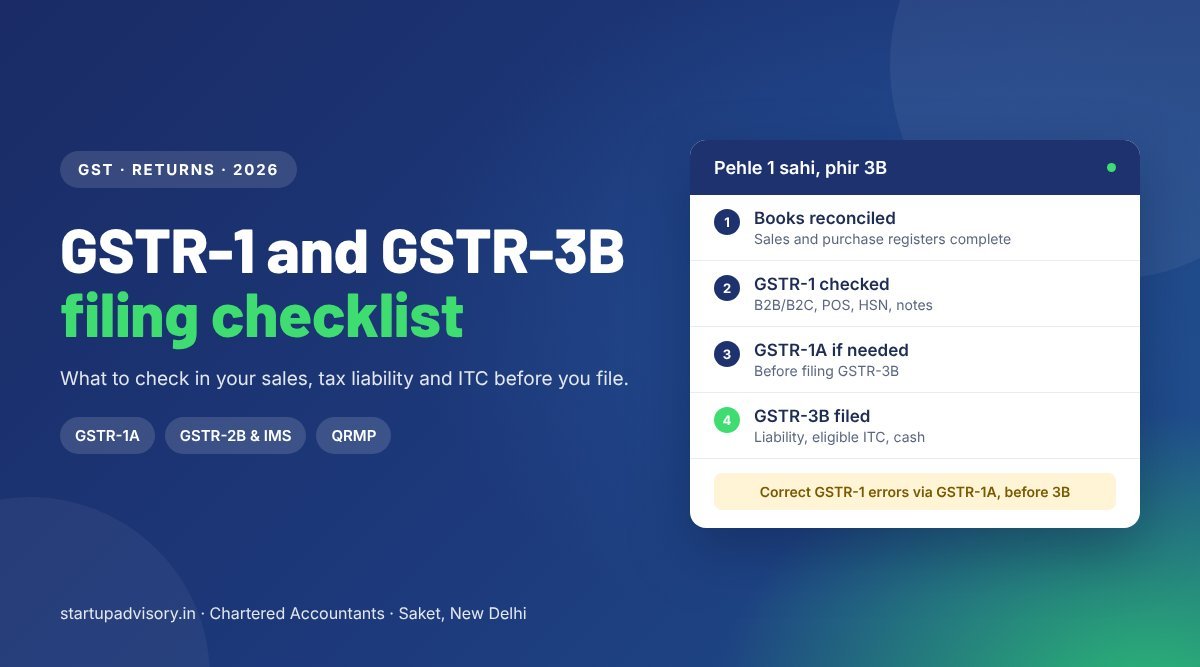
For a monthly routine that catches these before you file, see our GSTR-1 and GSTR-3B filing checklist.
7. Reporting blocked credit in GSTR-3B
- Tag blocked purchases in your books. Map expense heads such as staff welfare, motor car, CSR, gifts and building work-in-progress to an “ITC blocked” flag in Tally, Zoho or your ERP.
- Report the full credit as it appears in GSTR-2B in Table 4(A) of GSTR-3B.
- Reverse the blocked part in Table 4(B)(1), which is meant for credit reversed under rules 38, 42, 43 and section 17(5).
- Check net ITC in Table 4(C) against your books, and keep the working for the annual return.
- Fix mistakes promptly. If blocked credit was claimed and used, reverse it and pay interest under section 50.
8. Common mistakes
- Claiming credit on a company car because it is used only for business. Business use does not lift the block on passenger vehicles up to 13 seats.
- Assuming the 2019 relaxation applies to earlier years. Version 1 still governs credits for July 2017 to January 2019.
- Relying on Safari Retreats to claim credit on a building after 1 October 2025. The retrospective amendment applies from 1 July 2017.
- Booking CSR purchases under general expense heads and claiming credit after 1 October 2023.
- Forgetting to reverse credit on stock written off, given as gifts or used as free samples.
- Treating capitalised renovation as a revenue repair to keep the credit. The accounting treatment decides the answer.
- Treating employee welfare as always blocked. Where a law obliges the employer to provide an item, the proviso allows credit.
- CBIC, CGST Act, 2017, updated up to 31 August 2021: section 17(5), with footnotes giving the original 2017 text of clauses (a) and (b) and their substitution by the CGST (Amendment) Act, 2018 with effect from 1 February 2019
- GST Council, Notification No. 28/2023-Central Tax dated 31 July 2023: sections 137 to 162 of the Finance Act, 2023 (except 149 to 154) in force from 1 October 2023
- GST Council, Notification No. 17/2024-Central Tax dated 27 September 2024: most CGST provisions of the Finance (No. 2) Act, 2024 in force from 1 November 2024
- Gazette of India, Finance (No. 2) Act, 2024, CGST extract: section 119 substitutes clause (i) (“sections 74, 129 and 130” replaced by “section 74 in respect of any period up to Financial Year 2023-24”)
- ICAI, Handbook on Blocked Credit under GST (November 2025): current text of section 17(5) with amendment footnotes (Notification Nos. 02/2019, 28/2023, 17/2024 and 16/2025-Central Tax)
- Notification No. 16/2025-Central Tax dated 17 September 2025: sections 122 to 124 (among others) of the Finance Act, 2025 in force from 1 October 2025
- Finance Bill, 2026 (Bill No. 3 of 2026), clauses 137 to 140: amendments to CGST sections 15, 34, 54 and 101A only
This article is general information, not tax advice. It reflects section 17(5) of the CGST Act and the amending Acts and notifications listed above, as read on 18 November 2026. Whether credit is blocked often depends on facts, such as how a vehicle is used or whether an item is capitalised, so take advice on your own case.
How Startup Advisory Can Help
Startup Advisory, in association with KNAP Advisory Private Limited, is a CA-led firm in Saket, New Delhi that runs GST compliance for businesses and finance teams across Delhi NCR:
- ITC review: we go through your expense ledgers, tag blocked items under the right version of section 17(5) and quantify reversals before a notice does.
- Monthly returns: GSTR-1 and GSTR-3B with Table 4 worked from your books, GSTR-2B and IMS.
- Notices and audits: replies to ITC mismatch and blocked credit notices, including construction and vehicle disputes.
Call 9311972982 or book a free consultation.