
Income Tax / ITR
Belated vs Revised vs Updated Return (ITR-U): Which One to File for AY 2026-27
Reviewed by CA Neeraj Rohilla, FCA — Chartered Accountant, Startup Advisory, Saket, New Delhi.
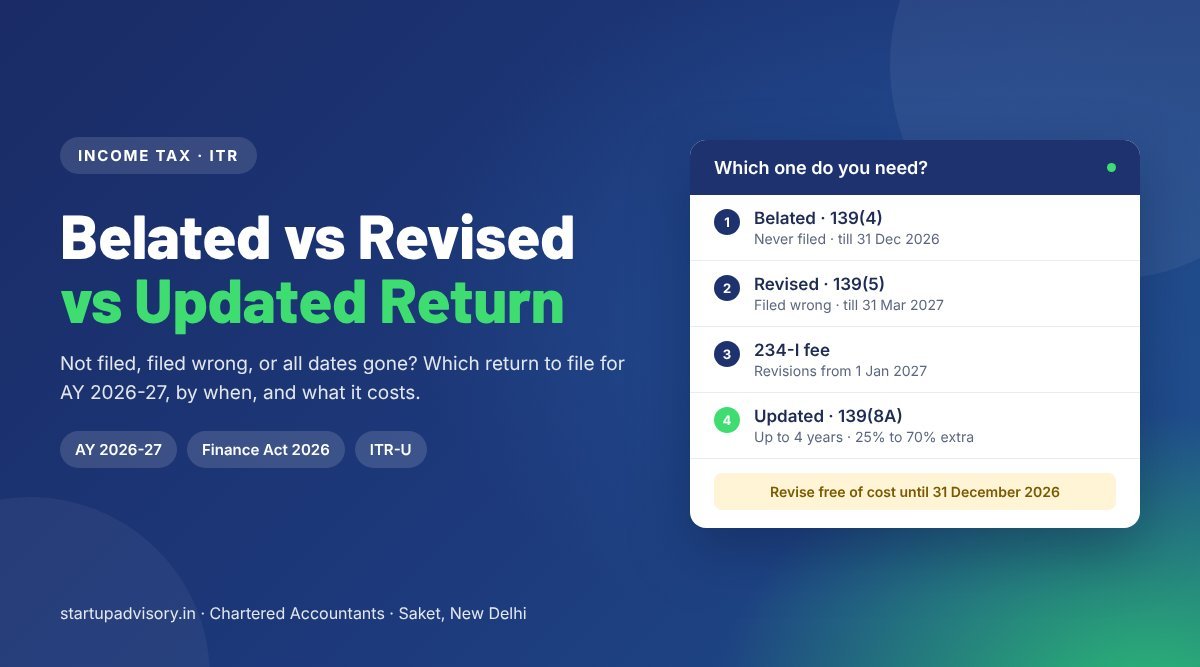
- Not filed at all? File a belated return under Section 139(4) by 31 December 2026, with a late fee.
- Filed, but something is wrong? File a revised return under Section 139(5). For AY 2026-27 the window now runs to 31 March 2027; it is free until 31 December 2026 and carries a fee after that.
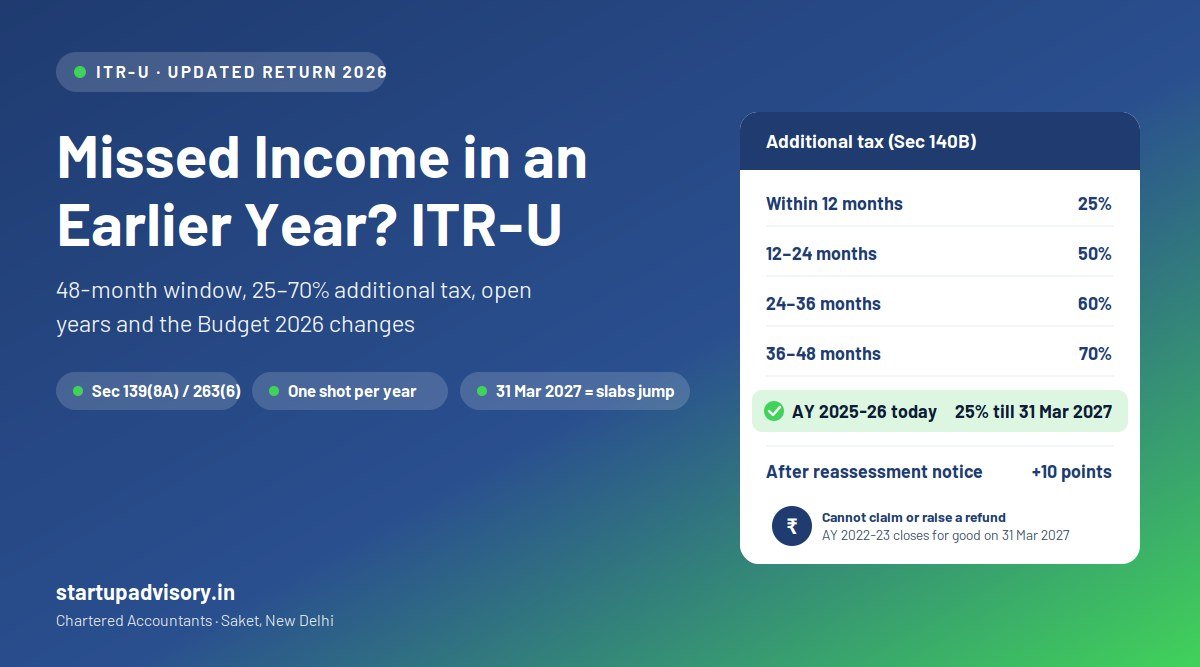
- Both dates gone, and you owe more tax? File an updated return (ITR-U) under Section 139(8A), up to 48 months from the end of the assessment year, with 25% to 70% additional tax.
From Tax Year 2026-27 these move to Section 263 of the Income-tax Act, 2025. Returns for AY 2026-27 and earlier still use the 1961 Act sections above.
Every year we get the same three messages after 31 July: “I forgot to file”, “I filed but missed my FD interest” and “I just found a capital gain from two years ago”. Each one needs a different return, and picking the wrong one either costs extra or gets rejected.
This guide covers the three options for FY 2025-26 (AY 2026-27), what each costs, and the changes made by the Finance Act, 2026.
1. Belated return: you never filed
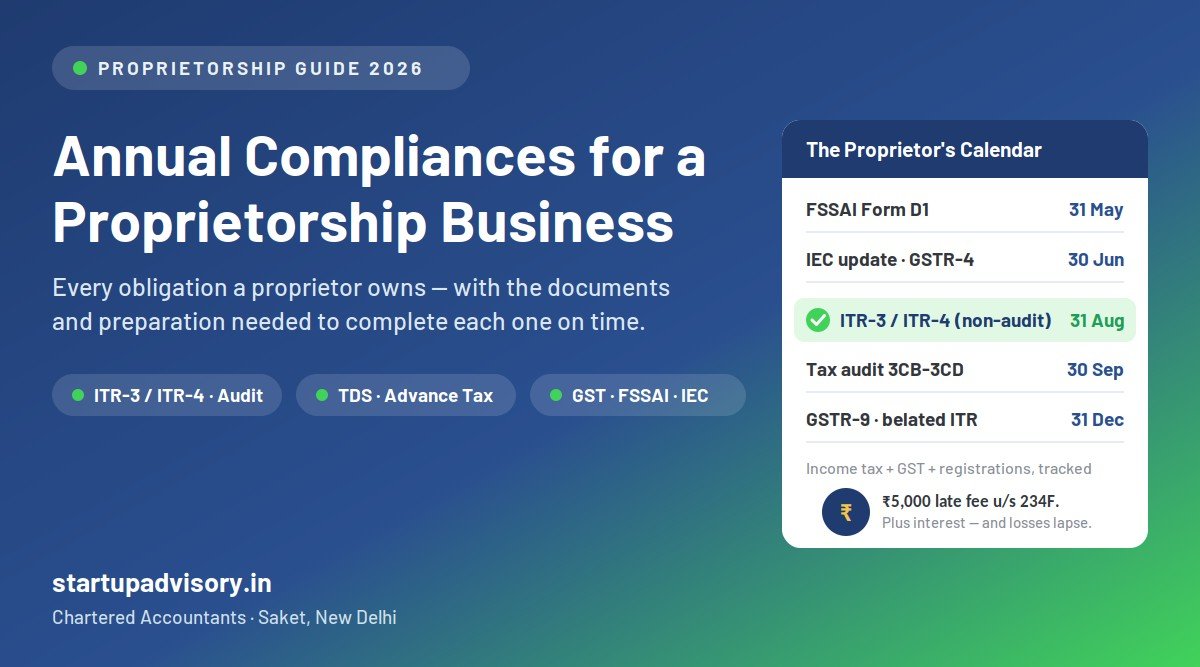
If you missed the due date (31 July 2026 for most individuals, 31 August 2026 for non-audit ITR-3 and ITR-4 filers), you can still file a belated return under Section 139(4). The Income Tax Department’s e-filing FAQ says that for AY 2026-27 it may be filed on or before 31 December 2026, or before the assessment is completed, whichever is earlier.
What it costs
- Late fee under Section 234F: ₹5,000. If your total income does not exceed ₹5 lakh, the fee cannot exceed ₹1,000.
- Interest under Section 234A: 1% a month on any tax still unpaid, from the day after the due date until you file. If all your tax was covered by TDS and advance tax, this is nil.
What you lose by filing late
- Carry-forward of most losses. Business losses and capital losses of the year cannot be carried forward from a belated return. Loss from house property and unabsorbed depreciation are the exceptions.
- The old tax regime, for most people. The choice to opt out of the new regime has to be made in a return filed by the due date (or, with business income, in Form 10-IEA by the due date). A belated return is generally taxed under the new regime.
A belated return can be revised later, within the revised-return window below. For the step-by-step filing process, see missed the ITR deadline: how to file a belated return.
2. Revised return: you filed, but something is wrong
A revised return under Section 139(5) replaces a return you already filed (original or belated). Use it for a missed income, a wrong deduction, a wrong ITR form or a TDS mismatch.
The window is now 12 months
The Finance Act, 2026 (assented on 30 March 2026) extended the revised-return window from nine months to twelve months from the end of the financial year. The e-filing FAQ gives the AY 2026-27 date as 31 March 2027, or before the assessment is completed, whichever is earlier.
But the last three months carry a fee
A new fee in Section 234-I applies to a revised return filed more than nine months after the end of the financial year, which for AY 2026-27 means from 1 January 2027:
- ₹1,000 if your total income does not exceed ₹5 lakh;
- ₹5,000 in any other case.
So the practical deadline to revise free of cost is still 31 December 2026, the same day as the belated return deadline.
| Point | AY 2025-26 and earlier | AY 2026-27 |
|---|---|---|
| Last date | 31 December of the assessment year (9 months) | 31 March 2027 (12 months) |
| Fee | None | None till 31 Dec 2026; Section 234-I fee from 1 Jan to 31 Mar 2027 |
| Fee amount | – | ₹1,000 (total income up to ₹5 lakh) / ₹5,000 (others) |
| Cut-off if assessed | Before completion of assessment | Before completion of assessment |
There is no limit on how many times you revise within the window. Each revised return replaces the previous one, so the last one filed is the one that counts. If the revision raises your tax, pay the extra tax and interest by challan before you file it.
3. Updated return (ITR-U): the dates are gone and you owe tax
An updated return under Section 139(8A) lets you report income you left out, even years later, as long as you pay extra. It can be filed whether or not you filed an original, belated or revised return.
Time limit and additional tax
You can file within 48 months from the end of the assessment year. On top of the tax and interest, you pay additional tax as a percentage of that tax and interest:
| Filed within | Additional tax |
|---|---|
| 12 months from end of the assessment year | 25% |
| 12 to 24 months | 50% |
| 24 to 36 months | 60% |
| 36 to 48 months | 70% |
For AY 2026-27, ITR-U opens once the revised-return window closes, that is from 1 April 2027.
When ITR-U is not allowed
- It cannot claim or increase a refund.
- It cannot reduce the tax already declared.
- It cannot be a nil or loss return, where the original was not.
- Only one updated return is allowed per assessment year.
- Not where a search or survey has started, or an assessment or reassessment for that year is pending or completed.
- Under the 1961 Act text, not where a Section 148A show-cause notice is issued more than 36 months after the end of the assessment year (unless the Assessing Officer later decides it is not a fit case for reassessment).
What the Finance Act, 2026 changed
The CBDT’s FAQs on Budget 2026 describe two relaxations in the updated-return provision of the Income-tax Act, 2025 (Section 263(6)):
- After a reassessment notice: an updated return can be filed even after a reassessment notice (Section 280 of the 2025 Act), with 10 percentage points more additional tax: 35%, 60%, 70% and 80% for the four 12-month bands.
- Reducing a loss: an updated return can now be filed where it reduces the loss claimed in the original return.
The CBDT FAQ says these returns may be filed after the enactment of the Finance Act, 2026, which received assent on 30 March 2026. It describes them only under the 2025 Act. If you want to use either relaxation for AY 2026-27 or an earlier year (which follow the 1961 Act), have your CA confirm it applies to that year before you file.
For which years are still open and what each one costs today, see our full ITR-U guide.
4. All three side by side
| Point | Belated | Revised | Updated (ITR-U) |
|---|---|---|---|
| Section (1961 Act) | 139(4) | 139(5) | 139(8A) |
| When to use | Never filed | Filed with an error | Income left out and other dates gone |
| Last date, AY 2026-27 | 31 Dec 2026 | 31 Mar 2027 | 31 Mar 2031 (48 months) |
| Cost | 234F fee ₹1,000 / ₹5,000 + 234A interest | Free till 31 Dec 2026; 234-I fee ₹1,000 / ₹5,000 after | Tax + interest + 25% to 70% additional tax |
| Refund allowed? | Yes | Yes | No |
| Lower tax allowed? | – | Yes | No |
| How many times? | Once | Any number within the window | Once per year |
5. Worked examples
6. Section numbers under the Income-tax Act, 2025
From Tax Year 2026-27 (the year that started on 1 April 2026), returns are filed under the Income-tax Act, 2025:
- Belated, revised and updated returns: Section 263 (the revised return is Section 263(5) and the updated return is Section 263(6)).
- Late-filing fee and the late-revision fee: Section 428, clauses (a) and (b), with the same ₹1,000 / ₹5,000 amounts.
- The revised-return window is 12 months from the end of the tax year, so for Tax Year 2026-27 it runs to 31 March 2028, with the fee after nine months.
Anything for AY 2026-27 or earlier, including this year’s belated and revised returns, still uses the 1961 Act sections. See what changes under the Income-tax Act, 2025.
- Download AIS and Form 26AS and match every income line
- Pay any extra tax and interest by challan first
- Pick the right ITR form for your income
- Keep the acknowledgement number of your original return (for a revised return)
- e-Verify within 30 days, or the return is treated as not filed
- Income Tax Department e-filing portal, Income Tax Returns FAQs (belated return by 31 December 2026; revised return by 31 March 2027; AY 2025-26 and earlier cannot be revised or filed belated after 1 April 2026; updated return 48 months, one per year, no refund or lower tax)
- Income Tax Department, Section 234-I (fee for revised return beyond nine months: ₹1,000 if total income does not exceed five lakh rupees, ₹5,000 otherwise)
- Income Tax Department, Section 234F (late-filing fee)
- Income Tax Department, Section 139 (sub-sections (4), (5) and (8A): forty-eight months, exclusions, Section 148A proviso)
- Income Tax Department, Section 428, Income-tax Act, 2025 (fees for late return and late revision)
- CBDT, FAQs on Budget 2026 (revised return 12 months, Section 428(b) / 234-I fee, updated return slabs, filing after a reassessment notice at 35/60/70/80%, loss reduction)
Sources read on 18 November 2026.
Return mein galti hai? Book a consultation
We check your AIS and 26AS against what you filed, tell you which of the three returns fits, compute the fee or additional tax, and file it before the cheaper window closes.
Book a consultation ITR filing services
General information; every case is different. Speak to your CA before you file.