
GST / Input Tax Credit
ITC Not Showing in GSTR-2B? 7 Reasons Input Tax Credit Gets Denied (and How to Fix Them)
Reviewed by CA Neeraj Rohilla, FCA — Chartered Accountant, Startup Advisory, Saket, New Delhi.
1. How GSTR-2B is built, and why your ITC is missing
GSTR-2B is a statement the GST portal prepares for you every month. You do not file it. It is built from what your suppliers report: their GSTR-1, GSTR-1A or Invoice Furnishing Facility (IFF) for business-to-business (B2B) invoices, debit notes and credit notes, plus a few other sources such as Input Service Distributor (ISD) returns and import data from customs.
The timeline for a normal month looks like this:
| Date | What happens | Who acts |
|---|---|---|
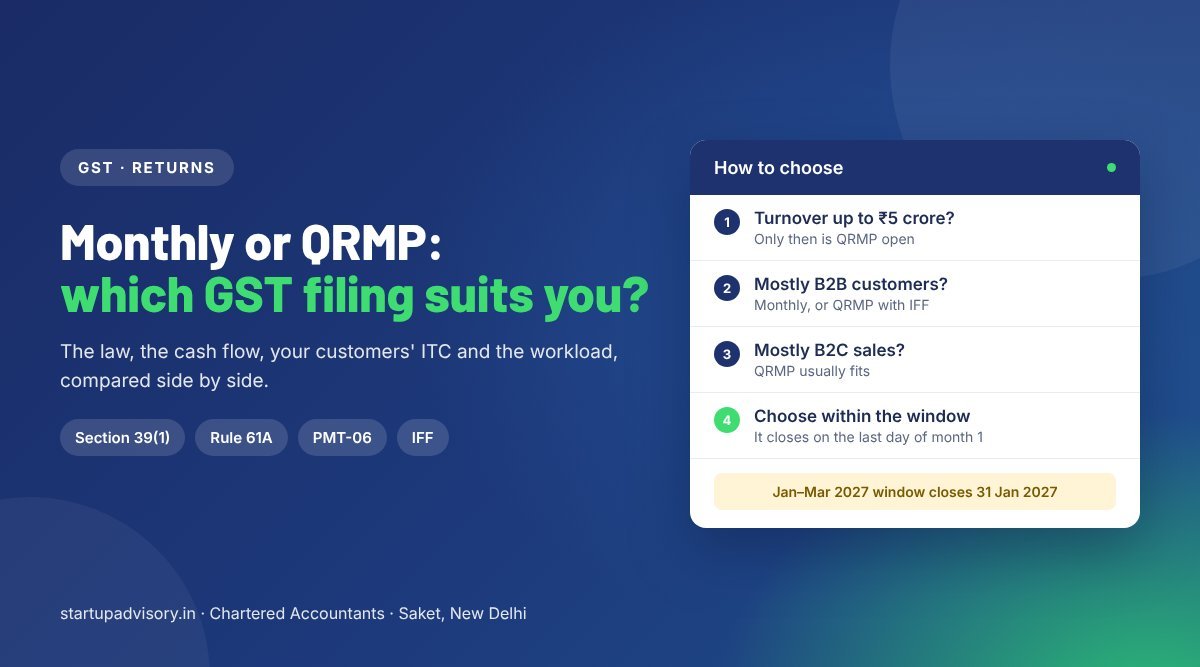
| Through the month to the 11th | Monthly suppliers report your invoices in GSTR-1 (due on the 11th). Quarterly (QRMP) suppliers use IFF from the 1st to the 13th for the first two months of a quarter, and quarterly GSTR-1 by the 13th for the third. | Supplier |
| As they are reported | The invoices appear in your Invoice Management System (IMS), where you can accept, reject or keep them pending. | You |
| 14th | The portal generates your GSTR-2B for the previous month from the records in IMS. | Portal |
| 14th to filing | You can still change IMS actions. If you do, you must recompute GSTR-2B before filing GSTR-3B. | You |
| 20th | GSTR-3B is due for monthly filers (22nd or 24th of the month after the quarter for QRMP filers, depending on the state). ITC is auto-filled from GSTR-2B. | You |
So an invoice can be missing from your GSTR-2B for only a few reasons: the supplier has not reported it yet, reported it after the cut-off, reported it wrongly, or you rejected it or kept it pending in IMS. Each of these has a different fix, which we cover in section 4.
2. IMS: accept, reject or keep pending
The Invoice Management System went live on the GST portal in October 2024, and taxpayers could act on records from 14 October 2024. Every invoice a supplier reports lands in your IMS first. The action you take decides what reaches GSTR-2B:
| Your action in IMS | Effect on GSTR-2B | Effect on GSTR-3B |
|---|---|---|
| Accept | Shown under “ITC Available” | Credit is auto-filled |
| Reject | Shown under “ITC Rejected” | No credit is auto-filled |
| Pending | Not included; stays on the IMS dashboard | No credit for now |
| No action | Deemed accepted when GSTR-2B is generated | Credit is auto-filled |
- Deemed acceptance is not eligibility. An invoice you ignore is treated as accepted, so the credit flows into GSTR-3B. You are still responsible for removing it if it fails a section 16 or 17 test.
- Acting after the 14th. Until you file GSTR-3B you can change any action. GSTN’s FAQs say that after any change following the draft GSTR-2B, you must recompute GSTR-2B so that the new figures flow into GSTR-3B.
- How long “pending” lasts. An invoice kept pending stays in IMS until you act on it or until the section 16(4) time limit passes. Credit notes and certain downward amendments can be kept pending for one tax period only, from the October 2025 tax period; after that the pending option is disabled and, with no action, they are deemed accepted.
- What is not in IMS. Reverse charge (RCM) records, ISD and non-resident documents, and records where credit is not available because of place of supply or the section 16(4) time limit do not go through IMS. RCM records still appear in GSTR-2B. GSTN later added a separate “Import of Goods” section to IMS for bill of entry data, so check that section too if you import.
3. The section 16 conditions for claiming ITC
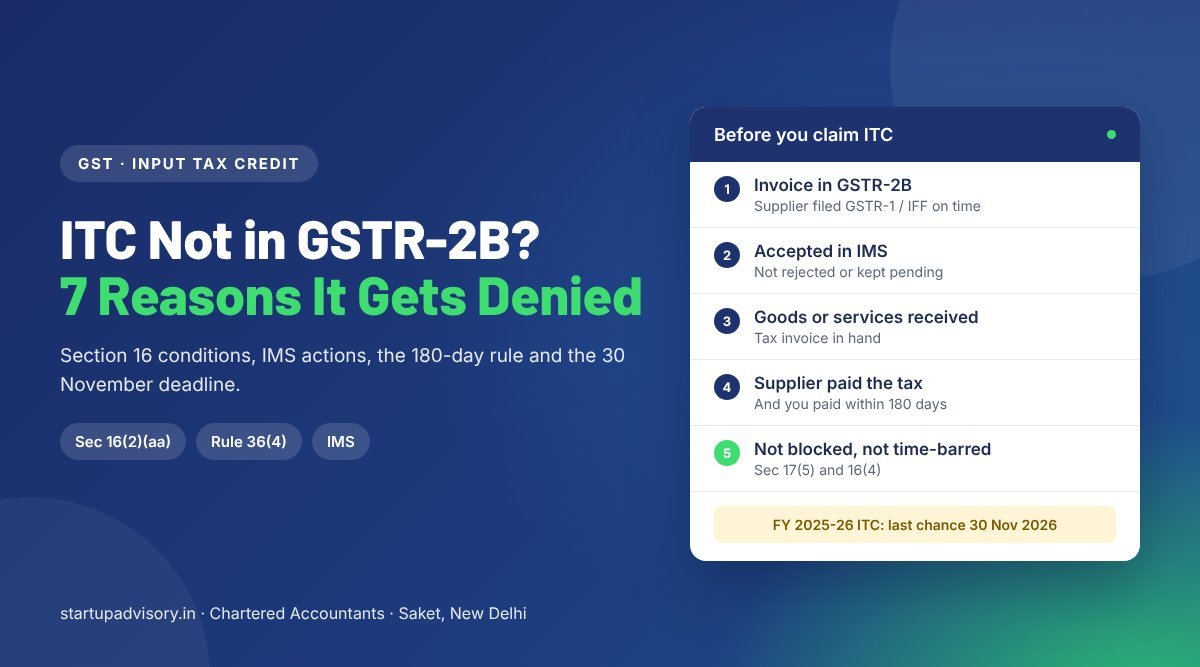
Section 16(2) of the CGST Act lists the conditions. You need all of them, not just a GSTR-2B entry:
| Clause | Condition | What it means in practice |
|---|---|---|
| 16(2)(a) | You hold a tax invoice or debit note | A valid tax invoice from a registered supplier (or another prescribed document, such as a bill of entry for imports). |
| 16(2)(aa) | The supplier has reported it and it is communicated to you | The invoice appears in your GSTR-2B. Rule 36(4) says the same thing in procedure. |
| 16(2)(b) | You have received the goods or services | Includes “bill to, ship to”: goods delivered to another person on your direction, and services provided to another person on your direction and account, count as received by you. |
| 16(2)(ba) | The credit communicated to you has not been restricted | Credit shown to you under section 38 must not be restricted under that section. |
| 16(2)(c) | The supplier has actually paid the tax to the Government | In cash or through its own credit. A supplier who reports the invoice but never files GSTR-3B fails this test. |
| 16(2)(d) | You have filed your own return | Your GSTR-3B under section 39. |
Then come the provisos and limits that catch most businesses:
- Goods in lots: where goods under one invoice come in instalments, credit is available on receipt of the last lot.
- 180-day payment rule: if you do not pay the supplier the value and tax within 180 days of the invoice date, an amount equal to the credit has to be paid back with interest (second proviso to section 16(2) and rule 37). You can take it again when you pay (third proviso).
- Depreciation: no credit on the tax portion of capital goods if you claim depreciation on that tax under the Income-tax Act (section 16(3)).
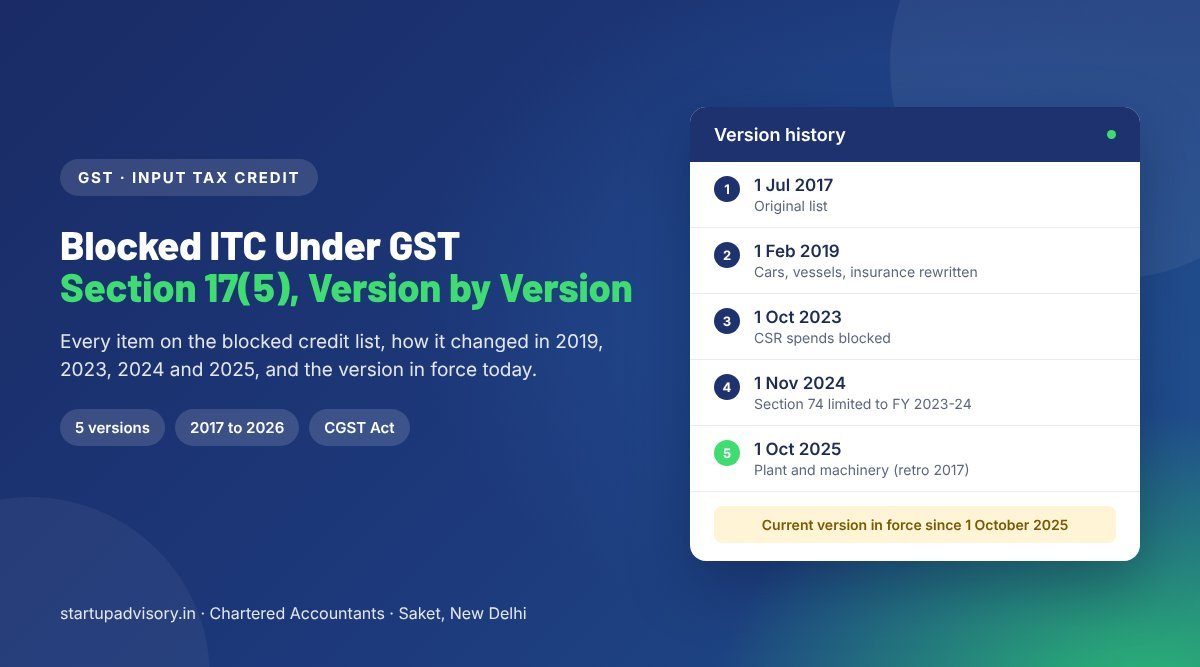
- Blocked credits: section 17(5) blocks credit on items such as most passenger vehicles, food and beverages, club memberships and construction of immovable property. Our version-wise section 17(5) guide lists every item, with a selector for each period since 2017.
- Time limit: no credit after 30 November following the end of the financial year, or the annual return date if earlier (section 16(4)). See section 6.
4. 7 reasons ITC gets denied, and how to fix each one
1. The supplier did not file GSTR-1, or filed after the cut-off
This is the most common reason. If the supplier has not reported the invoice, it is not in your IMS or GSTR-2B, and you cannot claim it. If the supplier reported it after the cut-off (after the 11th for a monthly filer, or the 13th for IFF or quarterly GSTR-1), it lands in next month’s GSTR-2B.
2. Wrong GSTIN or wrong invoice details
If the supplier reported the invoice against a wrong GSTIN (a branch in another state, an old registration, a typing error), it goes into someone else’s GSTR-2B. A wrong invoice number, date or amount makes reconciliation fail. A wrong place of supply can push the invoice into the “ITC Not Available” part of GSTR-2B.
3. You rejected the invoice, or kept it pending, in IMS
A rejected record goes to “ITC Rejected”, and a pending record stays out of GSTR-2B. Both mean no auto-filled credit in GSTR-3B for that month.
4. The supplier did not pay the tax
Section 16(2)(c) requires the tax to be actually paid to the Government. A supplier can report the invoice in GSTR-1, so you see it in GSTR-2B, and then never file GSTR-3B. Under rule 37A, if the supplier has not filed GSTR-3B for that period by 30 September following the end of the financial year, you must reverse the credit in a GSTR-3B filed by 30 November, or pay it with interest. When the supplier later files the return, you can re-avail the credit.
5. The supplier issued a B2C invoice
If you did not give your GSTIN, or the supplier did not record it, the sale is reported as business-to-consumer (B2C). B2C sales never reach your GSTR-2B, so there is no credit, even though you paid GST. Hotel bills, airline tickets, online purchases and small vendors are typical cases.
6. The credit is blocked under section 17(5)
Some credits appear in GSTR-2B and are still not allowed: passenger vehicles up to 13 seats (with exceptions), food and beverages, outdoor catering, health and life insurance (with an employer-obligation exception), club memberships, works contracts and goods or services for construction of immovable property, gifts and free samples, and goods lost, stolen or destroyed.
7. You paid the supplier late, or the claim is time-barred
Two different time rules apply. First, if you do not pay the supplier within 180 days of the invoice date, rule 37 requires you to pay or reverse the credit, in proportion to the unpaid amount, with interest, in the GSTR-3B for the period immediately after the 180 days. You can re-avail it when you pay, and rule 37(4) says the section 16(4) time limit does not apply to that re-availment. Second, under section 16(4), credit not taken by 30 November after the financial year (or the annual return date if earlier) is lost.
5. A monthly reconciliation routine that keeps ITC safe
- By the 5th: close the purchase register for the previous month, with every invoice, debit note and credit note entered exactly as on the document.
- Before the 11th: compare the register with what has arrived in IMS. Remind suppliers whose invoices are missing (13th for quarterly suppliers).
- Before the 14th: act in IMS. Accept what matches, reject with reasons, and keep pending only what you are still checking.
- On or after the 14th: download GSTR-2B and match it invoice by invoice with your books. Our free GSTR-2B vs books reconciliation tool does the first pass.
- Before filing: remove blocked credit, invoices unpaid beyond 180 days and suppliers who have not filed GSTR-3B. Recompute GSTR-2B if you changed any action after the 14th.
- By the 20th: file GSTR-3B, and carry the open items (missing, rejected, pending, reversed) into next month’s follow-up list.
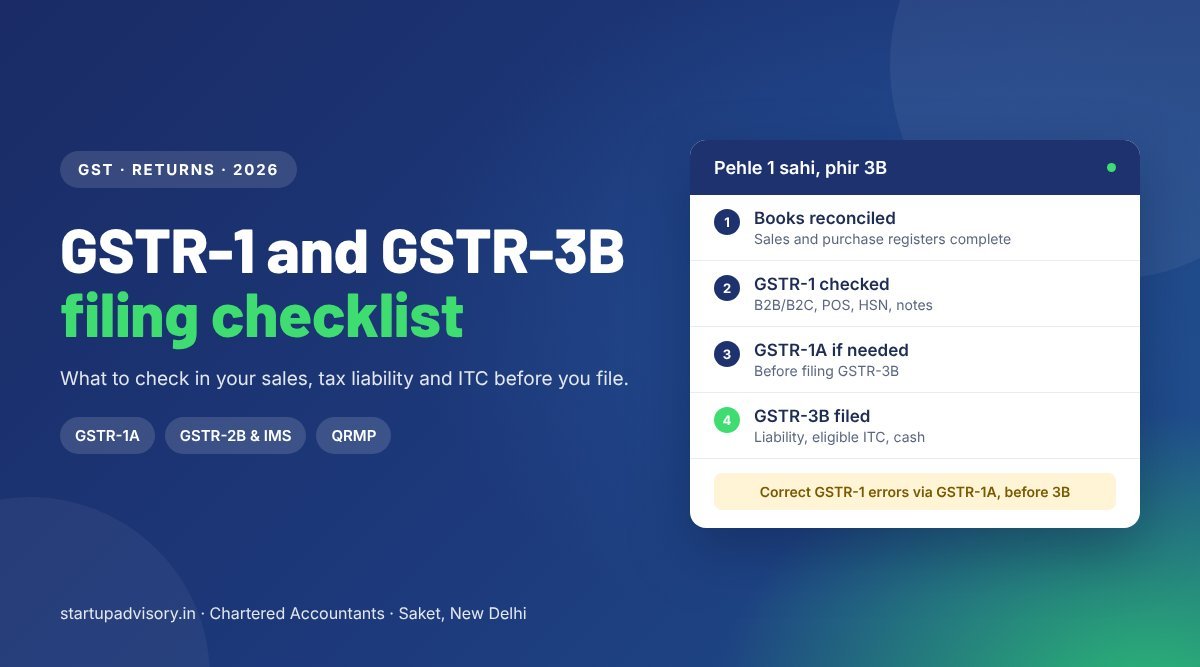
The sales side matters too: your GSTR-1 fills your customers’ GSTR-2B. Our GSTR-1 and GSTR-3B filing checklist covers the full pre-filing review, including GSTR-1A and the GSTR-3B liability lock.
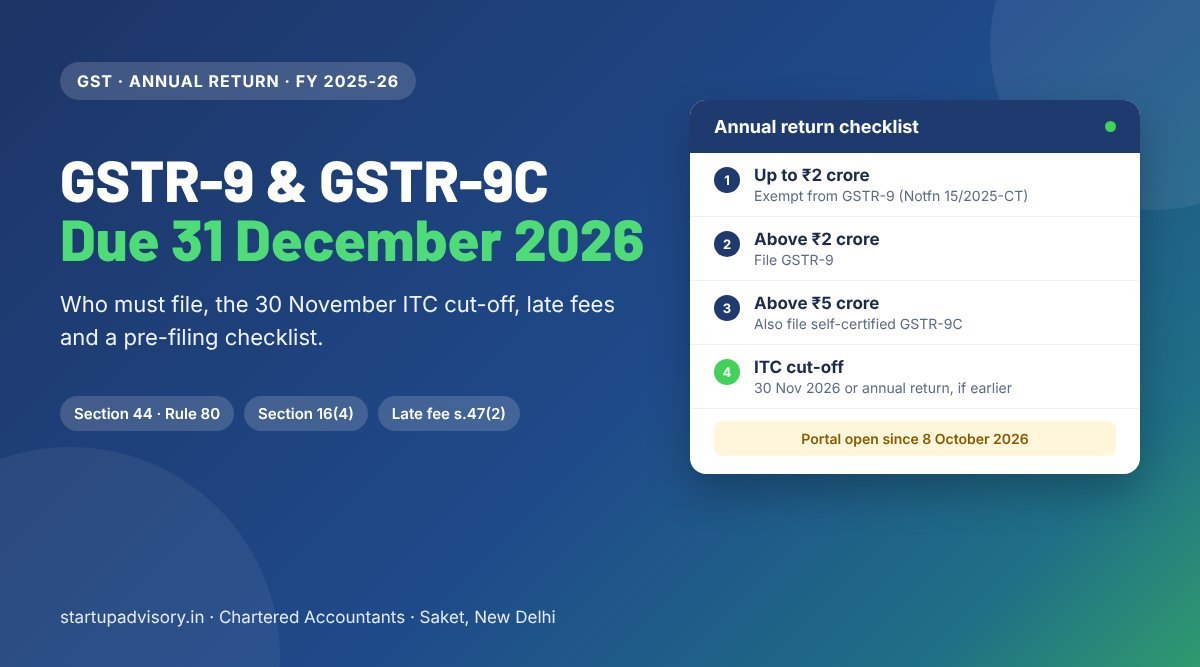
6. The FY 2025-26 deadline: 30 November 2026
Section 16(4), in its form since 1 October 2022, says credit on an invoice or debit note cannot be taken after 30 November following the end of the financial year to which it relates, or after you file the annual return for that year, whichever is earlier. For FY 2025-26 that means:
| You are | Last return to claim FY 2025-26 ITC | What to do now |
|---|---|---|
| Monthly filer | October 2026 GSTR-3B (due 20 November 2026), filed by 30 November 2026 | Review every FY 2025-26 invoice not yet claimed and include it in the October return |
| QRMP (quarterly) filer | July to September 2026 GSTR-3B (due 22 or 24 October 2026); the October to December return is filed after 30 November | If that return is not yet filed, file it by 30 November 2026 with the pending credit |
| Anyone who has filed GSTR-9 for FY 2025-26 | The return filed before the GSTR-9 filing date | Credit not claimed by then is lost; this is why GSTR-9 should not be filed early |
- Rule 37A reversals for FY 2025-26 suppliers who had not filed GSTR-3B by 30 September 2026 are also due by 30 November 2026.
- Re-availment after payment of credit reversed under the 180-day rule is not limited by section 16(4) (rule 37(4)).
- No extension found: we found no notification or GST Council press release extending the section 16(4) date for FY 2025-26 as of 19 November 2026. Check the GST portal before relying on any later date.
For the annual return itself, see our GSTR-9 and GSTR-9C guide for FY 2025-26.
7. What may change from 2027
At its 57th meeting on 8 October 2026, the GST Council recommended several ITC-related changes. None of them is in force yet; the press release says they take effect only through notifications, circulars or law amendments.
- Aligning time limits: amendments to sections 16, 37 and 39 of the CGST Act so that the time limits for correcting GSTR-1 and GSTR-3B line up with the section 16(4) time limit for ITC.
- A new correction mechanism from the April 2027 return: including a rule to align ITC in GSTR-3B with GSTR-2B, a rule placing IMS (accept, reject, pending, and how long credit notes can stay pending) in the CGST Rules, and statements for reverse charge credit and for ITC reversal and reclaim. Public consultation was recommended first.
- Wider ITC under section 17(5): removing the block on items such as outdoor catering, health and life insurance and free samples, once the law is amended.
Our 57th GST Council summary covers the full list.
- CBIC, CGST Act, 2017, section 16, and CGST Rules, 2017, rule 36 and rule 37, read on 19 November 2026; rule 37A as read on taxinformation.cbic.gov.in on 15 November 2026
- GSTN, Frequently Asked Questions on the Invoice Management System (22 September 2024)
- GSTN, Introduction of “Pending” option for credit notes and declaration of reversal amount in IMS (17 October 2025) and Handling of inadvertently rejected records (19 June 2025)
- GST Council, Press release on the recommendations of the 57th meeting (8 October 2026; also PIB release ID 2320934)
This article is general information, not tax advice. It reflects the CGST Act and Rules and GSTN advisories as read on 19 November 2026. Portal functionality changes often, so check the latest advisories on the GST portal before you file.
ITC atka hai? Book a GST reconciliation review
Startup Advisory, in association with KNAP Advisory Private Limited, is a CA-led firm in Saket, New Delhi that recovers and protects input tax credit for businesses across Delhi NCR:
- ITC recovery review: books vs GSTR-2B for FY 2025-26, with a list of credit still claimable before 30 November 2026 and suppliers to chase.
- Monthly reconciliation: IMS actions, GSTR-2B matching, rule 37 and 37A tracking, and GSTR-3B filing.
- Notices: replies to DRC-01C and ITC mismatch notices, with working papers.
Call 9311972982 or book a free consultation.