
MSME Finance
DPR for a Bank Loan: What Banks Check and How to Prepare One
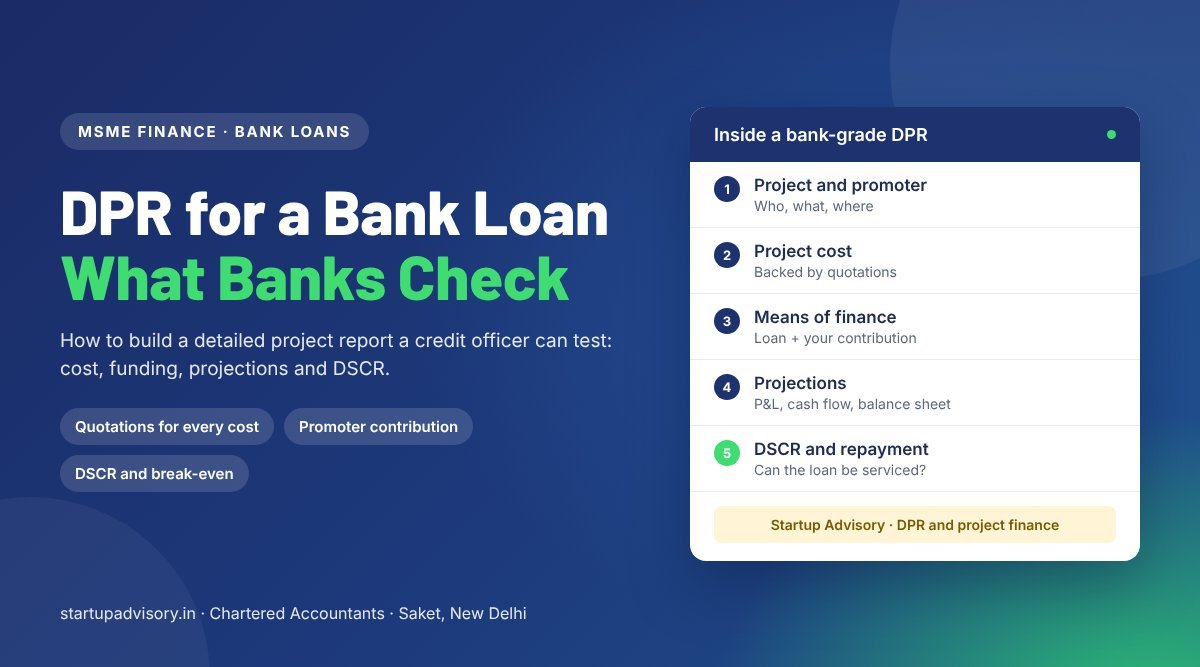
A bank does not lend against an idea. It lends against a file its credit team can defend: a project whose cost is evidenced, whose promoter has money in the game, and whose numbers show the loan being repaid from the business itself. The DPR is that file. A good one shortens appraisal. A weak one is the most common reason a fundable project stalls.
This guide explains what goes into a bank-grade DPR, what the credit officer tests in each section, the RBI rules that protect MSE borrowers during the process, and the mistakes that send reports back. It is written for founders and MSME promoters applying for a term loan or a scheme-linked loan in India, and it follows on from our guide to what investors check in a financial model, which covers the equity side.
1. What is a DPR, and when does a bank ask for one?
A DPR is a structured report that a bank asks for when it is financing a project: a new unit, an expansion, new machinery or a scheme-linked loan. It answers four questions in one document: what is being built, what it costs, who pays for it, and how the loan gets repaid.
There is no single format prescribed by law. Each bank has its own appraisal template, and schemes such as PMEGP publish model project profiles. What RBI does require is that banks give MSME borrowers an indicative checklist of documents when they apply (RBI Master Direction on lending to MSMEs, para 4.7). Ask the branch for that checklist before you start, and build the DPR to it.
| Type of loan | Is a DPR usually needed? |
|---|---|
| Term loan for a new unit or expansion | Yes. This is the core use of a DPR. |
| Scheme-linked loans (PMEGP, PMFME, state schemes) | Yes, in the scheme's or bank's format, with the subsidy built into the means of finance. |
| Machinery or equipment loan | Often a shorter project note with quotations and projections. |
| Working capital (cash credit, overdraft) | Usually not a full DPR; banks look at financial statements, projected turnover and stock and debtor levels. |
2. What should a bank-grade DPR contain?
A bank-grade DPR contains nine parts, and each one answers a question the credit officer will ask. The table shows the parts and what the bank is really checking in each.
| Section | What it shows | What the bank checks |
|---|---|---|
| 1. Executive summary | Project, cost, loan asked for, repayment period, key ratios | Whether the request makes sense on one page |
| 2. Promoter profile | Background, experience, net worth, other businesses | Ability to run this business; credit history |
| 3. Project description | Product or service, location, premises, capacity, process | Whether the premises and approvals are in place |
| 4. Market and sales plan | Customers, pricing, competition, how sales will be won | Whether the sales assumptions are believable |
| 5. Project cost | Land and building, machinery, other assets, pre-operative costs, working capital margin | Quotations behind every major item |
| 6. Means of finance | Term loan, working capital, promoter contribution, subsidy | Promoter money that can be evidenced |
| 7. Projected financials | P&L, cash flow and balance sheet for the loan period | Realistic capacity use, costs that include GST, TDS and payroll obligations |
| 8. Ratios and repayment | DSCR, break-even, repayment schedule with moratorium | Whether cash covers each instalment |
| 9. Annexures | Quotations, KYC, Udyam, premises papers, bank statements, ITRs | That every number above has a document behind it |
3. What do banks check when they appraise a DPR?
Banks check whether the project is viable, whether the promoter is committed and creditworthy, and what happens if things go wrong. In practice that comes down to six tests.
- Cost is evidenced. Machinery and equipment should match supplier quotations, and premises costs should match the sale deed or rent agreement. A round figure with nothing behind it tells the appraiser the cost was guessed.
- Contribution is real. Your share of the cost should be visible in bank statements or already spent on the project. A means of finance that shows promoter money the statements cannot support is where many files stall.
- Sales are believable. Sales should ramp up over time, not start at full capacity in month one, and should be supported by your experience, orders or market evidence.
- Cash covers repayment. The projected cash flow should cover interest and principal every year with a margin. This is the DSCR test (section 4).
- The promoter is creditworthy. Banks look at your credit report, existing loans, past tax returns and how you have run other businesses.
- There is a fallback. Primary security (the assets financed), collateral where it can legally be taken, and credit guarantee cover such as CGTMSE.
4. How is DSCR calculated, and why does it matter so much?
DSCR (debt service coverage ratio) measures how many times the cash the business generates covers the loan payments due in the same year, and it is the single number most credit officers look at first. A common working used in project reports is:
DSCR = (Profit after tax + Depreciation + Interest on term loan) ÷ (Interest on term loan + Principal repaid in the year)
A DSCR below 1 means the business cannot meet its instalments from its own cash. Banks set their own minimum average DSCR in their credit policy and also look at the lowest year, so a project that only works in its best year will struggle. Break-even, the sales level at which the business covers all its costs, is usually shown alongside.
5. Do you need collateral, and where does CGTMSE fit?
For micro and small enterprises, you do not need collateral for a loan of up to ₹20 lakh. Para 4.1 of the RBI Master Direction on lending to MSMEs (updated as on 9 February 2026) says banks are mandated not to accept collateral security on such loans, and the change applies to loans sanctioned or renewed on or after 1 April 2026. Banks may go up to ₹25 lakh without collateral under their own internal policy, and the same ₹20 lakh collateral-free treatment applies to units financed under PMEGP.
Above those limits, banks may use credit guarantee cover where it applies. RBI's MSME FAQs (updated as on 29 July 2025) say CGTMSE covers credit facilities of up to ₹10 crore. Our CGTMSE guide explains eligibility, fees and how the guarantee works. For a DPR, the point is simple: say clearly whether you are offering collateral, seeking CGTMSE cover, or both, because it changes how the bank structures the loan.
| MSME category | Investment in plant, machinery or equipment | Turnover |
|---|---|---|
| Micro | Up to ₹2.5 crore | Up to ₹10 crore |
| Small | Up to ₹25 crore | Up to ₹100 crore |
| Medium | Up to ₹125 crore | Up to ₹500 crore |
Source: RBI Master Direction on lending to MSMEs, para 2.1, based on Gazette notification S.O. 1364(E) dated 21 March 2025. Both the investment and the turnover test must be met.
6. How long can the bank take, and what are your rights as an MSE borrower?
For a loan of up to ₹25 lakh to a micro or small enterprise, the bank must take its credit decision within 14 working days. Larger loans follow the bank's Board-approved sanction time norms (RBI Master Direction on lending to MSMEs, para 4.4). The same Direction also gives you these rights (para 4.7):
- Every application, physical or online, gets an acknowledgement with a unique application number, and its status is sent to you automatically.
- The bank must give you an indicative checklist of documents when you apply.
- If the application is rejected, the bank must tell you the main reasons in writing.
A complete DPR with every annexure in place is what lets the 14-day clock run in your favour. An incomplete file usually goes back with queries.
7. What changes for a scheme-linked DPR such as PMEGP?
A scheme-linked DPR must fit the scheme's limits and show the subsidy inside the means of finance. Under PMEGP, KVIC's PMEGP FAQ sets the maximum project cost at ₹50 lakh for a manufacturing unit and ₹20 lakh for a service unit, own contribution at 10% of project cost for general category applicants and 5% for special categories, and 10 working days of EDP training before the claim for projects costing more than ₹5 lakh.
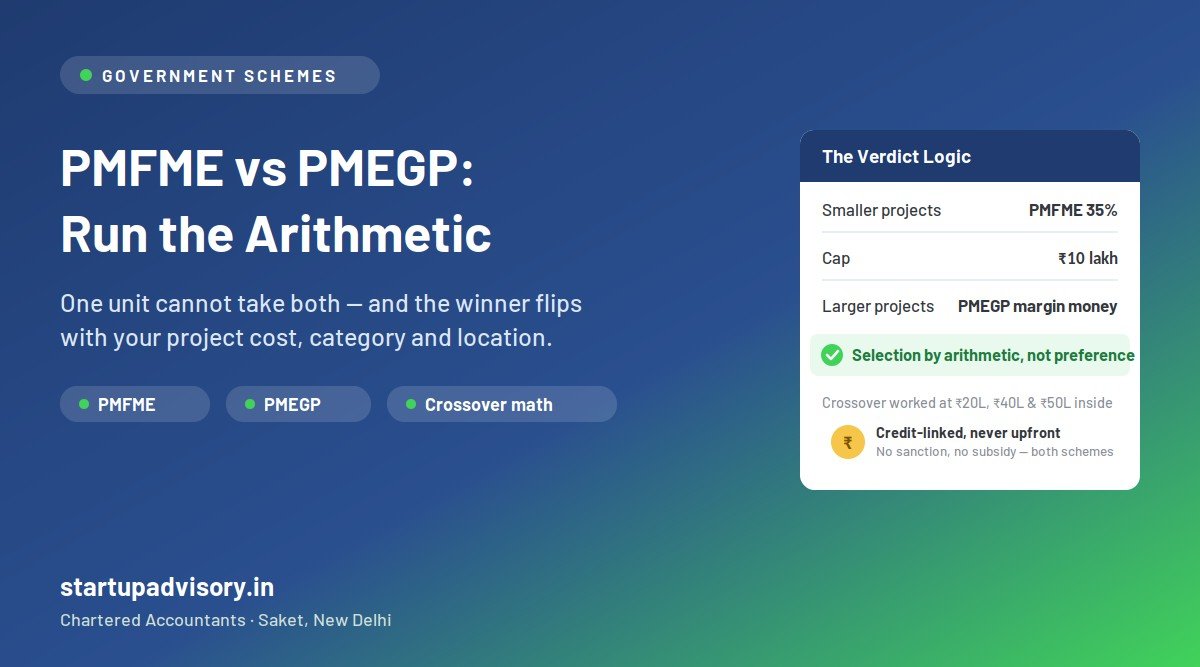
The margin money subsidy is credit-linked: it is not paid to you upfront, and the project must first be sanctioned by the bank. If your unit is in food processing, PMFME is the alternative, and one unit cannot claim both. Our PMFME vs PMEGP comparison works through which scheme gives more at different project costs, and our MSME schemes guide covers the wider list.
8. How do you prepare a DPR step by step?
Prepare the DPR in six steps, starting with the evidence rather than the spreadsheet.
- Get the bank's checklist and format. Ask the branch for its document checklist and any project report template, and check the scheme's model project profile if one applies.
- Collect quotations and premises papers. Get supplier quotations for every machine and major asset, and the sale deed, lease or rent agreement for the premises.
- Fix the means of finance. Decide the loan amount, your contribution and any subsidy, and make sure the contribution is in your bank account.
- Build the projections. Prepare monthly figures for the first year and annual figures for the loan period: sales built from capacity and price, costs including salaries, rent, power, GST and statutory payroll costs, depreciation and interest.
- Test DSCR, break-even and a downside case. Check every year's DSCR, not just the average, and show what happens if sales are lower or slower.
- Write the narrative and assemble annexures. Add the promoter profile, market section and process description, then attach KYC, Udyam registration, ITRs, bank statements and quotations in the order of the checklist.
- Promoter KYC (PAN, Aadhaar, address proof) and photographs
- Entity documents: certificate of incorporation or partnership deed, PAN, GST registration, Udyam registration
- Income tax returns and financial statements for the last two to three years (for an existing business)
- Bank statements for the last six to twelve months, showing the promoter contribution
- Supplier quotations for machinery and equipment
- Premises documents: ownership papers or rent agreement, and any approvals needed for the activity
- Existing loan sanction letters and repayment track record, if any
9. Why do DPRs get rejected?
Most DPRs that come back are rejected for avoidable reasons in the numbers, not because the business idea is bad.
| Mistake | Why it hurts | Fix |
|---|---|---|
| Round-number project cost | Signals the cost was guessed | Tie every major item to a quotation |
| Full capacity from month one | Inflates profit and DSCR | Show a realistic ramp-up |
| Contribution not in the bank | Means of finance cannot be verified | Deposit or spend it before applying |
| Costs that leave out GST, TDS or payroll obligations | Overstates cash flow | Build statutory costs into the projections |
| Subsidy counted wrongly | Scheme math fails at the nodal agency | Compute it on the scheme's eligible cost base |
| Template text | The appraiser has read it before | Write the market and promoter sections for your project |
How Startup Advisory can help
Startup Advisory is a CA-led firm in Saket, New Delhi. Our DPR preparation service builds bank-grade and scheme-grade project reports for units across Delhi NCR: project cost against quotations, means of finance, projections with DSCR and break-even, and the bank's annexures. We can also take the file to sanction through our bank loan and project finance support. Fees depend on the size and type of project, so book a free consultation or call 9311972982 for a quote.
Sources and scope
- Reserve Bank of India, Master Direction – Lending to Micro, Small & Medium Enterprises (MSME) Sector (updated as on 9 February 2026): para 2.1 (classification), para 4.1 (collateral-free loans up to ₹20 lakh from 1 April 2026), para 4.4 (14 working days), para 4.7 (acknowledgement, checklist, written reasons).
- Reserve Bank of India, FAQs on Micro, Small and Medium Enterprises (updated as on 29 July 2025): CGTMSE cover up to ₹10 crore; Certified Credit Counsellors.
- Khadi and Village Industries Commission, PMEGP e-portal FAQ: maximum project cost, own contribution and EDP training.
Prepared 25 November 2026. The DPR structure, appraisal tests and mistakes described above reflect common bank practice and are guidance, not legal requirements; each bank applies its own credit policy. The DSCR example uses made-up figures for illustration only.