
Virtual CFO / MIS
MIS Report for Startups: What Founders and Investors Should See Every Month
Reviewed by CA Neeraj Rohilla, FCA — Chartered Accountant, Startup Advisory, Saket, New Delhi.
Most startups do not lack numbers. They have a bank app, an accounting package, a payment gateway dashboard and a spreadsheet of sales. What they lack is one monthly document that puts those numbers together, explains what changed and says what the team will do about it. That document is the MIS report.
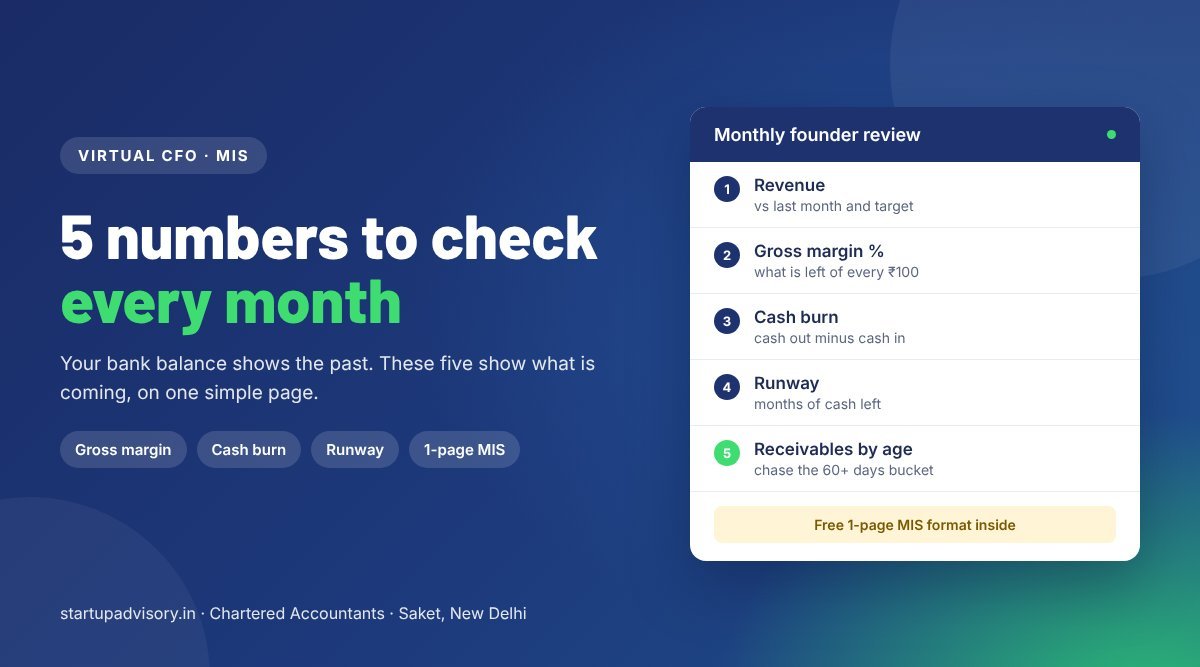
If you are just starting out, our 5 numbers every founder should check every month gives you a 1-page format to begin with. This guide is the next step: what a full startup MIS should contain once you have a team, a budget and investors (or are about to have them).
1. What is an MIS report, and how is it different from financial statements?
An MIS (Management Information System) report is a monthly management report that compares actual results with the budget and the previous month, adds the operating KPIs behind those results, and explains the reasons. It is built for decisions, not for filing.
| Financial statements | MIS report | |
|---|---|---|
| Main purpose | Statutory filing, audit, tax | Running the business, decisions |
| Frequency | Usually annual (plus any interim needs) | Monthly (some items weekly) |
| Format | Prescribed (for companies, Schedule III to the Companies Act, 2013) | Your own; whatever helps management |
| Compares with | Previous year | Budget, last month, same month last year |
| Non-financial data | Very little | Customers, orders, churn, headcount, pipeline |
| Commentary | Notes to accounts | Reasons for variances and actions |
Both should come from the same reconciled books. An MIS that does not tie back to the books will be found out at the year-end audit, or worse, in investor due diligence.
2. Do founders, the board and investors need different MIS reports?
Yes, but they should be cuts of one set of numbers, not three separate exercises. Build the full internal pack first and take the other two from it.
| Version | Reader | Frequency | Length | Focus |
|---|---|---|---|---|
| Internal MIS pack | Founders, functional heads | Monthly | 8–15 pages or tabs | Everything, down to department and product |
| Board pack | Directors, nominee directors | Before each board meeting | 5–10 pages plus annexures | Performance vs plan, cash, key risks, decisions needed |
| Investor update | All investors | Monthly or quarterly | 1–2 pages or an email | Headline metrics, highlights, lowlights, asks |
Page counts here are a practical guide, not a rule. If your shareholders’ agreement sets out information rights (for example, monthly MIS within a set number of days), that agreement decides the format and timing, so read it before you design the pack.
3. What are the 8 sections of a startup MIS report?
A complete startup MIS covers performance, cash, position, drivers, people, compliance and actions. Here is a structure that works for most early and growth-stage companies.
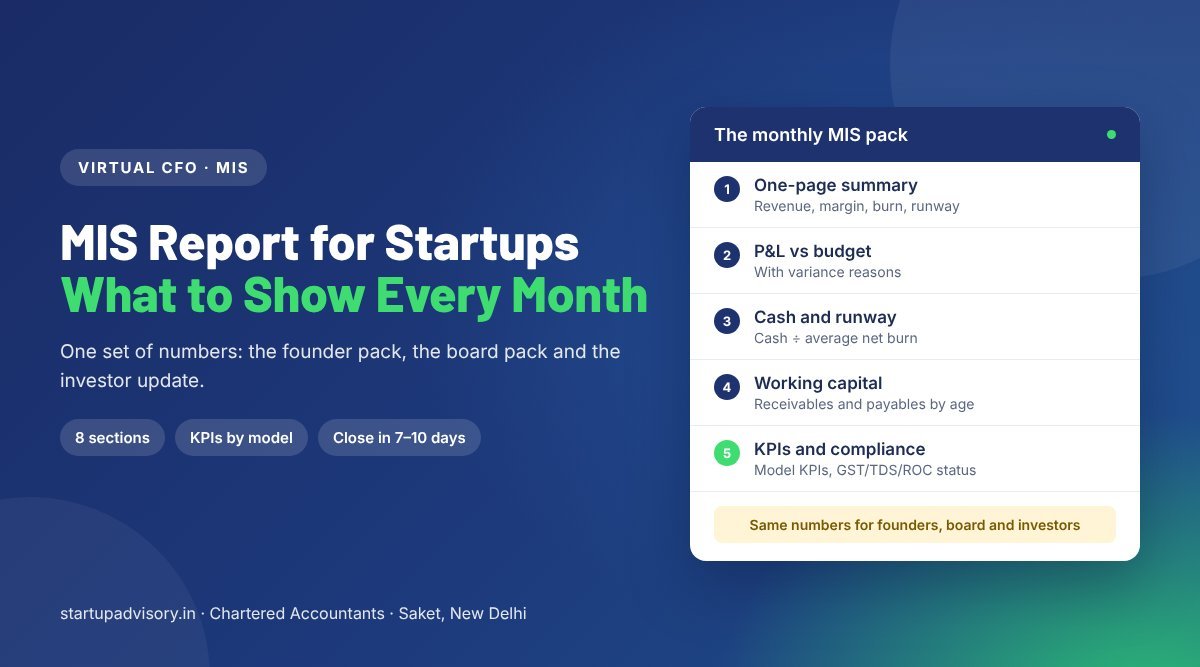
- One-page summary (dashboard). Revenue, gross margin %, EBITDA or operating loss, net burn, closing cash, runway in months and your 3–5 key KPIs, each shown against budget and last month with a simple up/down marker. Add three highlights and three concerns in one line each.
- P&L: actual vs budget vs last month. Revenue by product, channel or customer group; direct costs and gross margin; operating costs grouped by function (people, marketing, technology, rent and admin). Show the month and year to date.
- Cash flow, burn and runway. Opening cash, cash in, cash out and closing cash from the bank, then gross burn, net burn and runway. Use the same runway formula every month: cash in bank ÷ average monthly net burn (we use the last three months’ average, as in our cash flow management playbook). Add a 3-month cash forecast once you can.
- Balance sheet snapshot and working capital. Receivables and payables by age (0–30, 31–60, 60+ days), inventory if you hold stock, advances, loans and statutory dues payable. Name the five largest overdue customers.
- Business KPIs. The few operating numbers that explain revenue for your model (see the next section). Keep the definitions fixed and written down at the back of the pack.
- Headcount and payroll. Opening and closing headcount by team, joiners and leavers, open positions, and payroll cost against budget. People cost is often the biggest line in a startup P&L.
- Compliance status. GST returns, TDS payments and returns, PF/ESI, ROC filings and any notices: filed, paid or pending, with due dates. Our GST and TDS compliance calendar lists the monthly dates.
- Risks, decisions and actions. What needs a decision this month, the top risks (a large customer at risk, a funding gap, a regulatory change), and last month’s actions with their status.
4. Which KPIs should a startup MIS track for its business model?
Track the 5–8 KPIs that explain how your revenue is made, not every metric your tools can produce. The right set depends on the business model.
| Business model | KPIs worth tracking monthly |
|---|---|
| SaaS / subscription | MRR and ARR; new, expansion and churned MRR; logo and revenue churn; net revenue retention; CAC and CAC payback; customers by plan |
| E-commerce / D2C | Orders, average order value, contribution margin per order after shipping, returns and marketplace fees; repeat purchase rate; marketing spend as % of revenue; inventory days; RTO (return to origin) rate |
| Marketplace | GMV, take rate, net revenue; active buyers and sellers; repeat rate; cost per acquisition on each side |
| Services / agency / IT services | Billable utilisation; revenue per employee; project margin; order book and pipeline; unbilled revenue; debtor days |
| Manufacturing / trading | Capacity utilisation; gross margin by product; inventory and debtor days; purchase price variance; working capital cycle |
Write a one-line definition for each KPI (for example, whether CAC includes salaries of the sales team) and do not change it without saying so in the pack. Changed definitions are one of the quickest ways to lose an investor’s trust.
5. How should the MIS explain variances?
Explain every material variance in one line: what moved, why, and what you will do. Numbers without reasons push the reader to guess, and the guess is usually worse than the truth.
Set a materiality threshold so the commentary stays short, for example any line more than 10% or a fixed rupee amount away from budget, whichever you choose. Then use a simple format:
| Line | Actual | Budget | Variance | Reason | Action |
|---|---|---|---|---|---|
| Marketing | ₹9,00,000 | ₹6,00,000 | ₹3,00,000 over | Festive campaign moved from November to October | November budget cut by the same amount |
| Revenue – enterprise | ₹12,00,000 | ₹15,00,000 | ₹3,00,000 short | One renewal signed late | Invoice raised 3 November; track in December MIS |
Figures above are illustrative only.
Separate timing differences (money that will arrive or be spent next month) from permanent ones (a customer lost, a price cut). The board needs to know which is which.
6. When should the monthly MIS be ready?
Fix a date and keep it. Once invoicing, expense entries and bank reconciliation happen through the month, many small teams can close and issue the MIS within 7–10 working days of month-end. This is a practice target, not a legal deadline.
| Working day | Task | Owner |
|---|---|---|
| Day 1–2 | All sales invoices raised; expense bills and payroll entries booked | Accounts |
| Day 2–3 | Bank, payment gateway and marketplace settlements reconciled | Accounts |
| Day 3–4 | Provisions and accruals (unpaid bills, salary, interest); prepaid expenses adjusted | Accounts / finance lead |
| Day 4–5 | Receivables and payables ageing; GST and TDS ledgers checked against returns | Accounts |
| Day 5–7 | KPIs pulled from product, CRM and sales tools; P&L vs budget prepared | Finance lead / Virtual CFO |
| Day 7–8 | Commentary written; reviewed with founders | Virtual CFO + founders |
| Day 8–10 | Investor update and board extract sent | Founder |
Note that GST and TDS deadlines fall in the same window (for example, TDS deposit by the 7th and GSTR-3B for monthly filers by the 20th), so plan the close around them rather than against them.
7. What do investors look for in a startup MIS?
Investors read the summary first and look for consistency, honesty and early warning. In practice they check:
- Cash and runway: closing cash, net burn and months of runway, and whether runway is moving towards the next raise.
- Growth and quality of revenue: month-on-month growth, gross margin and the KPI that proves the model works (retention for SaaS, repeat purchase for D2C).
- Plan vs actual: whether the team hits its own budget, and whether variances are explained.
- Consistency: the same definitions and formats every month, and figures that agree with the last update and, later, with the audited accounts.
- Lowlights and asks: founders who share bad news early and ask for specific help (an introduction, a hire) get more useful support.
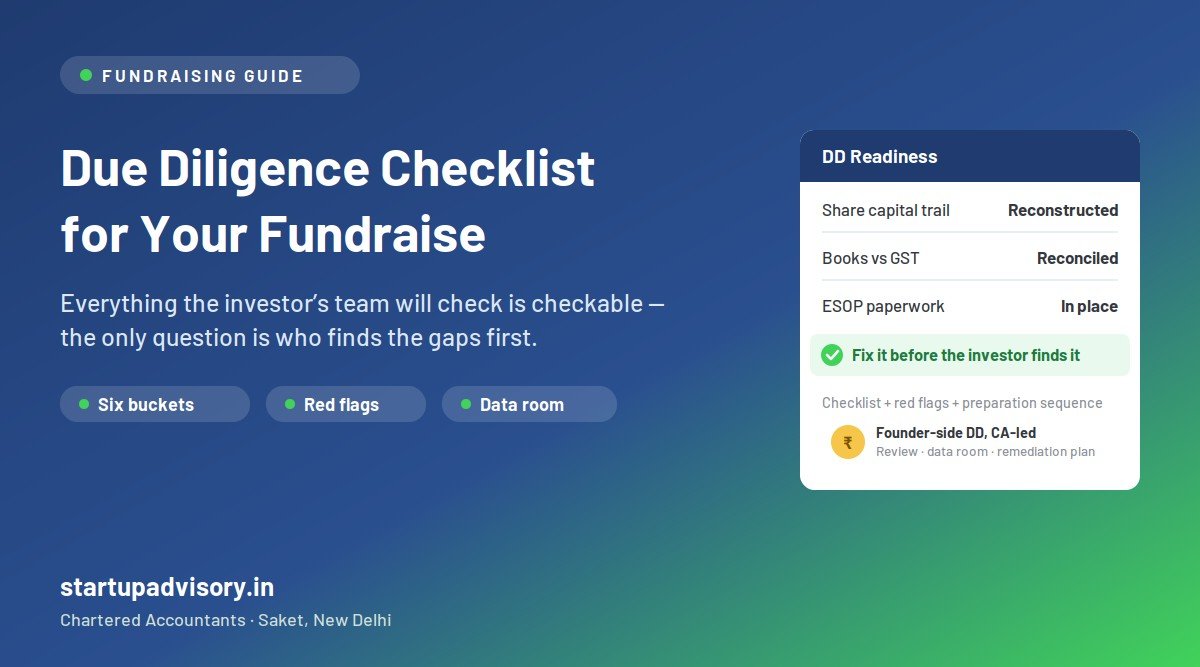
When you start fundraising, the same MIS feeds your financial model and the data room, and is one of the first things checked in startup due diligence.
8. What are the most common startup MIS mistakes?
- Numbers that do not tie to the books. Revenue from the gateway dashboard, costs from the bank and nothing reconciled.
- Cash basis passed off as profit. No accruals for unpaid bills or salaries, so the month looks better than it was.
- Too many metrics. 40 KPIs and no commentary. Nobody reads past page two.
- Moving definitions. CAC or churn calculated differently from last month without a note.
- Late packs. An MIS that arrives on the 25th describes a business that has already moved on.
- No actions. A report that does not end with decisions and owners is just a record.
- Books closed; bank and gateway settlements reconciled
- Accruals and provisions booked
- Summary page: revenue, gross margin, net burn, cash, runway, key KPIs
- P&L vs budget and last month, with variance reasons
- Receivables and payables ageing; top overdue customers named
- Headcount and payroll vs budget
- GST, TDS, PF/ESI and ROC status
- Risks, decisions needed and actions with owners
- Investor update and board extract taken from the same numbers
Not sure whether to keep this in-house? Read what a Virtual CFO actually does and what a Virtual CFO costs in India.
Want your MIS prepared and reviewed every month?
Monthly MIS and financial reporting is part of every Virtual CFO tier at Startup Advisory, starting from the Essentials tier at ₹10,000 a month. The Growth tier (from ₹25,000 a month) adds forecasting, unit economics and a monthly strategy review, and Fundraise & Scale (from ₹45,000 a month) adds the financial model and investor data-room support.
Explore Virtual CFO services Book a consultation
General information; every business is different. Speak to your CA for advice on your case.