
Virtual CFO
Virtual CFO for E-commerce and D2C Brands: What It Covers and When You Need One
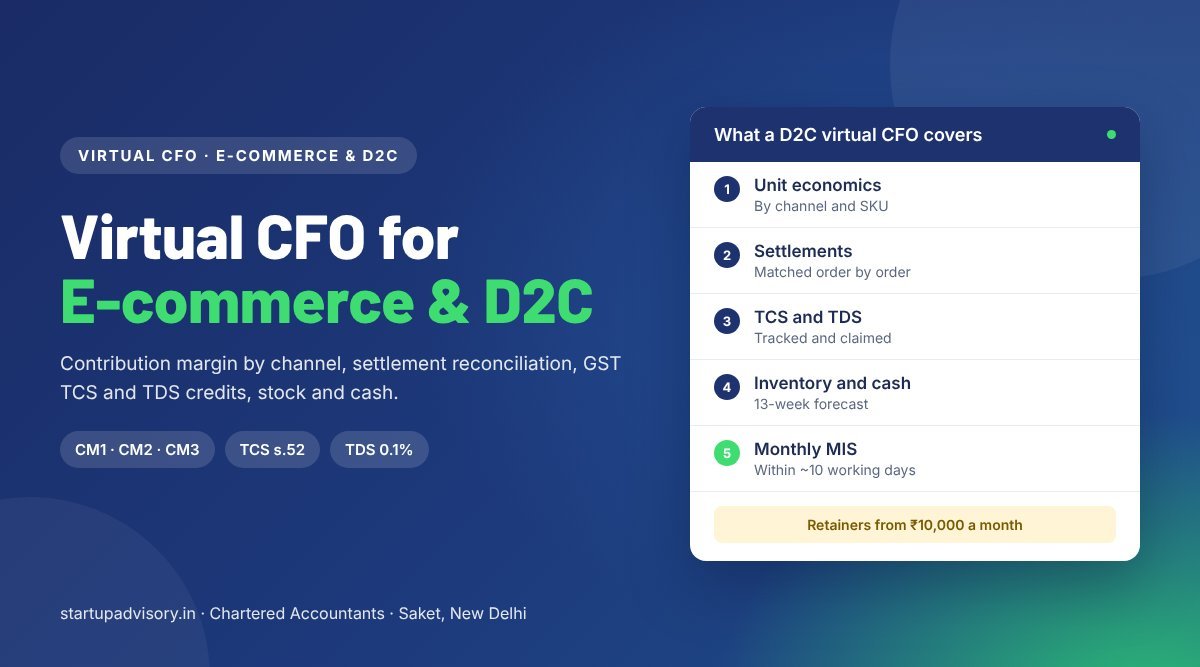
An e-commerce brand can grow its orders every month and still run out of cash. Revenue arrives net of commissions, shipping, returns and tax deductions. Stock is paid for weeks before it sells. Ad spend moves faster than the books. A virtual CFO is a part-time finance lead who makes those numbers visible and turns them into decisions, without the cost of a full-time hire.
This guide explains what that work looks like for a D2C brand or a marketplace seller in India: the unit economics to track, how to reconcile settlements, the GST and income-tax deductions that sit inside every payout, inventory and working capital, and the monthly reports a founder should get. For the general role, see what a virtual CFO does.
1. What does a virtual CFO do for an e-commerce or D2C brand?
A virtual CFO for an e-commerce brand owns the numbers between an order and the cash in the bank. The work falls into six areas, and most brands need all of them once they sell on more than one channel.
| Area | What the virtual CFO does | What the founder gets |
|---|---|---|
| Unit economics | Builds contribution margin by channel, category and top SKUs | A list of products and channels that make or lose money after ads and returns |
| Settlement reconciliation | Matches marketplace and payment-gateway payouts to orders, fees, returns and deductions | Revenue you can trust, and claims raised for short payments |
| Tax credits | Tracks GST TCS and income-tax TDS deducted by platforms and checks they are claimed | No cash left unclaimed in the GST portal or Form 26AS |
| Inventory and cash | Plans purchases against sales velocity, ageing and the cash cycle | A 13-week cash view and a reorder plan |
| Pricing and ad spend | Sets margin floors for discounts and limits for customer acquisition cost | Clear rules on how far a sale or campaign can go |
| Reporting and funding | Prepares the monthly MIS, the financial model and lender or investor packs | A board-ready view and a credible fundraise or loan file |
2. Why do e-commerce numbers need different finance work?
E-commerce numbers need different work because the sale, the cash and the cost all arrive at different times and in different shapes. A traditional business invoices a customer and collects the invoice. A marketplace seller receives a settlement that is the order value minus commission, fixed fees, shipping, return charges, TCS and TDS, often for orders from several weeks.
- Gross sales overstate revenue. Cancellations, returns-to-origin (RTO) and customer returns can reverse a large share of orders, and they show up later than the sale.
- Fees are many and change often. Commission, closing fees, weight-based shipping, storage and advertising are billed separately and can differ by category.
- Tax is deducted before you are paid. GST TCS and income-tax TDS reduce every payout. Both are credits, but only if someone reconciles and claims them.
- Stock sits in several places. Your warehouse, a marketplace fulfilment centre and goods in transit all hold cash, and GST registration may be needed in each state where stock is kept.
None of this is visible in a profit and loss account that shows one line for sales. That is the gap a virtual CFO fills.
3. Which unit economics should a D2C brand track every month?
A D2C brand should track contribution margin in three layers, plus the customer metrics that drive it. Contribution margin is what each order leaves after the costs that rise and fall with that order.
| Metric | How it is usually worked out | What it tells you |
|---|---|---|
| Net revenue | Gross order value less GST, discounts, cancellations and returns | The sales you actually keep |
| CM1 | Net revenue less product cost (landed cost of goods) | Whether the product itself is priced right |
| CM2 | CM1 less marketplace fees, payment gateway charges, packaging, shipping and RTO costs | Whether the channel works for this product |
| CM3 | CM2 less performance marketing (ads) spend | Whether growth is paying for itself |
| Customer acquisition cost (CAC) | Marketing spend divided by new customers in the period | What a new customer costs you |
| Average order value (AOV) and repeat rate | Net revenue per order; share of orders from returning customers | How much each customer is worth over time |
| Return and RTO rate | Returned or undelivered orders as a share of shipped orders, by channel and pin code | Where margin is leaking |
Definitions vary between brands, so fix yours once and keep them steady month to month. A brand with a healthy CM1 and a negative CM3 has a marketing problem, not a product problem. A brand with a weak CM2 on one marketplace may do better moving that product to its own website.
4. How should marketplace settlements be reconciled?
Marketplace settlements should be reconciled order by order, every month, against your own order data. Matching only the bank credit to a settlement report total hides short payments and missing reimbursements.
- Pull three data sets for the month: your order and shipment data, the marketplace settlement or payment reports, and bank statements.
- Match each order to its settlement line, and flag orders that were delivered but not paid, or paid at the wrong amount.
- Break each payout into parts: sale value, commission and fees, shipping, return charges, TCS, TDS and any reimbursements.
- Check fees against the rate card for your category and weight slab, and raise claims for overcharges and for lost or damaged returns within the platform's time limit.
- Post the results to the books, with fees as expenses (and their GST as input tax credit where the invoice supports it), and TCS and TDS as receivables.
- Repeat for payment gateways and cash-on-delivery partners on your own website.
Our bookkeeping team does the monthly reconciliation for Amazon, Flipkart and Shopify sellers, and the virtual CFO reviews the exceptions and the trend.
5. What GST and income-tax deductions sit inside every payout?
Two deductions sit inside most marketplace payouts: GST tax collected at source (TCS) and income-tax TDS. Both are your money and can be claimed, which is why they belong in the reconciliation above.
| Point | GST TCS | Income-tax TDS on e-commerce |
|---|---|---|
| Law | Section 52, CGST Act 2017 | Section 194-O, Income-tax Act 1961; from 1 April 2026, the section 393 table of the Income-tax Act, 2025 |
| Who deducts | Every e-commerce operator | The e-commerce operator |
| Base | Net value of taxable supplies made through the platform by other suppliers | Gross amount of sales or services made through the platform |
| Rate | Notified rate, capped at 1% by law; CGST rate 0.25% under Notification 15/2024-Central Tax, plus the matching state tax | 0.1% |
| Exemption | None in section 52 itself | No TDS for an individual or HUF seller with gross sales up to ₹5 lakh in the year who has given PAN or Aadhaar |
| How you get credit | Claim it in your electronic cash ledger (section 52(7)) and use it to pay GST | Claim it against your income tax when you file the return |
The operator must deposit TCS and file a monthly statement within ten days after the month ends (section 52(3) and (4)). The amounts it reports flow to your GST account, so compare them every month with your own sales on that platform. A difference usually means a wrong GSTIN, a wrong state or a timing gap, and it is easier to fix with the operator in the same quarter than at year end.
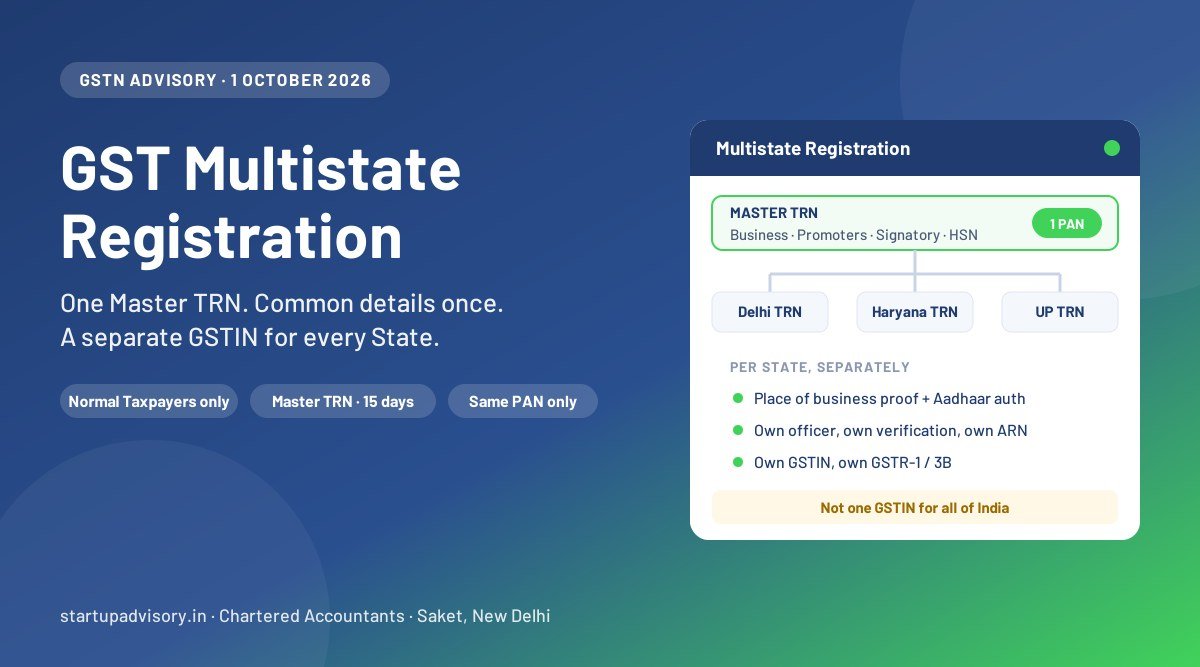
Registration is the other point to watch. Section 24(ix) of the CGST Act lists sellers who supply through an operator that must collect TCS among those who must register, with no turnover threshold in section 24 itself. Exemption notifications can relax this for some small sellers, so check the current position before selling without a GSTIN. If you keep stock in a marketplace warehouse in another state, you will normally need a GSTIN there too; see our guide to multi-state GST registration.
6. How should inventory and working capital be managed?
Inventory should be managed against cash, not only against sales targets. In most product brands, stock is the largest use of cash, and it is the one founders find hardest to see.
- Cash conversion cycle. Days of inventory plus days until marketplaces pay you, minus the credit days your suppliers give. A longer cycle means growth needs more cash.
- Stock ageing by SKU and location. Slow stock in a fulfilment centre can attract storage charges and still has to be counted at year end.
- Reorder rules. Reorder points based on recent sales velocity and supplier lead time, reviewed before every sale season.
- A 13-week cash forecast. Weekly receipts from each channel, supplier payments, ad spend, salaries, GST and TDS, so that a stock order never collides with a tax payment.
If the forecast shows a gap, the virtual CFO can prepare the case for working capital, whether that is a bank limit or investor money. Our guide to a DPR for a bank loan explains what lenders test.
7. What reports should a D2C founder get every month?
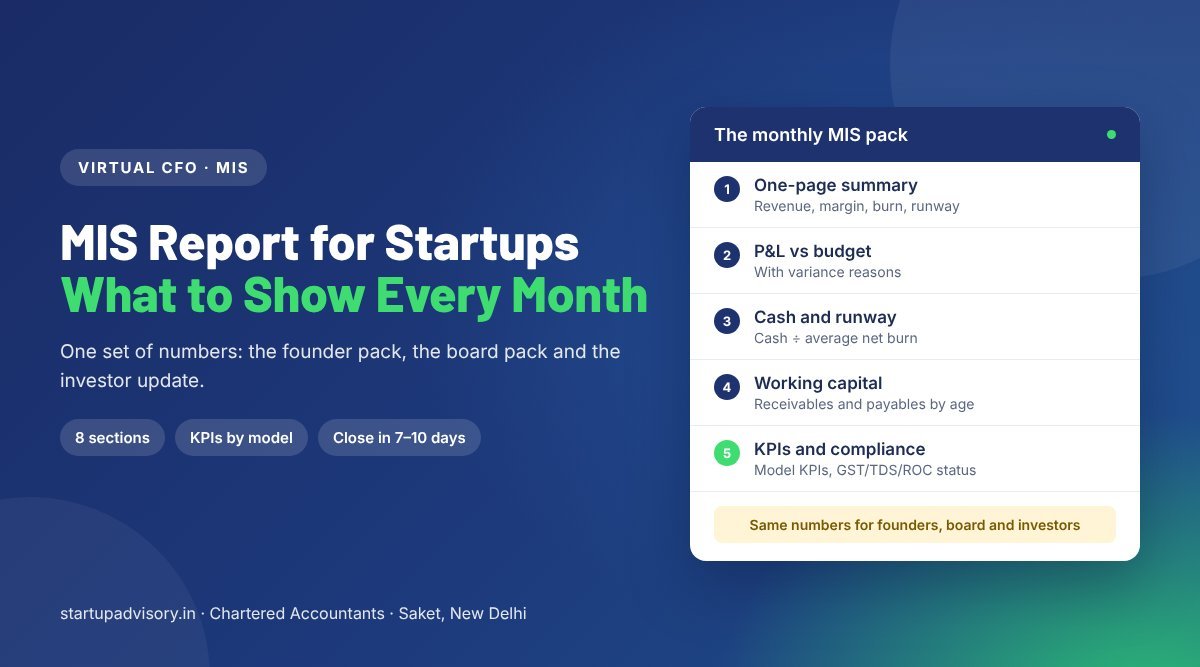
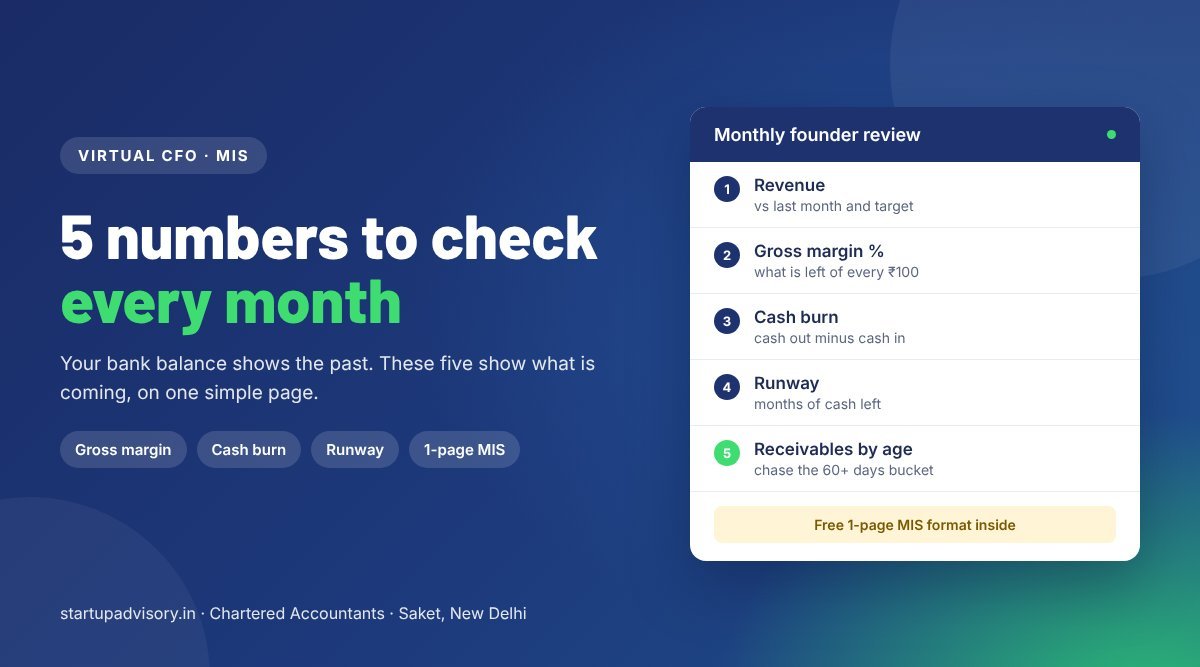
A D2C founder should get a short monthly MIS within about ten working days of month end, with the same layout every month. The essentials are:
- a one-page summary: net revenue, CM1/CM2/CM3, cash, runway and three actions;
- contribution margin by channel and for the top SKUs, against budget and last month;
- marketing efficiency: CAC, return on ad spend and repeat rate;
- returns and RTO by channel, with the cost in rupees;
- inventory: value, ageing and weeks of cover;
- settlement exceptions and tax credits pending (TCS, TDS, input tax credit);
- the 13-week cash forecast.
Our guide to the startup MIS report shows the full pack and how to explain variances.
8. When does an e-commerce brand need a virtual CFO, and what does it cost?
An e-commerce brand usually needs a virtual CFO once it sells on several channels or spends heavily on ads and can no longer tell which products make money. Other common triggers are cash tied up in stock, unexplained settlement differences, and a fundraise or bank loan on the horizon.
| Startup Advisory tier | Starting price | Fits an e-commerce brand that |
|---|---|---|
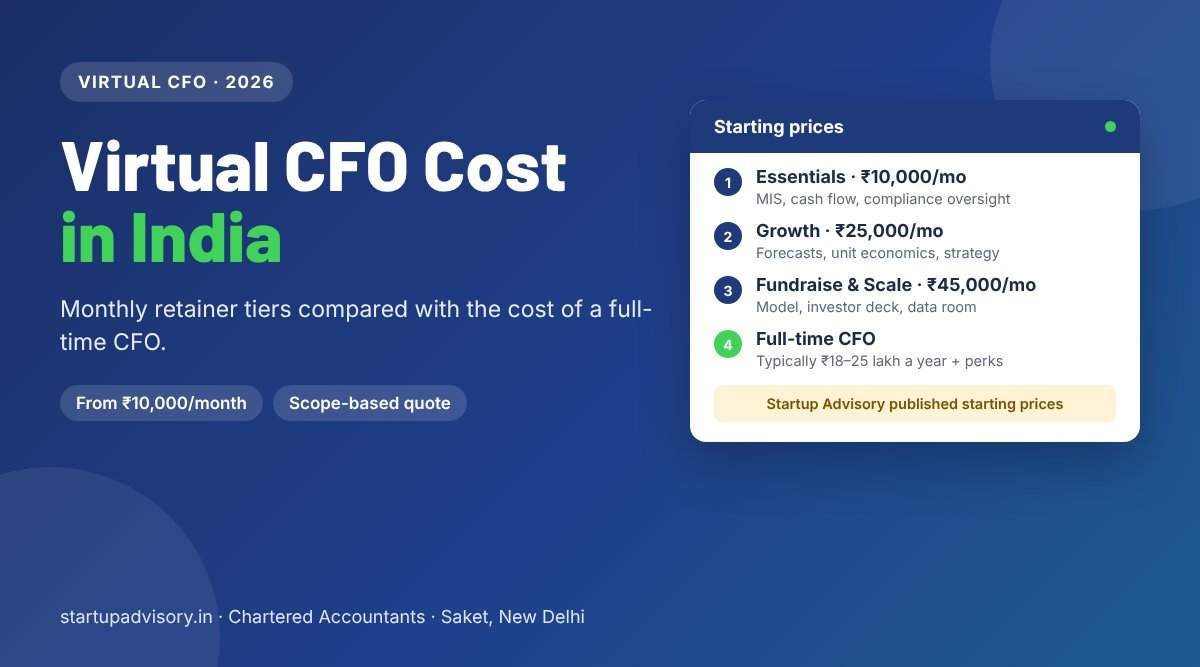
| Essentials | ₹10,000 / month | Sells on one or two channels and needs monthly MIS, cash tracking and GST and TDS oversight |
| Growth | ₹25,000 / month | Is scaling across channels and needs unit economics, forecasting and a monthly strategy review |
| Fundraise & Scale | ₹45,000 / month | Is raising capital or preparing for due diligence and needs the financial model, investor deck and data room |
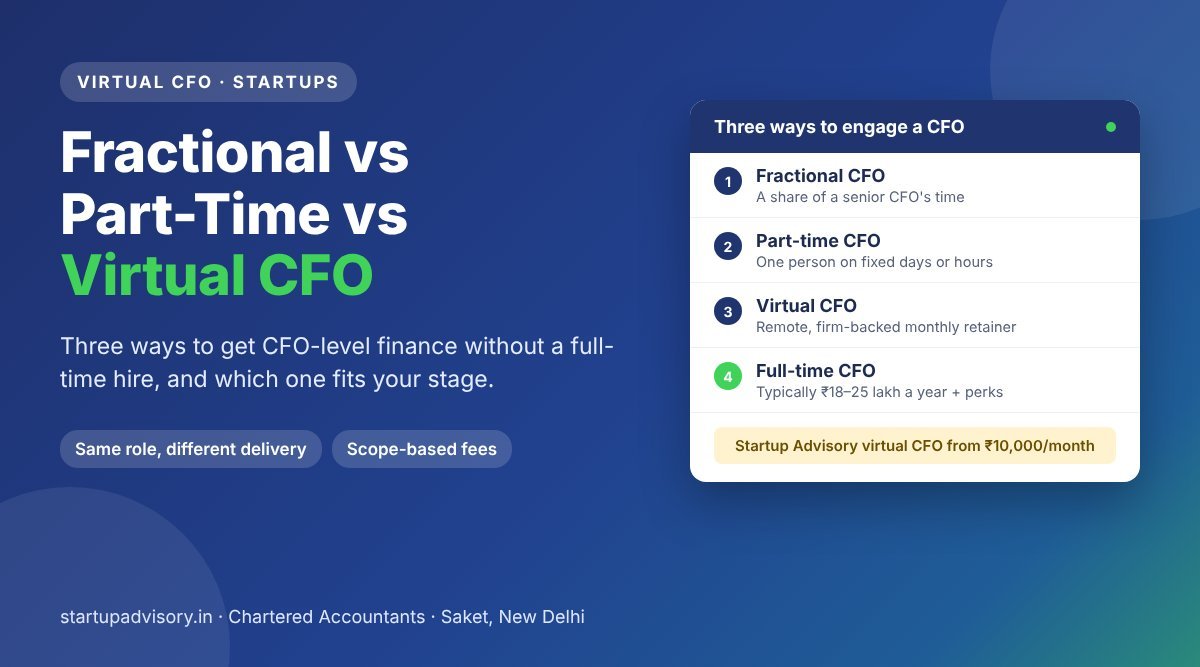
These are starting prices from our Virtual CFO service and published price list; the final fee is set after a scoping call. For how this compares with a full-time hire, see virtual CFO cost in India.
How Startup Advisory can help
Startup Advisory is a CA-led firm in Saket, New Delhi. Our Virtual CFO service works with D2C and e-commerce brands on contribution margin, settlement reconciliation, inventory and cash planning, monthly MIS and fundraising, with our bookkeeping and GST teams handling the books and returns underneath. Book a free consultation or call 9311972982.
Sources and scope
- CBIC, Section 52, CGST Act 2017 (collection of tax at source: rate up to 1%, net value of taxable supplies, payment and statement within ten days after the month, credit in the electronic cash ledger).
- CBIC, Section 24, CGST Act 2017 (compulsory registration, clauses (ix) and (x)).
- GST Council, Notification No. 15/2024-Central Tax dated 10 July 2024 (CGST TCS rate 0.25%).
- Income Tax Department, Section 194-O, Income-tax Act 1961 (0.1% TDS; ₹5 lakh exemption for individual and HUF participants with PAN or Aadhaar).
- Startup Advisory price list and Virtual CFO page for our fees.
Prepared 28 November 2026. The unit-economics definitions, reconciliation steps and report list reflect common practice and are guidance, not legal requirements. The illustration uses made-up figures. Check GST registration exemptions and current TCS and TDS rates for your own case before acting.