GST / E-Invoicing
GST Changes from 1 January 2027: E-Invoicing for RCM, GSTR-7A and E-Way Bill Numbers
Reviewed by CA Neeraj Rohilla, FCA — Chartered Accountant, Startup Advisory, Saket, New Delhi.
- The changes at a glance
- E-invoicing for RCM self-invoices and import of services
- Who is covered and which purchases
- Sandbox, voluntary period and go-live
- A worked example
- Points the advisories leave open
- New table in the GSTR-7A TDS certificate
- E-way bill numbers grow to 14 digits
- GST dates to keep in January 2027
- Recommended or scheduled, but not from 1 January
- December 2026 readiness checklist
1. The changes at a glance
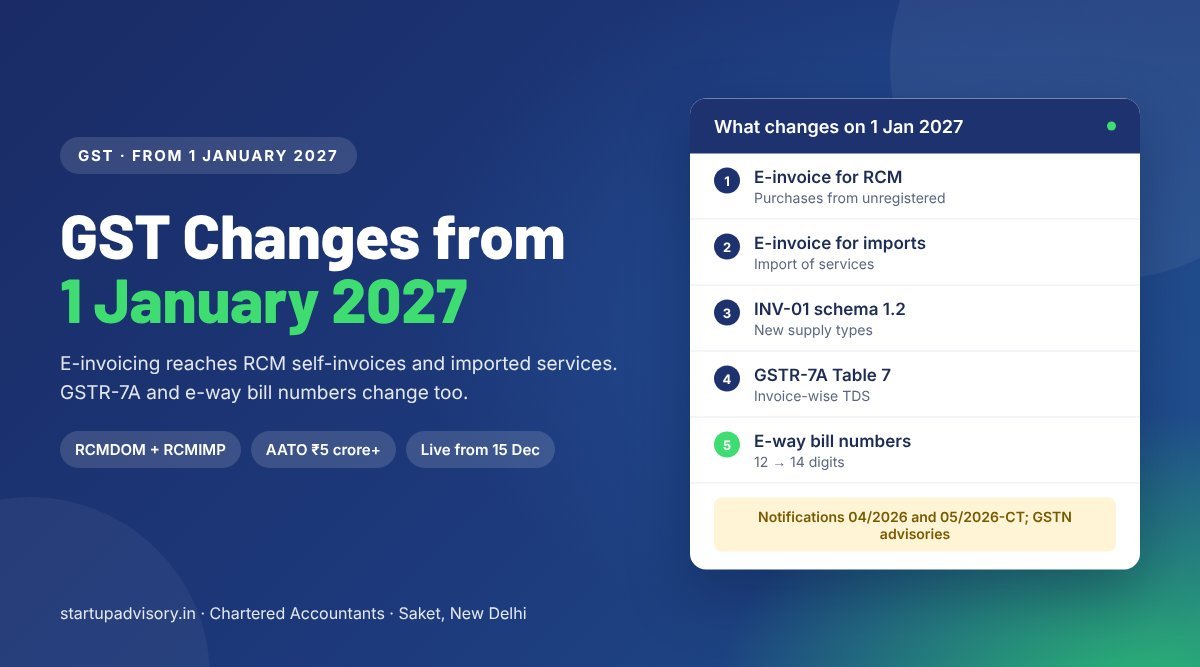
We checked each item below against the Gazette text or a GSTN advisory. If a change is not on this list, we could not find it in an official source as of 25 November 2026.
| Change from 1 January 2027 | Legal or official basis | Status | Who it affects |
|---|---|---|---|
| E-invoicing for RCM self-invoices on supplies from unregistered persons, and for import of services | Notification No. 04/2026-Central Tax, 26 Oct 2026, G.S.R. 918(E), amending Notification No. 13/2020-Central Tax (rule 48(4)) | Notified; in force 1 Jan 2027 | Recipients already on e-invoicing (AATO ₹5 crore and above) |
| FORM GST INV-01 schema 1.1 → 1.2, with new supply types RCMDOM and RCMIMP | Para 67, Notification No. 05/2026-Central Tax, G.S.R. 919(E) | Notified; in force 1 Jan 2027 | E-invoicing businesses, ERPs, GSPs and ASPs |
| FORM GSTR-7A Table 7 replaced (invoice-wise TDS certificate) | Para 55, Notification No. 05/2026-Central Tax | Notified; in force 1 Jan 2027 | GST TDS deductors and their suppliers |
| E-way bill number 12 → 14 digits; consolidated e-way bill 10 → 11 digits | GSTN advisory, 4 Nov 2026 | System change announced by GSTN (“proposed”) | Consignors, transporters, ERP and API users |
All three notified items come from one Gazette issue: the Gazette of India, Extraordinary, No. 846 of 26 October 2026. Most of the other amendments in Notification No. 05/2026-Central Tax took effect on 1 November 2026, and some take effect on 1 December 2026 or 1 April 2027 (section 10). For the Council meeting behind them, see our note on the 57th GST Council meeting outcomes.
2. E-invoicing for RCM self-invoices and import of services
Up to 31 December 2026, e-invoicing applies only to outward supplies: a covered supplier reports its B2B and export invoices to an Invoice Registration Portal (IRP) and gets an Invoice Reference Number (IRN). The scope comes from the first paragraph of Notification No. 13/2020-Central Tax, issued under rule 48(4). Until now it covered supplies “to a registered person or for exports”.
Notification No. 04/2026-Central Tax replaces those words. From 1 January 2027 the notification applies in respect of:
- supply of goods or services or both to a registered person;
- supply of goods or services or both for exports;
- supply of goods or services or both received from an unregistered person where the tax is payable on reverse charge basis by the recipient; and
- import of services.
Items (3) and (4) are new. In both cases the supplier cannot issue a GST invoice, so the registered recipient raises a self-invoice under Section 31(3)(f) of the CGST Act and pays the tax under reverse charge. From 1 January that self-invoice must be reported to an IRP and carry an IRN, just like an outward e-invoice. GSTN calls these “recipient generated self-invoices” (advisory of 16 October 2026).
Notification No. 05/2026-Central Tax makes the matching change to the form. From 1 January 2027 FORM GST INV-01 becomes “Schema (Version 1.2)”. The supply-type field now lists B2B, B2C, SEZWP, SEZWOP, EXPWP, EXPWOP, DEXP, SEZWPA, SEZWPNA, RCMDOM (“Domestic supply from unregistered person under RCM”) and RCMIMP (“Import of services”).
3. Who is covered and which purchases
Who
Notification No. 04/2026-Central Tax changes which transactions are e-invoiced. It does not change who must e-invoice. The turnover threshold and the exempt classes in Notification No. 13/2020-Central Tax stay as they were. GSTN's advisory puts the class at registered taxpayers with an aggregate annual turnover of ₹5 crore and above, which is the current e-invoicing threshold. If you already issue e-invoices on your sales, you will need IRNs on these self-invoices too. If you are in an exempt class or below the threshold, nothing changes for you.
Which purchases (RCMDOM)
RCMDOM covers reverse charge purchases where the supplier is unregistered. Common examples for a business in this bracket:
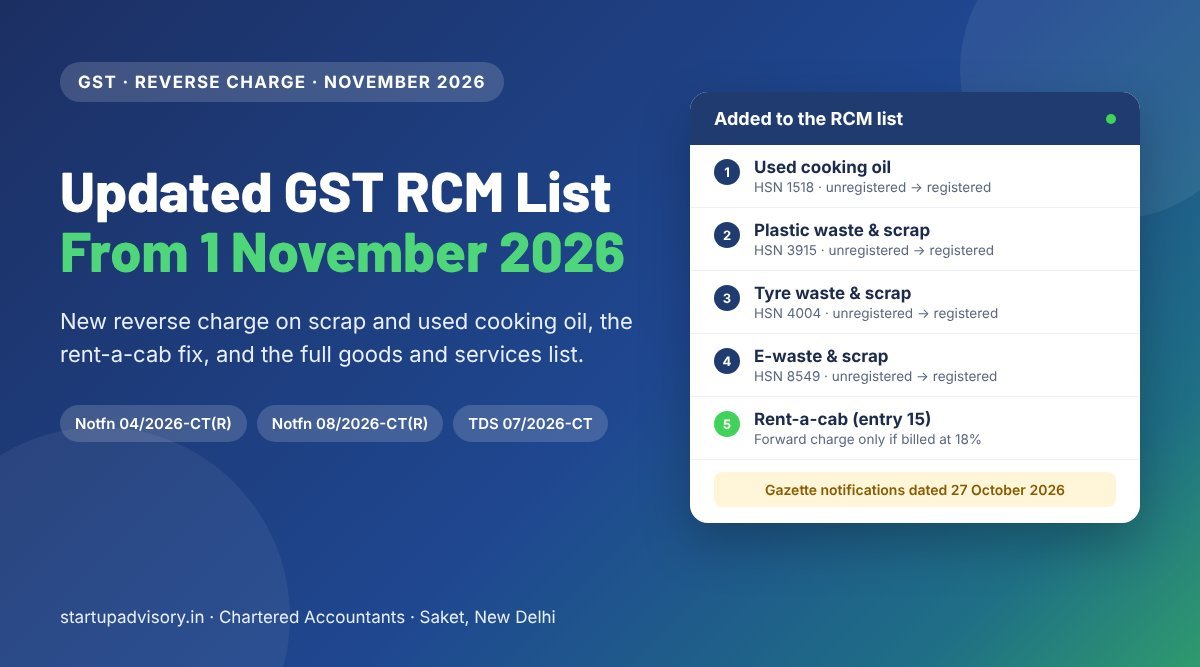
- Goods on the reverse charge list bought from unregistered sellers, including the used cooking oil and plastic, tyre and e-waste scrap added from 1 November 2026 (see our updated RCM list), and metal scrap.
- Notified services from unregistered providers on which the recipient pays reverse charge, such as legal services from an individual advocate who is not registered, sitting fees paid to directors, or a goods transport agency that is not registered.
- Renting of property by an unregistered person, where it falls under the reverse charge entry.
Where the supplier is registered but the recipient still pays reverse charge, the recipient does not raise a Section 31(3)(f) self-invoice. That purchase is not an RCMDOM document. One example is a registered GTA that has not opted to charge tax itself.
Which purchases (RCMIMP)
RCMIMP covers services bought from a supplier outside India on which you pay IGST under reverse charge. Examples include software and cloud subscriptions billed by a foreign entity, overseas consultants and law firms, foreign advertising platforms and marketing agencies, and services from a foreign group company. Import of goods is not covered, because customs collects IGST on goods through the bill of entry. For how the tax itself works, see our guide to RCM on import of services.
Ordinary B2C sales stay outside e-invoicing. Some headlines suggest B2C invoices need IRNs from January. Neither notification says that.
4. Sandbox, voluntary period and go-live
| Date | What happens | Source |
|---|---|---|
| 8 October 2026 | 57th GST Council recommends e-invoicing for domestic RCM purchases from unregistered persons and import of services, for turnover of ₹5 crore and above (item 18.4) | Council press release |
| 16 October 2026 | RCMDOM and RCMIMP enabled on the sandbox of all six IRPs for testing | GSTN advisory |
| 26 October 2026 | Notification Nos. 04/2026 and 05/2026-Central Tax issued | Gazette No. 846 |
| 15 December 2026 | Proposed go-live on the production IRPs. Only documents dated 15 December 2026 or later are accepted for the new supply types | GSTN advisory, 17 Nov 2026 |
| 15 to 31 December 2026 | Voluntary IRN generation for RCMDOM and RCMIMP, for genuine transactions only (test data stays on the sandbox) | GSTN advisory |
| 1 January 2027 | E-invoicing of these self-invoices becomes mandatory | Notification No. 04/2026-Central Tax |
The technical specifications, business validations and validation codes are on the NIC e-Invoice API developer portal (einv-apisandbox.nic.in). The validations are the same on all six IRPs.
5. A worked example
A Gurugram manufacturer had an aggregate turnover of ₹40 crore in FY 2025-26, so it already e-invoices its sales. In January 2027 it has three purchases of this kind:
- Plastic scrap from an unregistered kabadi, ₹2,00,000 (received 6 January). Reverse charge applies to the buyer. The company raises a self-invoice within the time allowed by Rule 47A, reports it to an IRP as RCMDOM and gets an IRN. It then pays the tax in cash and reports it in Table 3.1(d) of GSTR-3B.
- A US design agency’s invoice for USD 3,000 (12 January). This is an import of services. The company raises a self-invoice, reports it as RCMIMP, pays IGST under reverse charge and claims the credit in Table 4A of GSTR-3B, subject to Sections 16 and 17.
- Legal fees of an unregistered individual advocate, ₹50,000. These are taxed under reverse charge in the hands of a business entity. The supplier is unregistered, so this is also an RCMDOM self-invoice with an IRN.
A trading company with ₹3 crore turnover that buys the same scrap still pays reverse charge and raises a self-invoice. It is below the e-invoicing threshold, so it does not need an IRN.
6. Points the advisories leave open
GSTN's advisories send taxpayers to the notifications for “applicability, scope, exemptions and compliance requirements”. They do not yet answer a few practical questions. We will update this guide when they do.
- The 30-day reporting limit. Taxpayers with AATO of ₹10 crore and above already face a limit on reporting e-invoices to the IRP more than 30 days after the document date. Neither advisory says whether this limit applies to RCMDOM and RCMIMP. The safe course is to report each self-invoice well within 30 days.
- Self-invoices dated before 1 January. Production accepts the new supply types only for documents dated 15 December 2026 or later. December self-invoices are voluntary, and January documents need IRNs.
- Flow into returns. The advisories do not say whether IRN data for these documents will be auto-populated into GSTR-1, GSTR-2B or GSTR-3B. Keep reporting reverse charge liability and credit in GSTR-3B as you do now, and reconcile it with the IRNs.
7. New table in the GSTR-7A TDS certificate
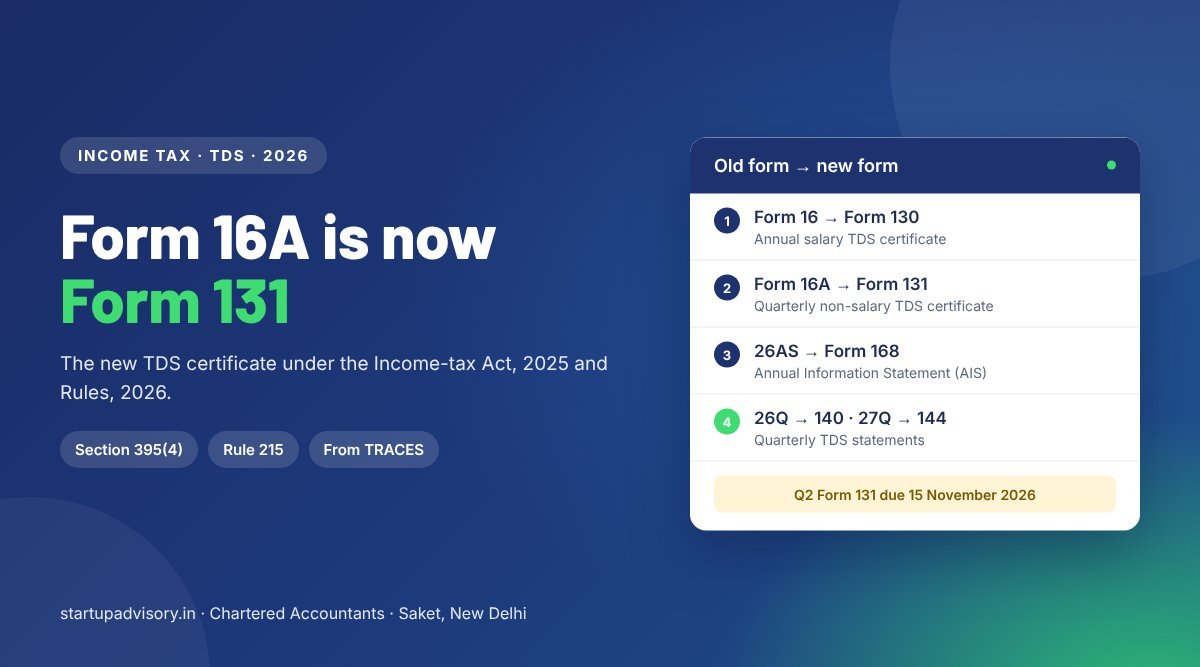
A registered person that deducts GST TDS under Section 51 files GSTR-7 and issues a TDS certificate in FORM GSTR-7A. Para 55 of Notification No. 05/2026-Central Tax replaces Table 7 of GSTR-7A from 1 January 2027. The new Table 7, “Details of supplies and Amount of tax deducted”, has these columns:
| Invoice / document details | Amount paid to deductee liable for TDS (₹) | Amount of tax deducted at source (₹) | ||||
|---|---|---|---|---|---|---|
| No. | Date | Value | Integrated tax | Central tax | State/UT tax | |
| 1 | 2 | 3 | 4 | 5 | 6 | 7 |
So the certificate will tie each deduction to a specific invoice. This affects more businesses than before. Since 1 November 2026, registered buyers of used cooking oil and plastic, tyre, metal and electronic waste and scrap from registered suppliers have had to deduct GST TDS (Notification No. 07/2026-Central Tax). Deductors should record invoice number, date and value against every deduction from now on, so January certificates can be issued without rework. The portal generates GSTR-7A from the GSTR-7 data, so check that your GSTR-7 working holds these fields.
8. E-way bill numbers grow to 14 digits
GSTN's advisory of 4 November 2026 says that, because of the volume of e-way bills, the existing numbering capacity is expected to run out. The following changes are proposed from 1 January 2027:
| Document | Existing format | From 1 January 2027 |
|---|---|---|
| E-way bill number | 12 digits | 14 digits |
| Consolidated e-way bill number | 10 digits | 11 digits |
This is a system change, not a change in the law. Who must generate an e-way bill, and when, stays the same. But anything that stores or checks the number can break: ERP fields, API integrations, database columns, validation rules, printed delivery challans and transporter apps. GSTN says the change will be released on the sandbox first, with details on the e-way bill portal. Ask your software provider now whether the new lengths are supported. For other e-way bill changes this year, including Metro Rail as a mode of transport from 1 November 2026 (GSTN advisory, 20 Nov 2026), see E-way bill changes 2026.
9. GST dates to keep in January 2027
These are not new rules, but they fall in the same weeks as the changes above:
| Date | What |
|---|---|
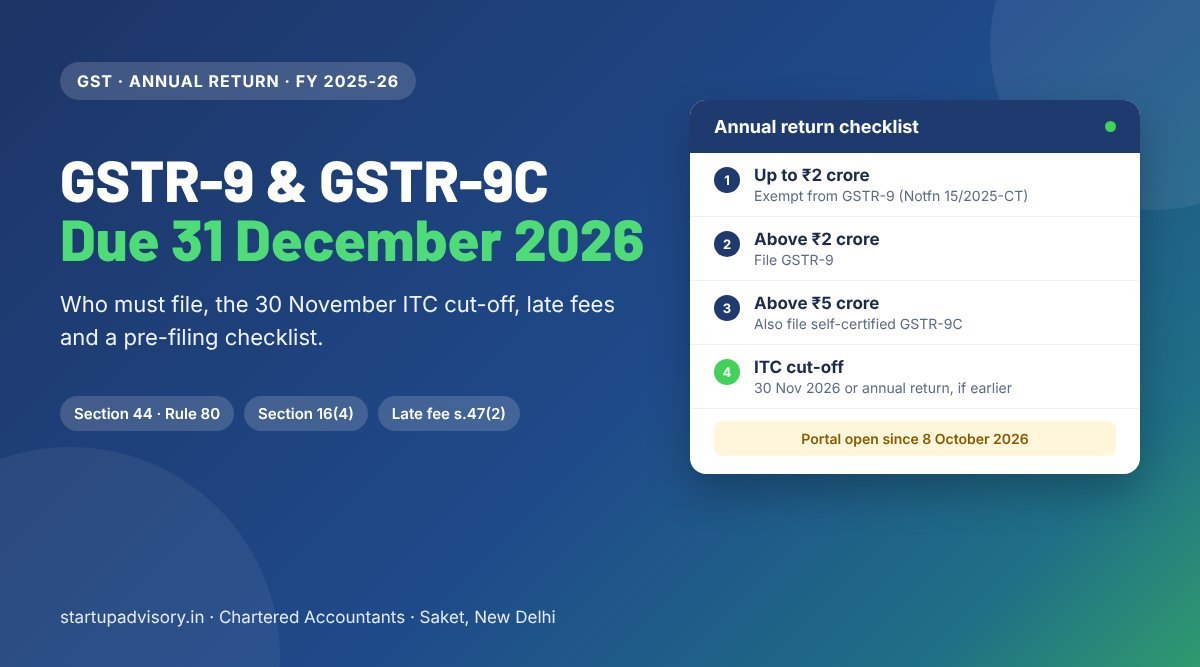
| 31 December 2026 | Due date for GSTR-9 and GSTR-9C for FY 2025-26; the late fee under Section 47(2) runs from 1 January 2027 for anyone who misses it |
| 18 January 2027 | CMP-08 for composition taxpayers for October to December 2026 (rule 62) |
| 20 January 2027 | Monthly GSTR-3B for December 2026 |
| 22 or 24 January 2027 | Quarterly GSTR-3B for October to December 2026 under QRMP, depending on the State (rule 61) |
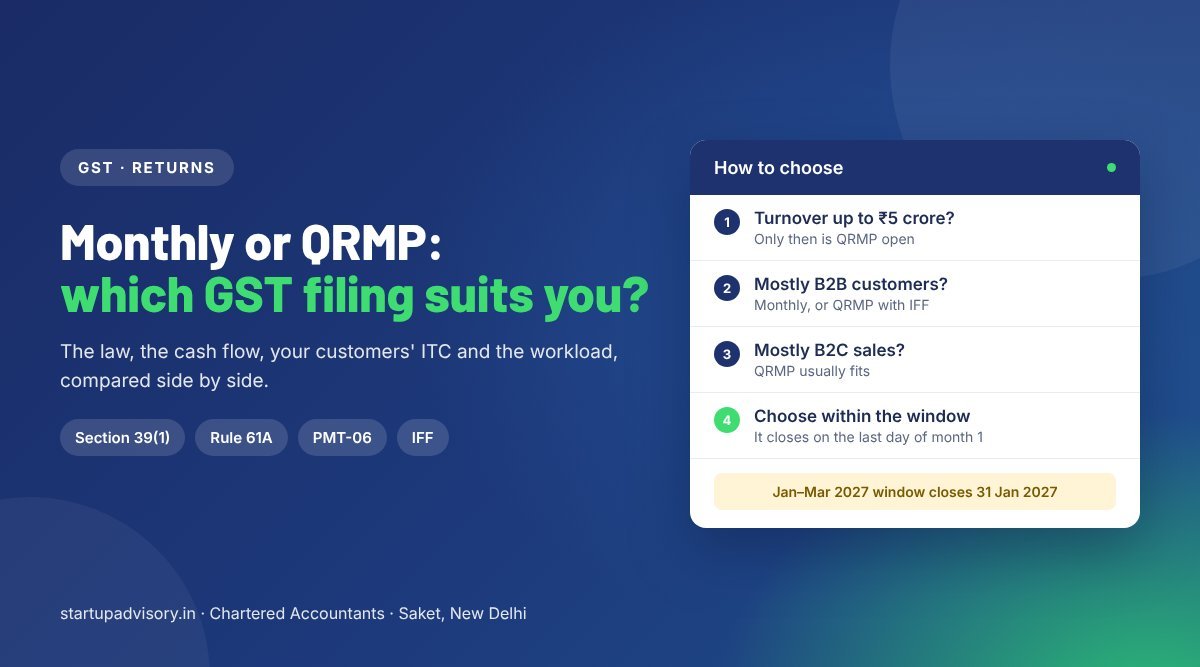
| 31 January 2027 | Last day to opt in to or out of QRMP for January to March 2027 |
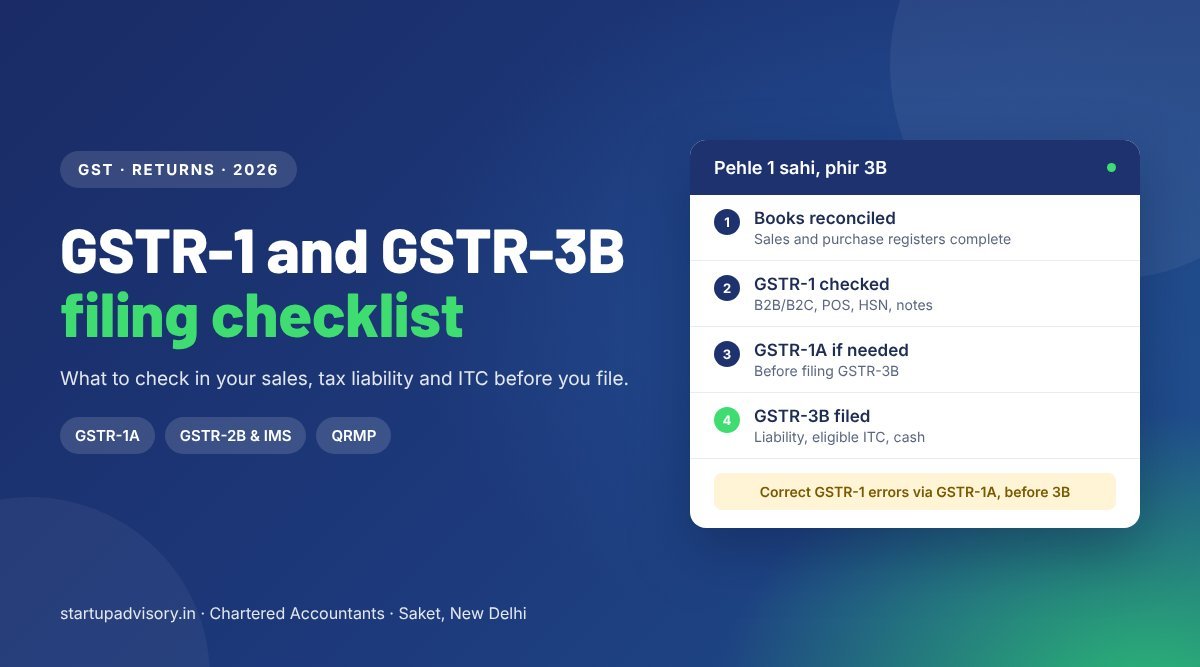
For the full monthly sequence, see our GSTR-1 and GSTR-3B filing checklist. Extensions are announced on the GST portal, so check it before each due date.
10. Recommended or scheduled, but not from 1 January
Several items in circulation are not January 2027 changes. Some are notified for other dates. Others are still only recommendations and need a notification, a rule or an amendment to the Act before they apply.
| Item | Where it stands (25 Nov 2026) |
|---|---|
| Registration and ITC changes, including rule 19(3) and rule 44 | Notified in 05/2026-Central Tax, effective 1 December 2026 |
| Rule 21A (suspension), new rule after rule 23, rule 86A (blocking of credit) and parts of rule 89 (refunds), including capital goods credit in refunds | Notified in 05/2026-Central Tax, effective 1 April 2027 |
| Optional annual return with quarterly payment (ARQP) for B2C-only taxpayers up to ₹5 crore | Concept note approved in principle by the 57th Council (item 17). No notification, rule or form |
| Late fee waiver for returns under Section 39(1) filed by the end of the due month, for turnover up to ₹5 crore | Proposed by the 57th Council (item 15). Not notified |
| New mechanism to amend liability and ITC in returns | Council says it may start “from the return of April, 2027” (item 5.2). Not notified |
| ₹10,000 minimum for show cause notices, lower general penalty under Section 125, changes to arrest and prosecution | Recommended (items 7 and 11). These need amendments to the CGST Act. Not in force |
11. December 2026 readiness checklist
- Check your e-invoicing status. Confirm whether your aggregate turnover crossed ₹5 crore in any year from 2017-18, and whether you fall in an exempt class.
- Pull a list of reverse charge purchases from unregistered suppliers and of every foreign vendor. These are your RCMDOM and RCMIMP documents.
- Ask your ERP, GSP or ASP for INV-01 schema 1.2 support and a sandbox test before 15 December.
- Give one person the job of raising each self-invoice and reporting it to the IRP, so a foreign invoice sitting in an inbox doesn’t miss the deadline.
- Do a live run between 15 and 31 December with a few genuine documents dated 15 December or later.
- Update e-way bill systems for 14-digit and 11-digit numbers, including printed formats and transporter apps.
- GST TDS deductors: capture invoice number, date and value for every deduction, ready for the new GSTR-7A table.
- Keep the 26 October 2026 Gazette notifications and the GSTN advisories on file with your January working papers.
- Gazette of India, Extraordinary, Part II, Section 3, Sub-section (i), No. 846, 26 October 2026 (CG-DL-E-27102026-277451): Notification No. 04/2026-Central Tax (G.S.R. 918(E)), F. No. CBIC-20001/1/2026-GST, amending Notification No. 13/2020-Central Tax dated 21 March 2020 (G.S.R. 196(E)); and Notification No. 05/2026-Central Tax (G.S.R. 919(E)), the Central Goods and Services Tax (Amendment) Rules, 2026, paras 55 (FORM GSTR-7A) and 67 (FORM GST INV-01)
- GSTN, Introduction of e-Invoicing Facility for Recipient Generated Self Invoices under RCM (RCMDOM and RCMIMP), 16 October 2026
- GSTN, Advisory on Implementation of e-Invoicing for RCMDOM and RCMIMP with effect from 1st January 2027, 17 November 2026
- GSTN, Revision in E-Way Bill and Consolidated E-Way Bill Numbering Formats w.e.f. 1 January 2027, 4 November 2026
- GSTN, Introduction of Metro Rail as an Additional Mode of Transport in the E-Way Bill System, 20 November 2026
- GST Council, press release on the recommendations of the 57th meeting, 8 October 2026 (items 5, 7, 11, 15, 17 and 18)
- Rule 48, CGST Rules, 2017 (CBIC); Sections 9, 31(3)(f), 51 and 68, CGST Act, 2017; Section 5(3), IGST Act, 2017
This article is general information, not tax advice. It reflects the Gazette text and GSTN advisories listed above as of 25 November 2026. Check your State’s SGST notification and any later CBIC or GSTN update before acting, and confirm your own position with a qualified professional.
How Startup Advisory Can Help
Startup Advisory is a CA-led firm in Saket, New Delhi. We handle GST compliance for businesses across Delhi NCR, including:
- A review of your purchase ledger to find every RCMDOM and RCMIMP document before 1 January.
- A self-invoice and IRN process for Tally, Zoho Books or your ERP, tested in December.
- Monthly GSTR-1 and GSTR-3B, with reverse charge liability and credit reconciled to the IRNs.
- GST TDS registration, GSTR-7 filing and the new-format GSTR-7A certificates.
- An e-way bill review for consignors and transporters moving to 14-digit numbers.
Call 9311972982 or book a free consultation.