
GST / Registration
GST Cancellation Auto-Approval from 1 December 2026: What Notification 08/2026-CT Changes
Reviewed by CA Neeraj Rohilla, FCA — Chartered Accountant, Startup Advisory, Saket, New Delhi.
- The notification at a glance
- How cancellation worked until now
- Old Rule 20(5)-(6) vs new
- The four conditions for auto-approval
- If you miss a condition: the officer route
- GSTR-10 is still due
- Worked examples
- What can still happen after cancellation
- Open points and the portal
- Step-by-step: cancelling from 1 December
1. The notification at a glance
We read the notification in the Gazette of India itself. Here are the key facts:
| Notification | No. 08/2026-Central Tax, G.S.R. 1006(E) |
|---|---|
| Name | Central Goods and Services Tax (Second Amendment) Rules, 2026 |
| Date | 25 November 2026 (Gazette of India, Extraordinary, Part II, Section 3(i), No. 899) |
| Power used | Section 164 of the CGST Act, 2017, on the recommendations of the GST Council |
| In force from | 1 December 2026 |
| What it changes | Substitutes sub-rules (5) and (6) of Rule 20 of the CGST Rules, 2017 (cancellation on the taxpayer’s own application). Nothing else. |
| Previous amendment | Notification No. 05/2026-Central Tax, 26 October 2026 (G.S.R. 919(E)), which rewrote Rule 20 from 1 November 2026 |
It is a short, one-paragraph amendment, but it finishes a reform that started in October. The 57th GST Council recommended that cancellation become system-based in phases. Phase one took effect on 1 November 2026 with conditions. This notification takes away those conditions. States issue matching SGST notifications, so check your State’s too.
2. How cancellation worked until now
Before 1 November 2026, every REG-16 application went to the jurisdictional officer. The officer had to examine it and pass a cancellation order. Queries and long delays were common, and a business that had already closed could stay registered for weeks, with returns still falling due.
From 1 November 2026, Notification No. 05/2026-Central Tax substituted the whole of Rule 20. Applications moved to electronic approval, but only where:
- all returns were filed and all dues paid, and
- either (a) the output tax liability on supplies to registered persons, declared in GSTR-1, GSTR-1A or IFF, did not exceed ₹2,50,000 in any month from the date of registration to the date of application, or (b) the taxpayer filed the final return in GSTR-10 within three days of the due date of the last returns.
GSTN’s advisory of 1 November 2026 explained how the portal ran this: a “Pending for Returns Filing” stage, then a check of output tax for each tax period. Anyone above ₹2.5 lakh in any period went to a “Pending for Final Return” stage and had three days to file GSTR-10. Miss it, and the application went to the officer. Composition taxpayers, non-resident taxable persons, OIDAR suppliers and input service distributors were approved electronically once their returns were in.
3. Old Rule 20(5)-(6) vs new
| 1 to 30 November 2026 (05/2026-CT) | From 1 December 2026 (08/2026-CT) | |
|---|---|---|
| Returns under Rule 20(2) and 20(3) | Filed within the time allowed | Filed within the time allowed (no change) |
| Tax, interest, fee, penalty, other dues | Paid | Paid (no change) |
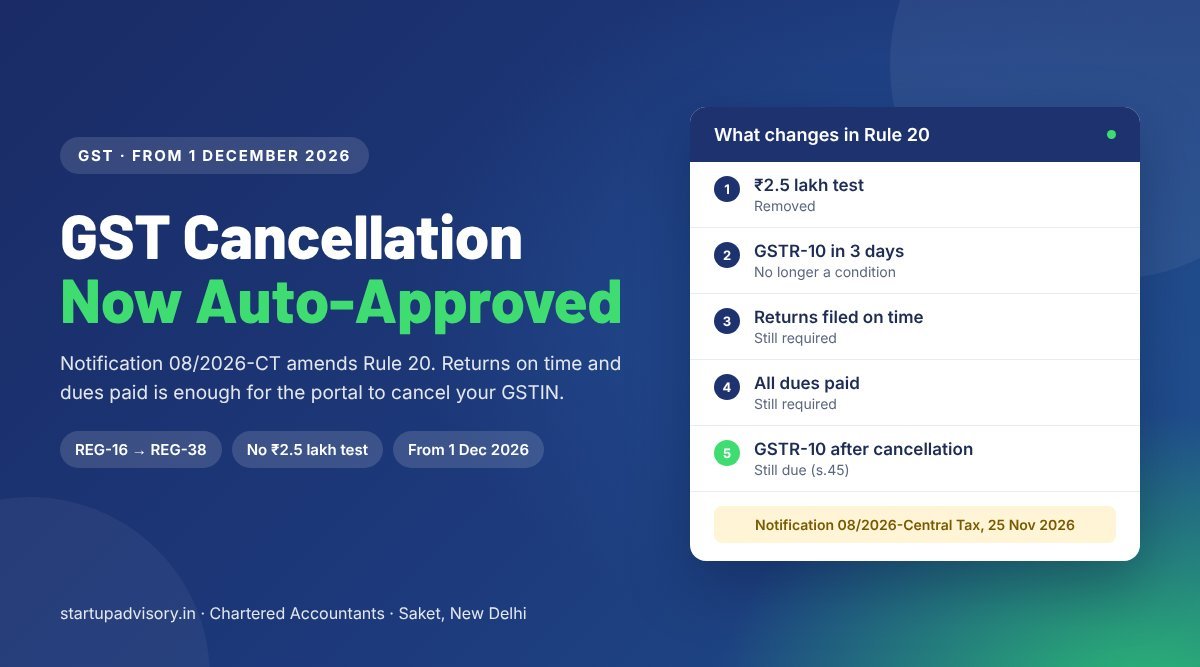
| ₹2.5 lakh monthly output tax test on B2B supplies | Required, unless GSTR-10 filed in 3 days | Removed |
| GSTR-10 within 3 days as an alternative | Required if the ₹2.5 lakh test failed | Removed |
| Result if conditions met | Portal cancels from the date sought; order in REG-38 | Portal cancels from the date sought; order in REG-38 |
| Sent to officer under Rule 20(6) when | Returns (or CMP-08) under 20(3) or GSTR-10 under 20(5)(b) not filed, or dues unpaid | Returns (or CMP-08) under 20(3) not filed, or dues unpaid |
In the words of the new Rule 20(5), where the returns under sub-rules (2) and (3) have been furnished in time and the amounts due have been paid, “the registration shall be cancelled electronically by the common portal” from the date from which cancellation is sought. It uses “shall”, so there is no officer discretion at this stage.
4. The four conditions for auto-approval
Rule 20(5) refers back to the rest of Rule 20, which did not change. Put together, these are the conditions from 1 December 2026:
- A REG-16 application under Rule 20(1). Apply within 30 days of the event that justifies cancellation (closure, transfer, change in constitution, turnover below the threshold and so on). Give the stock of inputs, semi-finished and finished goods and capital goods on the day before the application or the cancellation date, the tax liability on it, and any payment made. The 30-day limit does not apply where a sole proprietor has died; legal heirs can apply under Rule 20(13).
- All past returns filed before you apply (Rule 20(2)). Every return, including CMP-08 for composition taxpayers, due on or before the application date for any period up to the cancellation date. If you have filed GSTR-1 or IFF for a tax period, the GSTR-3B for that period must also be filed, even if it is not yet due. The portal blocks the application until this is done.
- The remaining returns filed by their due dates (Rule 20(3)). Returns for the period up to the application date or the cancellation date, whichever applies, must be filed no later than their due date. Late filing here is what most often sends a case to the officer.
- Every amount payable has been paid. Tax, interest, late fee, penalty “or any other amount which is liable to be paid”. That includes the Section 29(5) reversal on closing stock and capital goods, and confirmed demands still outstanding.
Meet all four and the portal cancels the registration from the date you asked for, sending the order in FORM GST REG-38. Rule 20(4) suspends your registration from the day you apply until the proceedings end, so you cannot issue tax invoices during that time.
5. If you miss a condition: the officer route
Under the new Rule 20(6), if the returns or CMP-08 under Rule 20(3) have not been filed, or any amount payable is unpaid, the application is forwarded to the proper officer. Sub-rules (7) to (12), unchanged since 1 November, then set tight timelines:
| Step | Time limit | Form |
|---|---|---|
| Officer cancels the registration if the application is in order | 15 days from receipt | REG-19 |
| Officer points out deficiencies | 15 days from receipt | REG-03 |
| You reply with clarifications or documents | 15 days from the notice | REG-04 |
| Officer approves (REG-19) or rejects (REG-05) | 15 days from your reply | REG-19 / REG-05 |
| No reply from you | After the 15 days | Deemed rejected |
| No action by the officer within either 15-day window | After the 15 days | Deemed approved (REG-19) |
So even the officer route now has a deemed-approval backstop. The quickest fix, though, is to stay out of it: file the last returns on time and clear the dues.
6. GSTR-10 is still due
Some headlines say GSTR-10 has been “removed”. It hasn’t. The notification removes GSTR-10 only as a condition for automatic approval. Section 45 of the CGST Act is unchanged. A registered person whose registration is cancelled must file the final return in FORM GSTR-10 within three months of the date of cancellation or the date of the cancellation order, whichever is later. Composition taxpayers, input service distributors, non-resident taxable persons and TDS/TCS registrants are outside Section 45.
GSTR-10 shows the closing stock and the tax payable on it. Missing it attracts late fee and can lead to a notice and a best-judgment assessment. Our tip: prepare the GSTR-10 figures when you file REG-16, because you need the same stock numbers for both.
7. Worked examples
- A Delhi trader closing on 31 December 2026. Monthly filer, registered since 2019, output tax on B2B sales of ₹3.4 lakh in March 2023. Under the November rule that one month failed the ₹2.5 lakh test, so he would have had to file GSTR-10 within three days. From 1 December he files REG-16 in January with cancellation sought from 31 December, files the December GSTR-1 and GSTR-3B by their due dates, pays the stock reversal, and the portal cancels the registration from 31 December in REG-38. GSTR-10 is then due within three months.
- A consultant who moved abroad. All returns filed, but a ₹1,500 late fee on an old GSTR-3B is unpaid. The portal cannot approve this application automatically and forwards it to the officer under Rule 20(6). Paying the fee before applying would have kept it automatic.
- A composition dealer converting to a company. She files CMP-08 for the last quarter on time and pays the dues. Cancellation is automatic, as it was in November. Section 45 does not apply to composition taxpayers, so she doesn’t file GSTR-10, but she still files the annual return in GSTR-4 under the composition rules.
8. What can still happen after cancellation
Automatic cancellation is not the end of scrutiny. Rule 20(14) to (18), unchanged, let the officer issue a show cause notice in REG-34 if there is reason to believe the effective date should be an earlier date under Section 29(3). You reply in REG-35 within 30 days. The officer either drops the case (REG-36) or changes the date (REG-37) within 30 days of the reply, and can also change it if you don’t reply.
An earlier date matters because credit availed and tax collected after that date can be questioned. Section 29(3) also keeps you liable for any tax and dues for periods before cancellation. Keep your books, invoices and return working papers for the full retention period.
9. Open points and the portal
- No GSTN advisory yet. When we checked on 27 November 2026, the latest GSTN item on cancellation was still the 1 November advisory, which describes the ₹2.5 lakh check. Expect an update for 1 December. Until the portal changes, the November stages may still show.
- Applications pending on 1 December. The notification has no transitional clause. A pending application should be tested against the new Rule 20(5) when the portal processes it after 1 December, but that is not yet confirmed. If you are in the “Pending for Final Return” stage now, filing GSTR-10 within the three days is the safe course.
- Department-initiated cancellation is separate. This change is only about cancellation on your application under Rule 20. Cancellation by the officer for non-filing or other grounds (Rule 21 and Rule 22) and revocation are not covered.
- SGST notifications. Each State notifies a matching SGST amendment. These usually follow quickly, but check your State’s notification.
10. Step-by-step: cancelling from 1 December
- Fix the cancellation date. Pick the date from which you want the registration cancelled, normally the day the business closed or was transferred. Apply within 30 days of that event.
- Work out the stock reversal. List inputs, semi-finished and finished goods and capital goods held on the day before the cancellation date and compute the Section 29(5) amount.
- File every pending return. File all GSTR-1, GSTR-3B (or CMP-08) returns due up to the date of application, including GSTR-3B for any period whose GSTR-1 or IFF is already filed.
- Pay all dues. Clear tax, interest, late fees, penalties and any demand that is payable, including the stock reversal amount.
- File FORM GST REG-16. Apply on the GST portal with the stock details and the liability, signed with DSC or EVC.
- File the remaining returns on time. File the returns for the period up to the cancellation date or application date by their due dates.
- Watch for REG-38 and file GSTR-10. Once the portal cancels the registration in REG-38, file the final return in GSTR-10 within three months, where Section 45 applies.
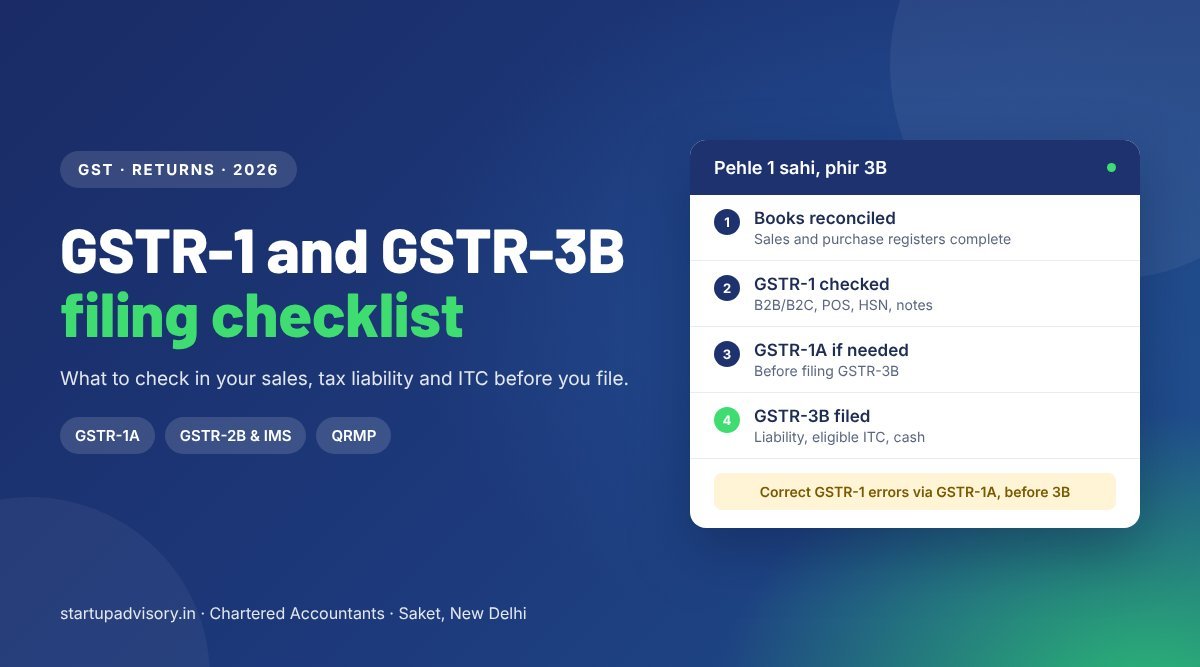
Before you file REG-16, also check for pending ITC issues, open e-way bills and any IMS actions for the last tax period. Our GSTR-1 and GSTR-3B filing checklist covers the last returns.
- Gazette of India, Extraordinary, Part II, Section 3, Sub-section (i), No. 899, 25 November 2026 (CG-DL-E-25112026-278173): Notification No. 08/2026-Central Tax, G.S.R. 1006(E), Central Goods and Services Tax (Second Amendment) Rules, 2026
- Gazette of India, Extraordinary, No. 846, 26 October 2026: Notification No. 05/2026-Central Tax, G.S.R. 919(E), substituting Rule 20 from 1 November 2026
- GSTN, Advisory on the Revised Process for Approval of Registration Cancellation application under Form GST REG-16, 1 November 2026
- Sections 29 and 45, CGST Act, 2017; Rule 20 and Rule 81, CGST Rules, 2017 (CBIC tax information portal)
This article is general information, not tax advice. It reflects the Gazette text and the GSTN advisory listed above as of 27 November 2026. Check your State’s SGST notification and any later CBIC or GSTN update before you act.
How Startup Advisory Can Help
Startup Advisory is a CA-led firm in Saket, New Delhi. We close GST registrations cleanly for businesses across Delhi NCR:
- A pre-cancellation check of pending returns, late fees, demands and IMS actions, so your application qualifies for auto-approval.
- The Section 29(5) stock and capital goods reversal, worked out and paid.
- REG-16 filing with the right cancellation date, and the last GSTR-1, GSTR-3B or CMP-08 on time.
- GSTR-10 final return, and replies to REG-03 or REG-34 notices if they come.
Call 9311972982 or book a free consultation.